
By Martha Bellisle
The Associated Press
SEATTLE — Voters in Washington state will decide the fate of an initiative that seeks to curb gun violence by toughening background checks for people buying semi-automatic rifles, increasing the age limit to 21 for buyers of those guns and requiring safe storage of all firearms.
Last year, Carla Tolle lost her 13-year-old grandson when his friend picked up his grandfather’s unsecured 12-gauge shotgun and fired 400 pellets into the boy’s chest, killing him instantly, she said. If a safe-storage law had been in effect, her grandson would still be alive, she said.
“Our goal is to make our schools and communities safer with a common-sense measure that puts safeguards in place to make sure that guns don’t get into the hands of people intent on doing harm,” said Kristen Ellingboe, spokeswoman for the Yes On 1639 campaign.
Opponents say Initiative 1639 strips the constitutional rights of 18- to 20-year-olds and criminalizes self-defense. Forcing gun owners to lock away their firearms could put them in danger, said Alan Gottlieb, founder of the Bellevue-based Second Amendment Foundation.
“You may not be able to get to them if you need them for self-defense,” he said. “When seconds count, your life could be in jeopardy.”
Opponents sued to get the initiative off the ballot, arguing there were flaws in the signature-gathering process. A Thurston County judge agreed, but the Washington Supreme Court overturned that ruling.
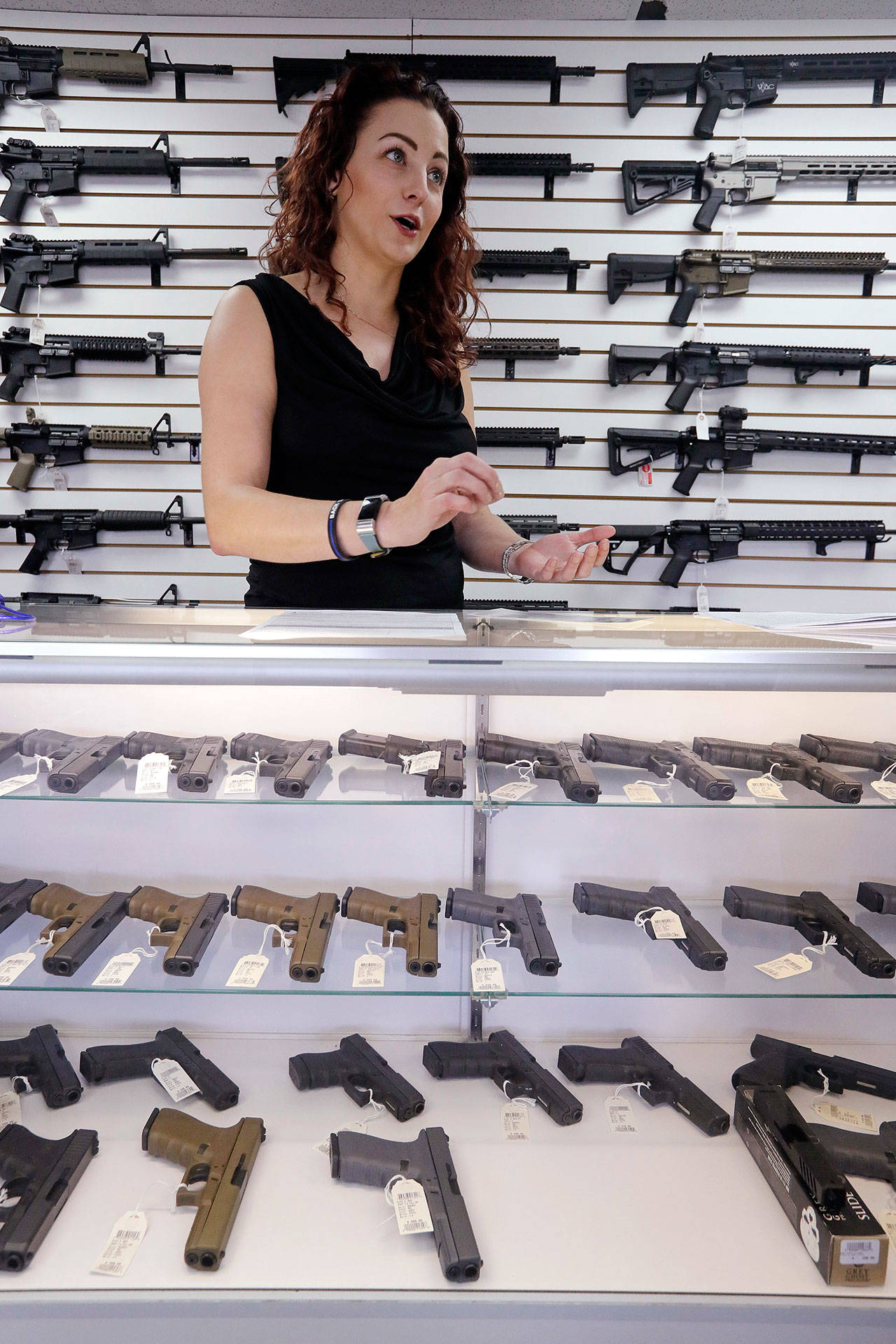
“The gun community is just afraid that it’s not going to stop,” Tiffany Teasdale, owner of Lynnwood Gun shop, said of the push for new gun-control measures. “You give an inch, they take a mile.”
North Olympic Peninsula gun shop owners either declined to comment or were not available.
The measure focuses on three main topics — safe gun storage, tougher background checks for people buying certain types of rifles, and upping the age to buy those rifles. But there’s opposition to some of the measure’s wording before even delving into its details.
In order to specify which rifles require the enhanced background checks, the initiative had to define those guns. The definition calls them “semi-automatic assault rifles,” which immediately sparked angry responses from gun-rights supporters.
Gottlieb said an “assault rifle” is a fully automatic firearm used by the military — it will continually fire rounds as long as your finger is compressing the trigger, or until the magazine is empty. In contrast, he said, semi-automatic rifles fire one round each time you pull the trigger. The problem, Gottlieb said, is that “the initiative defines virtually any semi-auto rifle as an ‘assault’ rifle.”
It slaps a military label on a semi-automatic rifle, which are about 90 percent of the rifles sold, he said.
Ellingboe, with Yes On 1639, said they used the term “semi-automatic assault rifle” in the definition “based on their function, not their appearance or any kind of nostalgia anyone might have about certain guns.”
“Semi-automatic assault rifles are specifically designed to kill quickly and efficiently and have been used in some of the country’s deadliest mass shootings,” the initiative states. Making the background check for these guns as thorough as the one used for buying a pistol “will help ensure that we keep these weapons out of dangerous hands.”
People buying long-guns in Washington state are run through the FBI’s National Instant Criminal Background Check System, or NICS. Background checks for pistol sales are done by local law enforcement agencies that can access more detailed records that might expose mental health issues or harder-to-find criminal records. The initiative requires these enhanced background checks when someone buys a semi-automatic rifle. Exempt from the change would be antique firearms or any rifle “that is manually operated with a bold, pump, lever or slide action.”
Nineteen-year-old Nikolas Cruz legally purchased the semi-automatic rifle authorities say he used to kill 17 people at Marjory Stoneman Douglas High School in Parkland, Fla., in February. He had passed a less-thorough instant background check system.
The measure says a person buying a semi-automatic assault rifle must have taken a firearm safety class within the last five years. I-1639 also increases the age for purchasing these rifles to 21. Gottlieb said that would take away their right to self-defense.
“So, if I’m a 20-year-old veteran, I can’t protect myself, my wife and young child?” he said.
Eighteen-year-olds can drive, smoke, vote and join the military, Teasdale said. But a 20-year-old woman who’s being stalked can’t get a semi-automatic rifle to defend herself? Teasdale asked.
You must be 21 to buy a pistol under federal and state law, according to the initiative. “This makes sense, as studies show that 18 to 20 year olds commit a disproportionate number of firearm homicides in the United States and research indicates that the brain does not fully mature until a later age,” the measure says.
The initiative also seeks to keep firearms out of the hands of children by requiring owners to lock them up.
Washington lawmakers have repeatedly failed to pass a bill requiring the safe storage of guns. Several Washington cities, including Seattle, have passed ordinances that impose civil fines for failing to secure firearms. Initiative 1639 goes further by making a person criminally liable if their gun isn’t secured with a trigger lock or kept in a gun safe and it’s used to cause injury or death.
On October 14, 2017, Tolle’s 13-year-old grandson spent the night at his friend’s house, which is on the same property as the boy’s grandparents.
The boys went over to the grandparent’s house and were horsing around when the boy went into his grandfather’s bedroom and grabbed an unsecured, loaded 12-gauge shotgun.
“He picked it up, racked it and pointed it at my grandson, about 30 feet away,” Tolle said. “It hit my grandson from his upper chest to his lower face.”
The boy was found guilty in juvenile court of manslaughter and sentenced to five months in a juvenile facility, she said. But the grandfather faced no charges for failing to secure his weapons, she said.
The initiative would also create a new crime of “community endangerment.” It would be a felony if a gun isn’t safely stored and a prohibited person, such as a felon or child, uses it to injure or kill someone. It would be a misdemeanor if the gun isn’t secured and a prohibited person causes it to discharge, carries it in a public place to intimidate others or uses it to commit a crime.
The gun owner wouldn’t be liable if their firearm is stolen out of the safe, as long as they report the theft within five days.
Ellingboe, with the Yes On 1639, said being on vacation and missing the five-day deadline would be a valid defense if a person’s firearm is stolen from a secure location.
“It’s more about getting people to take reasonable and responsible measures to secure their guns,” she said.