
IT WAS GOOD to see the Navy back in town to celebrate the Fourth of July in Port Angeles. More than 1,000 people lined up at the dock to take a tour of the USS Momsen, a U.S. Navy destroyer.
To celebrate the Fourth, the Momsen’s crew joined the festivities — which included a hot dog eating contest, a baseball game and a parade. The U.S. Navy has a long history of partying in Port Angeles.
Beginning in 1895, the U. S. Navy Pacific Squadron, as the Fleet was known back then, spent nearly 40 summers on maneuvers in Port Angeles harbor.
The yearly arrival of the Navy to Port Angeles heralded the start of the biggest party in Washington state.
The battleships fired their big guns into the unpopulated hinterland. Some of the shells did not go off. For years, there was a sign way up in the woods that read, “Danger! Unexploded Artillery Shells,” which acted like a magnet for us kids for decades afterwards.
The Navy launched torpedoes, conducted night attacks and mock landings.
The visiting 10,000 sailors doubled the population of Port Angeles.
The first Clallam County Fair was held in honor of The Pacific Squadron’s Admiral Lester A. Beardslee. The admiral spent so much time fishing at Lake Crescent, catching 350 trout in one day, that they named a species of trout after him.
The Naval Elks Lodge was built in 1913, with 10 Navy officers as charter members. There were parades, concerts, ship tours, baseball games, picnics and more.
The local moonshiners had to work overtime. An old timer told me the local girls would wear “wool socks in the spring, silk stockings in the fall.”
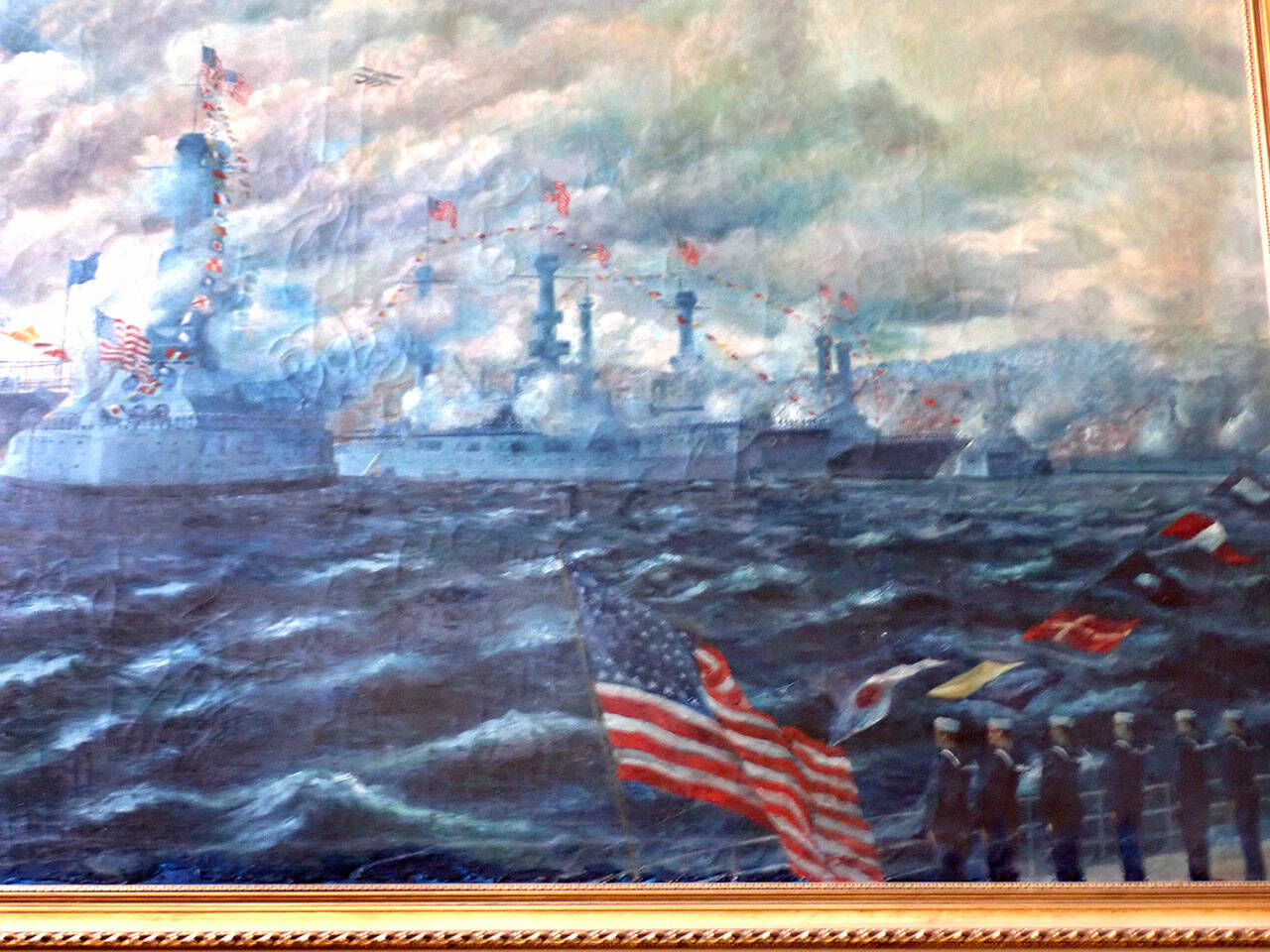
In May 1908, part of President Theodore Roosevelt’s Great White Fleet anchored in Port Angeles.
The fleet had been sent on a world cruise looking for what the president called, “a feast, a frolic or a fight.” It was part of Roosevelt’s “Talk softly, carry a big stick” policy.
The Kaiser noticed this maneuver left our Atlantic seaboard undefended. He offered Roosevelt the use of the German Navy, in case we had a problem with Britain while our Navy was on the other side of the globe. The Germans called Roosevelt’s “big stick” a “palm twig.”
The New York Times revealed some of the “armor” on the older Battleships was made of wood and canvas.
The Great White Fleet was met at every port with lavish entertainments and specially inflated prices. The GWF was supposed to open the doors of trade with China. We imagined 400 million starving Chinese peasants would buy American agricultural and industrial production.
Britain had used two Opium Wars to open trade doors with China. We hoped to wean the Chinese off British opium with American tobacco.
It was all part of what Rudyard Kipling called, “The White Man’s Burden.”
President Theodore Roosevelt said it was, “bad poetry but great, good sense.”
The British called it “philanthropy plus 5 percent.” Imperialism with a moral purpose, to Christianize.
In 1900, Mark Twain called it “bedraggled, besmirched and dishonored.”
The GWF visited Japan after a reluctant invitation. No wonder. The Japanese had their trade door forced open in 1853, when Commodore Matthew C. Perry fired a 13-gun salute in Tokyo Bay.
The Japanese learned the strategic importance of a modern navy. The British helped them build one.
The Japanese form of Imperialism, the so-called “Co-Prosperity Sphere,” started a war in the Pacific that consumed millions of human lives.
While the recent U.S. Navy visit to Port Angeles was more subdued than the past, we hope it ushers in a more peaceful future.
_________
Pat Neal is a Hoh River fishing and rafting guide and “wilderness gossip columnist” whose column appears here every Wednesday.
He can be reached at 360-683-9867 or by email via patnealproductions@gmail.com.
