
EDITOR’S NOTE: This report has been corrected to reflect that the amount of sediment deposited at the river mouth was measured in cubic meters. The source for that information has also been corrected.
PORT ANGELES — No one, not even among those studying the ecology of the Elwha River mouth, expected the degree of change seen there after the dams came down, according to a woman who has researched it for years.
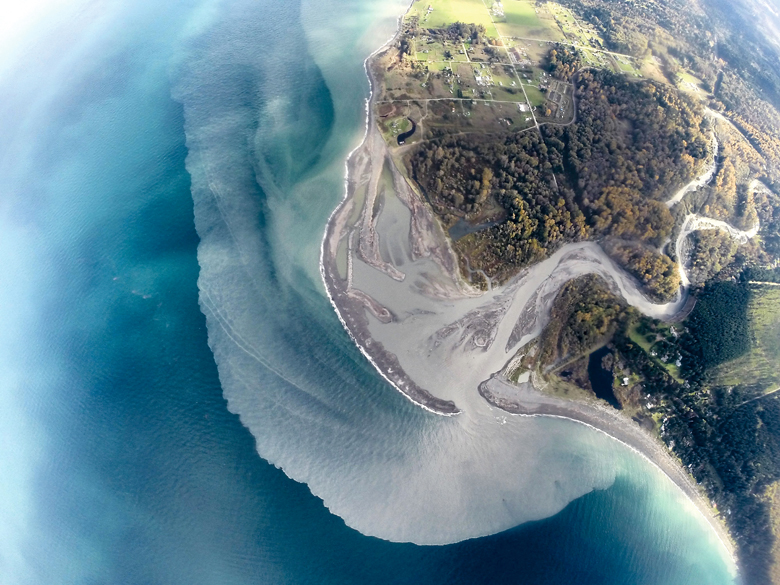
An area that once was little more than large cobbles is now a vast tract of quiet, sandy beach speckled with hundreds of seabirds and brushed by ocean waves. It contains pools constantly dimpled by the jumping of fish.
Sometimes, looking at the acres of new beach — and the new life it now supports — she nearly cries, said Anne Shaffer, a marine biologist and the executive director of the Coastal Watershed Institute of Port Angeles.
The institute studies the nearshore effects of the dam removal on the ecology of the watershed, including the estuary and the Strait of Juan de Fuca waters just offshore.
A community resource
“No matter who owns it, this is a community resource,” Shaffer said as she led a tour of the beaches late last month for Peninsula Daily News Publisher Terry Ward, his family and news staffers.
“It’s such a treasure,” Shaffer said, “just a gift.”
Elwha Dam, once located 5 miles south of the river mouth, was built in 1912. In 1927, Glines Canyon Dam was added 13 miles south of the river mouth.
The electricity gleaned from the dams was a major force in the development of the North Olympic Peninsula, but since the dams were built without fish ladders, they halted the annual migration of what once were legendary salmon runs on the Elwha River.
Destruction of both dams — the Elwha in 2012 and Glines Canyon in 2014 — and replanting of the bare banks in a $325 million restoration effort that was the largest in the nation released the river back to its wild state.
The reappearance of salmon high above the former dam sites has been well-documented.
But the changes in the river’s mouth have surpassed expectations.
Once the dams were removed, much of the sediment trapped behind them in Lake Mills and Lake Aldwell was carried downstream by the river to form some 80 to 100 acres of beach and push the estuary farther into the Strait.
Wind, predominantly from the west, and wave action have spread the sandy largesse to build a long, sandy beach at the eastern edge of Freshwater Bay.
So far, about 60 percent of an estimated 34 million cubic yards of sediment has been washed out of the former lakebeds, and 3 million cubic meters have been deposited at the river mouth, according to a handout from Shaffer.
“It’s a dynamic element, and it moves around,” said Dave Parks, senior resource scientist and hydrogeologist with the state Department of Natural Resources.
A single storm can dramatically revise the size and shape of the beach and the location of the river mouth, he said.
Fish return
The beaches and pools are attracting species of birds and fish that have been rare or absent from the river’s estuary for decades.
Among the fish that have appeared in the Elwha’s brand-new estuary are eulachon, long-fin smelt and red-sided shiners, Shaffer said.
Topping out at about 7 inches as mature adults, the fish are forage for salmon, seals and waterbirds.
A fourth new fish, American shad, which are native to the Atlantic Ocean but which have spread through the northern Pacific after they were introduced into the San Francisco Bay area in the 1800s, have also been spotted in the estuary, Shaffer said.
In a recent survey of fish in the estuary, researchers found juvenile steelhead, coho and chinook in abundance and, for the first time in over a decade of sampling, caught a number of large, powerful adult chum, Shaffer said.
Food for birds
The small fish are food for salmon, and that draws eagles, she said as she pointed to a bald eagle perched above the water.
The fish also feed the many waterbirds that have moved into the estuary to use it as a hunting ground and as a stopover during migration.
The changes seen at the river’s mouth, Shaffer said, are a discovery of what happens when nature is set free.
“All we had to do was get out of the way,” she said.
________
Reporter Arwyn Rice can be reached at 360-452-2345, ext. 5070, or at arwyn.rice@peninsuladailynews.com.
Executive Editor Leah Leach can be reached at 360-417-3530 or at lleach@peninsuladailynews.com.
