
By Matthew Brown
and Camille Fassett
The Associated Press
SANTA CRUZ, Calif. — Wildfires churning out dense plumes of smoke as they scorch huge swaths of the U.S. West Coast have exposed millions of people to hazardous pollution levels, causing emergency room visits to spike and potentially thousands of deaths among the elderly and infirm, according to an Associated Press analysis of pollution data and interviews with physicians, health authorities and researchers.
Smoke at concentrations that topped the government’s charts for health risks and lasted at least a day enshrouded counties inhabited by more than 8 million people across five states in recent weeks, AP’s analysis shows.
Major cities in Oregon, which has been especially hard hit, last month suffered the highest pollution levels they’ve ever recorded when powerful winds supercharged fires that had been burning in remote areas and sent them hurtling to the edge of densely populated Portland.
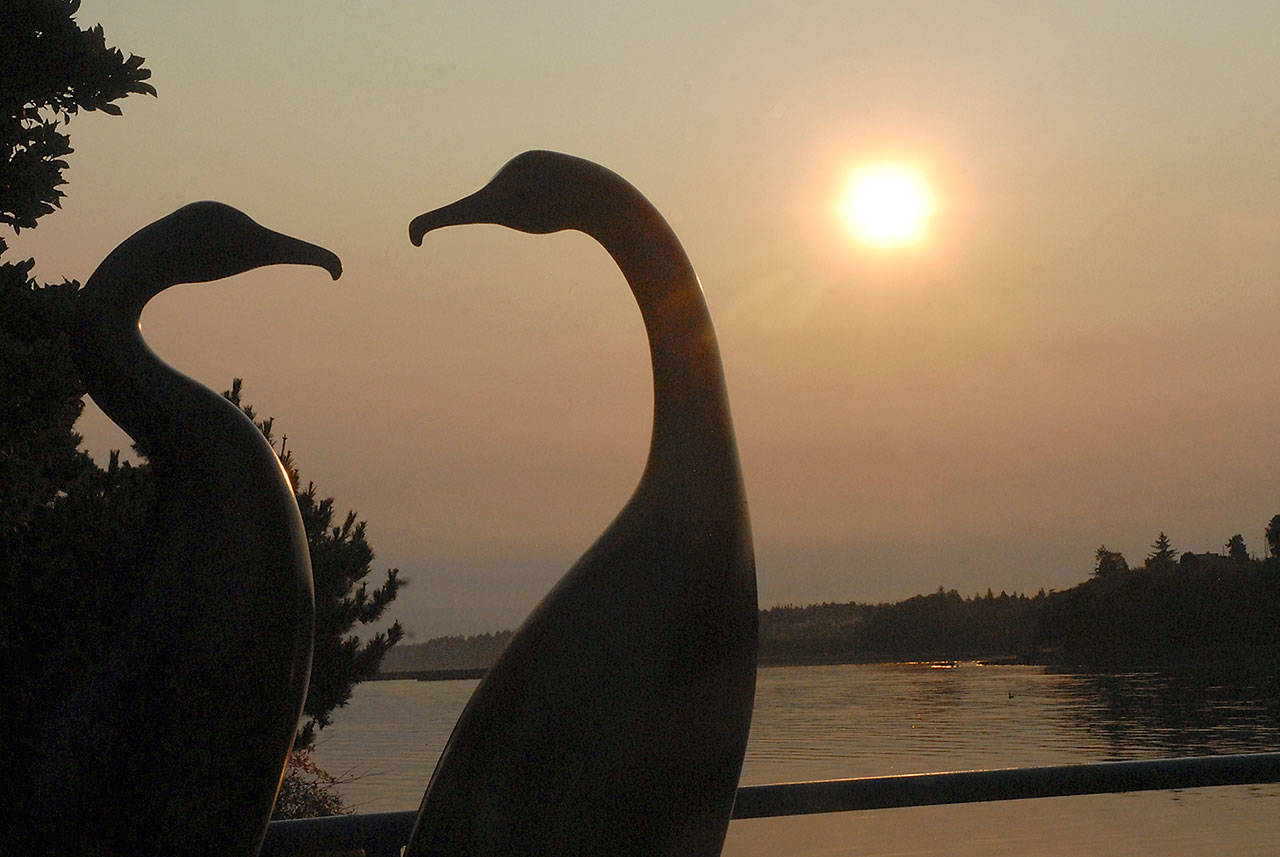
The North Olympic Peninsula was shrouded in smoke at hazardous levels for about a week in September because of fires in California and Oregon.
Medical complications began arising while communities were still enveloped in smoke.
“It’s been brutal for me,” said Barb Trout, a 64-year-old retiree living south of Portland in the Willamette Valley.
She was twice taken to the emergency room by ambulance following severe asthmatic reactions, something that had never happened to her before.
Trout had sheltered inside as soon as smoke rolled into the valley just after Labor Day but within days had an asthma attack that left her gasping for air and landed her in the ER.
Two weeks later, when smoke from fires in California drifted into the valley, she had an even more violent reaction that Trout described as a near-death experience.
“It hit me quick and hard —— more so than the first one. I wasn’t hardly even breathing,” she recalled.
After getting stabilized with drugs, Trout was sent home but the specter of a third attack now haunts her. She and her husband installed an alarm system so she can press a panic button when in distress to call for help.
“It’s put a whole new level on my life,” she said. “I’m trying not to live in fear, but I’ve got to be really really cautious.”
In nearby Salem — which experienced eight days of pollution at hazardous levels during a short period, some of the worst conditions seen the West over the past two decades, according to AP’s analysis — Trout’s pulmonologist Martin Johnson said people with existing respiratory issues started showing up at his hospital or calling his office almost immediately after the smoke arrived, many struggling to breathe.
Some could have permanent loss of lung function, he said. Then there are the “hidden” victims who Johnson suspects died from heart attacks or other problems triggered by the poor air quality but whose cause of death will be chalked up to something else.
Based on prior studies of pollution-related deaths and the number of people exposed to recent fires, researchers at Stanford University estimated that as many as 3,000 people over 65 in California alone died prematurely after being exposed to smoke during a six-week period beginning Aug. 1.
Hundreds more deaths could have occurred in Washington over several weeks of poor air caused by the fires, according to University of Washington researchers.
Wildfires are a regular occurrence in Western states but they’ve grown more intense and dangerous as a changing climate dries out forests thick with trees and underbrush from decades of fire suppression.
What makes the smoke from these fires dangerous are particles too small for the naked eye to see that can be breathed in and cause respiratory problems.
On any given day, western fires can produce 10 times more particles than are produced by all other pollution sources including vehicle emissions and industrial facilities, said Shawn Urbanski, a U.S. Forest Service smoke scientist.
Fires across the West emitted more than a million tons of the particles in 2012, 2015 and 2017, and almost as much in 2018 — the year a blaze in Paradise, Calif., killed 85 people and burned 14,000 houses, generating a thick plume that blanketed portions of Northern California for weeks. Figures for 2017 and 2018 are preliminary.
AP’s analysis of smoke exposure was based on U.S. Environmental Protection Agency data compiled from hundreds of air quality monitoring stations. Census data was used to determine the numbers of people living in affected areas of Oregon, Washington, California, Idaho and Montana.
At least 38 million people live in counties subjected to pollution considered unhealthy for the general population for five days, according to AP’s analysis. That included more than 25 million people in California, 7.2 million in Washington, 3.5 million in Oregon, 1 million in Idaho and 299,000 people in Montana.
The state totals for the number of people exposed to unhealthy air on a given day were derived from counties where at least one monitoring site registered unhealthy air.
Scientists studying long-term health problems have found correlations between smoke exposure and decreased lung function, weakened immune systems and higher rates of flu. That includes studies from northwestern Montana communities blanketed with smoke for weeks in 2017.
“Particulate matter enters your lungs, it gets way down deep, it irrigates the lining and it possibly enters your bloodstream,” said University of Montana professor Erin Landguth. “We’re seeing the effects.”
The coronavirus raises a compounding set of worries: An emerging body of research connects increased air pollution with greater rates of infection and severity of symptoms, said Gabriela Goldfarb, manager of environmental health for the Oregon Health Authority.
Climate experts say residents of the West Coast and Northern Rockies should brace for more frequent major smoke events, as warming temperatures and drought fuel bigger, more intense fires.
“The bad years will increase. The smoke will increase,” said Jeffrey Pierce an atmospheric scientist at Colorado State University. “It’s not unreasonable that we could be getting a 2020-type year every other year.”
