
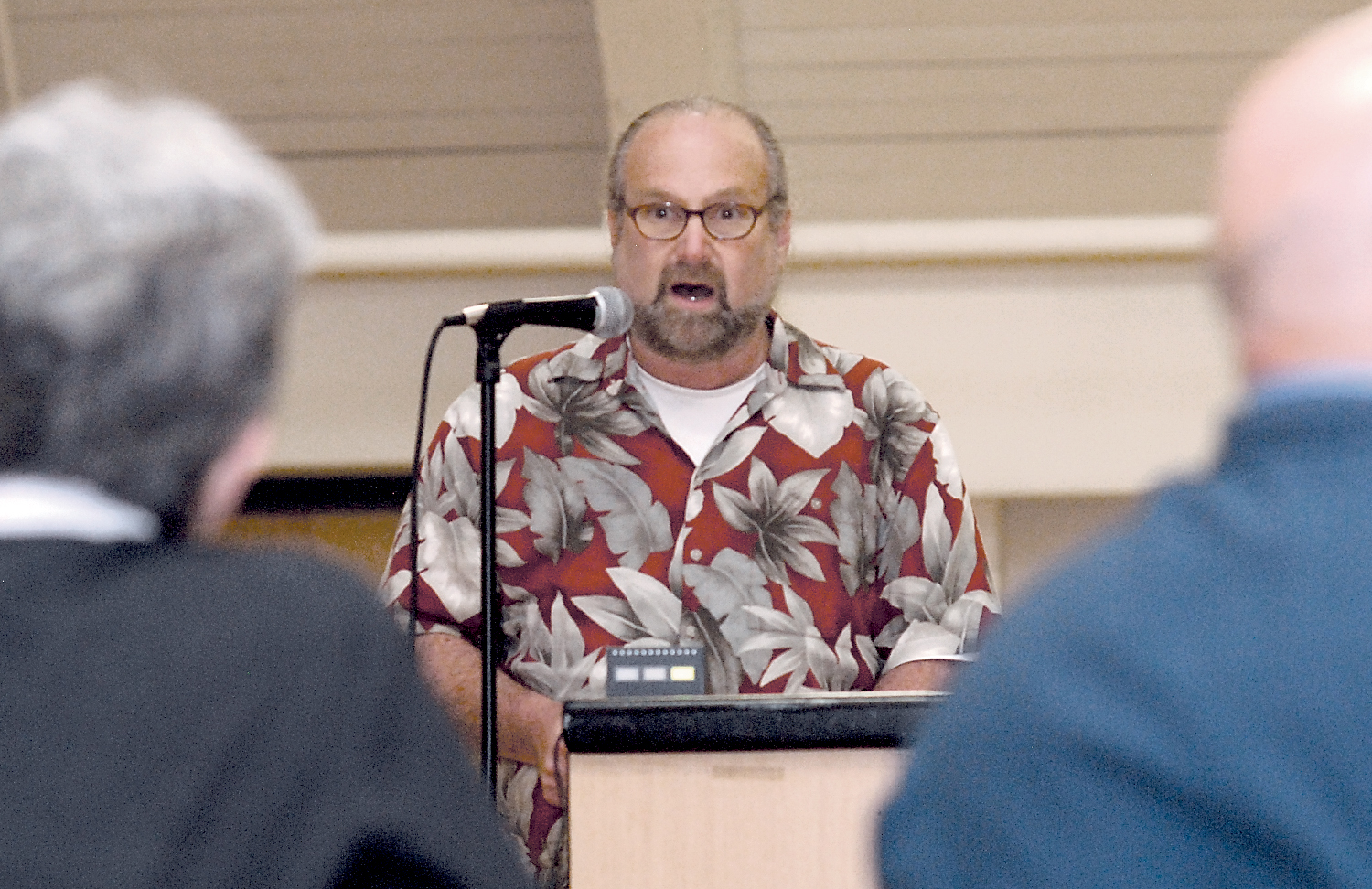
PORT ANGELES — At least one mind changed sides Wednesday at a public meeting on the Makah tribe’s request to resume whaling, turning upon a flow of tears shed by a man who said he’d swum with whales.
Gary Michael Lee of Salt Spring Island, B.C., led off the 19 people who testified at a NOAA National Marine Fisheries Service public hearing in the Vern Burton Community Center, 308 E. Fourth St.
He first urged NOAA Fisheries administrators to deny the Makah request for a waiver from the Marine Mammal Protection Act.
But after 18 others had spoken — 15 in favor of whaling — Lee returned to the lectern about an hour later and tearfully renounced his point of view.
“I’ve listened to all this testimony, and I’m moved,” he said. “These [whales] are valuable creatures, but a deal [the 1855 Treaty of Neah Bay] has been made.
“If they do it respectfully, if they do it honorably, I’m going to say, ‘Do what you’ve got to do. It breaks my heart, but do what you’re going to do.’”
His reversal stunned the people who’d remained at the hearing from an original audience of more than 100.
Donna Darm, director of NOAA Fisheries Protected Resources Division in Seattle, who chaired the hearing; NOAA Fisheries biologist Steve Stone; and public affairs officer Michael, both from Portland, Ore., said they’d never seen such a turnaround at a public meeting.
Darm said many people typically leave a hearing without listening to others, much less without changing their attitudes.
The remainder of the evening session was a low-key affair except for a performance by seven members of the Lower Elwha Klallam tribe who drummed and sang what they called “a help song” in Salish in support of the Makah during a recess in the hearing.
Lee’s initial statement invoked the Makah’s own totems of whales as he urged NOAA to continue the ban on whaling that has been in place since the tribe last legally hunted in 1999. Rogue hunters in 2007 killed a whale that sank in the Strait of Juan de Fuca.
“The Makah will never again be able to stand tall with the integrity and respect you’ve long and hard earned if you choose a path of short-sighted blunder,” said Lee, who later said he’d served aboard a whale-watching boat sailing out of Kauai, Hawaii, where he interacted with whales eye to eye.
“I’ve probably had more intimate interactions with cetaceans than the next million people combined,” he told the Peninsula Daily News after he finished testifying.
He changed his mind after hearing Makah tribal members say they’d been cheated of a right guaranteed in an 1855 treaty negotiated by Washington Territory Gov. Isaac Stevens and lost a foundation of their diet, religion and culture.
“I’m just ripped inside what my position is anymore,” Lee said.
Whaling opponents included D.J. Schubert of the Washington, D.C.-based Animal Welfare Institute.
“This opposition is not based on any disrespect to the Makah, their treaty rights or their culture,” he said.
He said the clause in the treaty that guarantees whaling rights “in common with all citizens of the United States” makes the tribe subject to the federal Marine Mammal Protection Act.
“It is critical for [NOAA Fisheries] to explain what that the ‘in common with’ language means,” Schubert said.
Schubert was followed by James Hudnall of the Society for Marine Mammalogy of Moss Landing, Calif., who called whaling “an ethical issue very similar to that relating to African elephants,”
Furthermore, he said, the threat to Pacific Coast Feeding Group whales, commonly known as resident whales, was insupportable.
“These are the whales that bring joy to summer visitors and money to the whale-watching industry,” Hudnall said.
Except for Izumi Stephens of Bainbridge Island, who said, “The whale has a life to live,” the rest of the hearing belonged to whaling advocates, most of whom identified themselves as members of the Makah tribe.
Chuck Tanner of the Seattle- and Kansas City-based Institute for Research and Education on Human Rights said the tribe had surrendered 300,000 acres of land in exchange for hunting, fishing, whaling and sealing rights.
“We first violated the treaty by destroying the Makah whaling by industrial whaling [that nearly extirpated gray whales by the 1920s],” he said.
“Some here would have us violate that treaty once more.”
Jason Roberts of the tribe wondered if resident whales were “too weak to make the journey north” and if killing them might improve their gene pool.
“The Lord tells us to be stewards of the earth,” said Craig Larsen of Chehalis, “not necessarily to treat other creatures just like people. . . . My gosh, we catch salmon by the millions, and nobody says a thing.”
Paul Hayte of the Makah tribe said one of his grandfathers hunted whales and another built canoes.
“We lived off those whales. We brought oil to Yakima. We brought meat to the [Pike Place] Market in Seattle,” he said.
Makah elder Dotti Chamberlin drew applause after she said, “Our tribe was filthy rich. . . . We owned the fourth corner of this nation,” which includes the marine traffic lanes for eastbound ships in the Strait of Juan de Fuca and the Olympic Coast Natural Marine Sanctuary off the Pacific Coast.
“The Makah Indian treaty is racist,” Chamberlin said. “Right from the beginning, they wanted to take our land. We had to give and give and give.
“Our culture is our treasure, and our families have remembered their history is our treasure. Think about the treaty and what we gave up to get that little reservation.”
She was followed by Ron Johnson of the tribe, who said the Makah weren’t worried about land when they signed the treaty.
“The Makah were worried about the ocean; that was their land. Seventy percent of us live off it today, what the Creator provided for us.”
Makah member Donna Scott said, “I don’t believe that outsiders who feed themselves through fast-food restaurants and grocery stores should have any say about our whaling rights.”
Sarah Krieger, a Makah from Joyce, asked, “Why should we Makah listen to a society that has nearly decimated the ocean with pollution and allowed certain species to overpopulate?”
Furthermore, she said, “the settlers have retained the 300,000 acres [the tribe ceded to the United Sates], and we are still waiting for the right to whale.
“The government should return our land. We’re asking for our rights back.”
NOAA Fisheries’ next step is to select its preferred choice of six alternatives (see accompanying report), then submit it to an administrative law judge.
Michael Milstein, public affairs officer for the agency, said Thursday it hoped to have the statement in the hands of an administrative law judge by the end of this year.
_______
Reporter James Casey can be reached at 360-452-2345, ext. 5074, or at jcasey@peninsuladailynews.com.
