
By Brian Melley
The Associated Press
LOS ANGELES — Anya Sellsted had scaled scary snow-covered passes and forded frightening rivers during her solo hike from Mexico to Canada when the hazards of California’s gargantuan winter finally caught up to her.
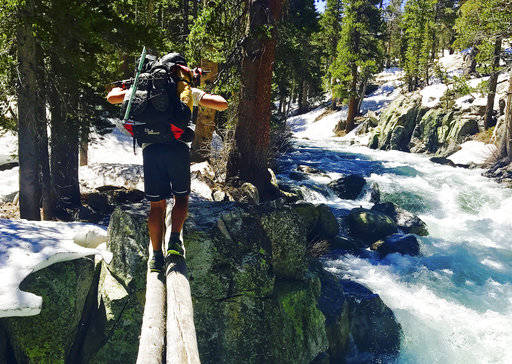
While crossing a partly submerged log in Yosemite National Park, Sellsted was sucked under the tree and down the rushing creek. She gasped for air as the weight of her 55-pound backpack pushed her under the frigid water.
No one was within miles as she was battered and scraped on rocks before grasping branches and saving herself.
“I couldn’t stop screaming and shaking and crying,” said Sellsted, who swigged whiskey to calm her nerves.
Sellsted is one of several hikers who reported harrowing incidents tackling the 2,650-mile Pacific Crest Trail across this year’s massive snowpack, which has fed swift streams and turned the dream trip of a lifetime into a near-death nightmare for some.
Hikers have survived an avalanche, falls on snow and close calls in raging rivers. Most have retreated to lower ground and detoured the hazardous Sierra Nevada — the highest, most rugged section of the scenic trail running the length of California and through Oregon and Washington.
Hiking the trail is an arduous endurance test, but not particularly perilous. It has become more popular each year and draws more than 3,000 hikers from around the world trying to cover the entire length within six months, though fewer than a quarter finished last year.
Given the length and likelihood of snow in the Sierra and Cascades, most hikers start in the Southern California desert in early spring with the hope that snow will melt by the time they reach alpine elevations.
With hundreds of so-called thru-hikers entering the high Sierra early in the season, their experiences can serve as cautionary tales for others planning summer wilderness escapes. More than a dozen people have drowned in Sierra rivers at lower elevations, including one in Yosemite and three in Sequoia National Park, and rangers are warning hikers to think twice about crossing swift water.
Marcus Mazzaferri, 25, of Seattle narrowly survived an ordeal after falling in a swollen Yosemite creek and abandoning his pack so he could get to shore before being swept over a waterfall. He lost all his gear and had to do jumping jacks and run in circles all night.
He got lost hiking for help the next day and was beginning to despair when he heard a beeping sound and discovered a snow-plowing crew, who took him to a ranger station.
“I remember the feeling of not being sure if I would survive or not,” Mazzaferri said.
Photos and videos on social media show whitewater churning beneath shaky log crossings and shirtless hikers wading chest-deep in still waters with packs over their heads. On cliff-hanging Forester Pass, the trail’s highest point at 13,200 feet, snow cover makes for precarious footing. Majestic landscapes display endless expanses of white framed by craggy black and gray peaks.
Jack Haskel of the Pacific Crest Trail Association urged hikers two weeks ago on Facebook to let more snow melt, saying he was worried someone would die.
“It’s not really ready for us yet,” he said. “Conditions are more like mountaineering than backpacking.”
Brien Bower, 25, an experienced mountaineer from Seattle, said there were two mindsets among hikers approaching the high Sierra: those who said everyone was going to die and those going for it.
Bower, who completed the trail two years ago, planned to turn around if he sensed danger.
He was climbing on skis near the top of 11,978-foot Glen Pass in Kings Canyon National Park in late May when he stopped to check the snow’s stability and triggered an avalanche. He hardly realized what happened before it carried him 400 feet — and off a 20-foot cliff — in about four seconds.
His hip was sore, but remarkably, he stayed atop the slide and wasn’t badly hurt. He left the mountains for a few days and returned farther north, where intimidating waters drove him from the trail again and he eventually quit after becoming sick.
“People are either continuing to get lucky or learning the skills on the job very fast,” he said.
Jake Gustafson, 21, a McDonald’s manager from Pennsylvania, was pressing with a friend despite “fear mongering” he read on social media.
The worst thing he encountered was sunburned nostrils from solar reflection off snow.
“We’re considered the daredevils,” said Gustafson, who sends a “Not dead yet” message by satellite to his mother each night.
“We like the sense of danger, I guess.”
Sellsted, 31, who works at a Seattle architecture firm, lost track of how many times she used her ice ax to arrest falls on steep and slick snow. She had gotten accustomed to chilly water crossings before she nearly drowned June 5 in Rancheria Creek.
After drying her gear, she carried on. But the next crossing was too spooky after her experience, so she hiked out and returned home.
“I made some mistakes thinking I could do this,” Sellsted said. “I got humbled pretty quickly.”
Still, she made it farther than most in the Sierra, covering nearly 1,000 miles in California.
She resumed her hike Monday in Oregon, expecting clear trails at lower elevations. But the trail was covered in snow, and she turned back.
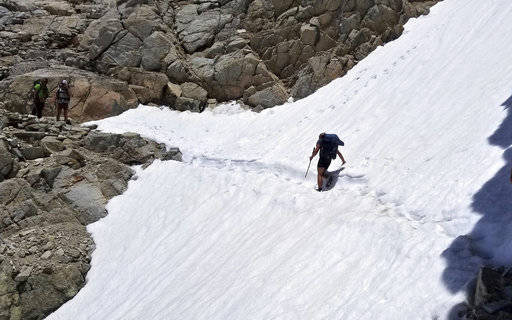
In this June 7 photo, Wesley Tils crosses a snowfield below Forester Pass in Sequoia National Park along the Pacific Crest Trail near Kings Canyon National Park, Calif. (Jake Gustafson via AP)
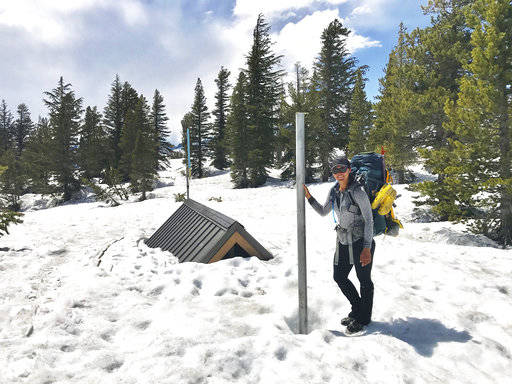
In this May 29 self-portrait photo taken with the help of a timer, Anya Sellsted stands in Mammoth Lakes, Calif. Sellsted had traversed the highest snow-covered passes and forded raging rivers during her hike from Mexico to Canada when she ran into trouble in the high Sierra Nevada mountains. (Anya Sellsted via AP)
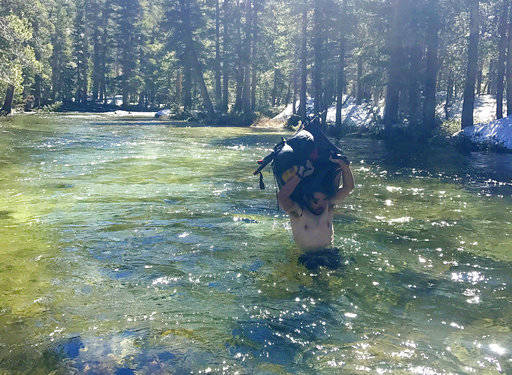
In this June 15 photo, Jake Gustafson crosses wading chest-deep in still waters with his backpack over his head at Evolution Creek along the Pacific Crest Trail near Kings Canyon National Park, Calif. (Wesley Tils via AP)
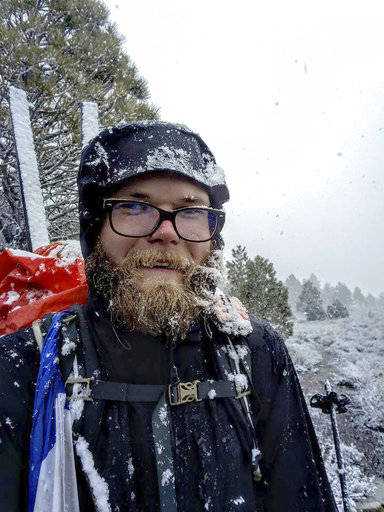
This May 15 selfie shows hiker Brien Bower in a snowstorm along the Pacific Crest Trail in California’s southern Sierra Nevada. Bower, who hiked the 2,600-mile trail in 2015, detoured from the trail this spring after being caught in an avalanche and encountering dangerous river crossings and ended his effort to complete the hike after getting sick. (Brien Bower via AP)
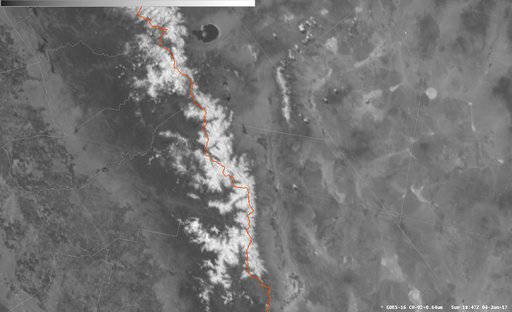
This June 4 satellite photo provided by the U.S. National Weather Service shows the Pacific Crest Trail in California’s high Sierra drawn in red surrounded by snowpack. The dream trip of a lifetime has turned to nightmares for some hikers as a massive snowpack in the Sierra Nevada covers the trail and turns rivers to torrents. (U.S. National Weather Service via AP)
