
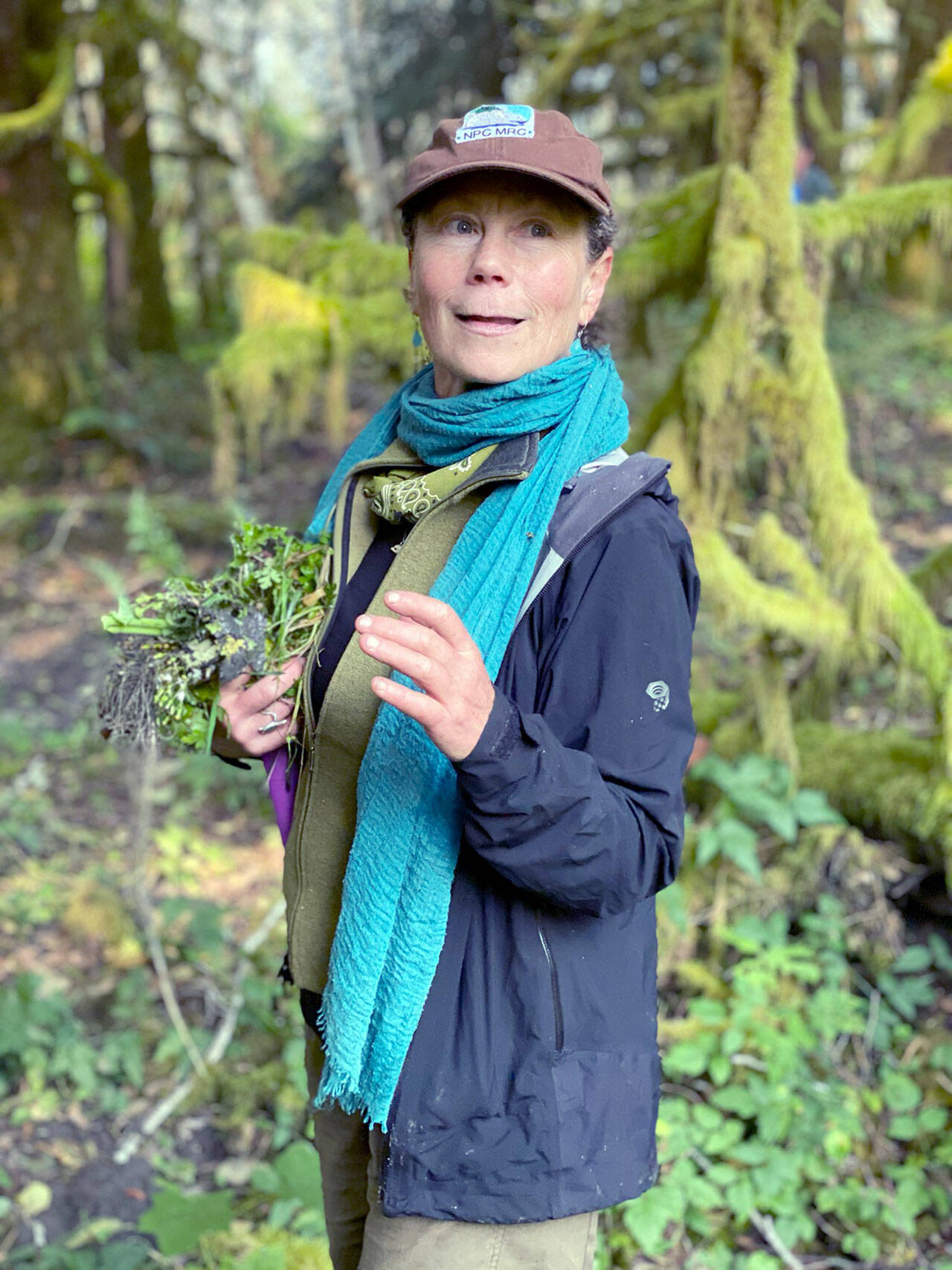
PORT TOWNSEND — Jill Silver was presented with the 2024 Eleanor Stopps Environmental Leadership award on Thursday as part of the Port Townsend Marine Science Center’s annual stewardship breakfast.
“Jill Silver is a shining example of who the Eleanor Stopps Environmental Leadership Award was designed for,” PTMSC Executive Director Diane Quinn said.
“Jill approaches conversation with a hands-on educational approach. She shares her knowledge of ecosystem health with local communities so that they may thrive through restoration efforts and be more resilient in the face of climate change.”
Silver is an ecologist and the founder and executive director of the 10,000 Year Institute, a conservation-focused 501(c)(3) which works on the West End.
The organization has 26 employees and does work for the national park, the national forest, state parks, the state Department of Natural Resources, the state Department of Transportation and others.
“It’s broad. We go from the ridgelines down to the valleys,” Silver said. “And we follow the rivers out into the marine environment.”
The organization works on a number of connected ecological features that influence and constitute watersheds, Silver said.
The work touches on forestry, fisheries, aquatic habitat restoration, wetland mapping and wetland species identification through environmental DNA sampling.
“I started out in the Hoh watershed, also working in the Sol Duc and other places in the ’90s, after graduating from Evergreen,” Silver said. “I ended up in the Hoh watershed for 11 years, working for the Hoh tribe. I learned to interpret the disturbance regimes, channel migration, erosion, trees falling into rivers, landslides, melting glaciers and the need to have resilient habitats that could be passively restored.”
An example of passive restoration would be growing trees that can fall into a river on a natural timeline, to create log jams, necessary for salmon habitat, she said.
“I ended up focusing on invasive plants, as a keystone operational area, in the Hoh watershed,” Silver said. “Nobody else was doing it, and nobody else was doing it well. I saw plants establishing that were limiting the native foundational vegetation communities and needing to be managed.”
While her work focuses broadly on protecting biodiversity, climate resilience and forestry resilience, she said those things depend on preventing non-native plants from taking hold. Non-native plants thrive on disturbance, she said.
“There is so much going on with climate change, with atmospheric river events, with heat domes, with melting glaciers putting lots of sediments into this migrating river,” Silver said. “Everyone comes out to look at the Hoh River and they see this amazing temperate rainforest ecosystem that looks healthy. As an ecologist, I can see all of the pain points, all of the places that if we walked away from treating invasive plants year-round, with local crews, persistently into the far future, the place would look like a lot of different river ststems in the Puget Sound, which are mostly non-native plants.”
Native plants bring essential functions to their ecosystems, she said. For example, they are homes to native insects. Silver said there are 500 species of native bees. Many of them only go to one native plant species to collect nectar or to pollinate.
“There’s a really complex ecosystem that comes apart without the native plants,” she said.
Silver said native plants will not persist for much longer if people don’t raise billions of dollars to implement management strategies.
“It has to be done regionally and continuously, and we need a lot of money,” Silver said. “We need these conservation teams that are place based, local, know where they live and work, and can go back to the same places over and over. That’s what makes me valuable. I’ve been working in the same place for 32 years now, and I grew up there for 32 years before that.”
Silver grew up and resides in the Mora area near Forks.
Scotch broom is one of the 26 species that the 10,000 Year Institute focuses on.
Scotch broom thrives in gravel, Silver explained. Gravel in mines and quarries retains seed banks from the invasive plant, and when gravel is transported for road work or culvert work, the seed often is transported with it.
Silver estimated there are more than 30,000 acres of Scotch broom on the Olympic Peninsula.
“No legislators are putting money into Scotch broom management,” Silver said. “No agencies have the money that they need to develop the crews they need. Then there’s the housing piece. There’s no housing in many places for crews to be working on it. It’s a conundrum. What’s gonna change it is wildfire. Scotch broom is extremely flammable.”
The 10,000 Years Institute has a student using Geographic Information System (GIS) technology to track reported wildfire events, looking at satellite imagery to see if the sites had Scotch broom in them.
Silver said she thinks real dangers presented by the presence of the plants may be what motivates systematic efforts eventually.
“I don’t want to work on invasive plants,” Silver said. “This is not what floats my boat, but I’m doing it because it’s necessary to protect biodiversity and climate resilience.”
________
Reporter Elijah Sussman can be reached by email at elijah.sussman@sequimgazette.com.
