
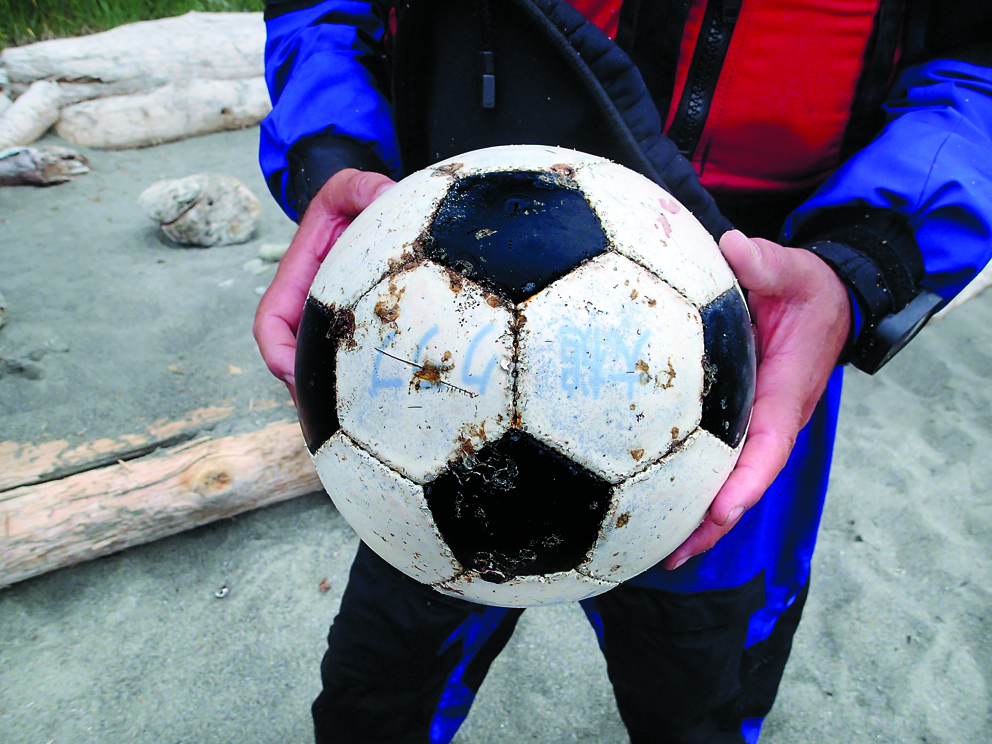
LAPUSH — A continuing survey of the coastline along western Clallam and Jefferson counties by three kayakers has revealed piles of debris on beaches, including a soccer ball with a Japanese soccer club’s name written in permanent marker.
The second leg of the Ikkatsu Project ended in LaPush last week.
Project members paddling the remote coastline to determine how much debris from the 2011 Japanese tsunami has arrived discovered that while some beaches have almost no debris, others are piled high.
One small pocket beach on the leg from Hobuck Beach to LaPush — a small beach with no name within Olympic National Park — was piled so high with debris that the team couldn’t see the beach and rocks underneath, said Ken Campbell, one of the expedition’s three members, on Thursday.
“This is going to be an Exxon Valdez-type incident in terms of money spent to clean it up,” Campbell said, referring to one of the largest oil spills in U.S. history.
In 1989, the tanker grounded and spilled more than 11 million gallons of crude oil in a remote location in Prince William Sound in Alaska.
Campbell reported that few items could be definitely identified as coming from Japan, but the sheer number of items, such as fishing floats, that were washed away from Japanese ports by the thousands, indicates that much of the mess is tsunami debris.
“One or two fishing floats could be from fishing boats,” he said.
“When you find 20 identical floats on one beach, it is likely from the tsunami.”
One of the few items that could be identified definitively as debris from the tsunami was a soccer ball from a club in Otsuchi, Iwate prefecture — one of the hardest-hit areas in the 2011 Tohoku tsunami.
The town of 16,000 lost more than 10 percent of its population as a result of the quake and the tsunami that followed.
On the ball was written the soccer club’s name in permanent marker, which was translated by a Japanese news service.
Sports balls have become one of the more common items associated with the tsunami that have been found on beaches from Alaska to Oregon, along with fleets of fishing floats and buoys, and piles of Styrofoam.
Those items float easily and have a high amount of surface to be blown ahead of the main debris field, which has been predicted to arrive in October by Seattle oceanographer Curtis Ebbesmeyer, an expert in wind-driven ocean debris.
Another item found during the expedition that almost certainly came from the tsunami was a residential herbicide applicator with Japanese labeling, Campbell said.
During the first leg of the Ikkatsu Project, the kayakers found what appeared to be the remains of a Japanese house at Cape B Beach, an isolated beach just south of Cape Flattery near Neah Bay.
The Ikkatsu expedition’s third and final leg of the trip, from LaPush to Ruby Beach, will be in August.
Most of the area covered by the expedition has no road access to beaches, where trash must be removed by hikers, by kayak or by helicopter, Campbell said.
Campbell is an author specializing in the Pacific Northwest outdoors.
Jason Goldstein is the team’s cartographer and GIS specialist. Steve Weileman is a documentary filmmaker and photographer.
The Washington chapters of the Surfrider Foundation are contributing financial support for expedition operating expenses.
Ikkatsu is affiliated with Global Adventure Guides, Olympic Coast National Marine Sanctuary, Coastal Watershed Institute, The Last Wilderness, 5 Gyres and Essex Explorations.
Dozens of items from the tsunami have landed on the Washington coast, including a 20-foot boat that washed ashore June 15 near Ilwaco.
Gov. Chris Gregoire has released $500,000 from her emergency fund to the state’s Military Department Emergency Management Division, which is coordinating the state’s response to the debris.
The state Department of Ecology is asking people to phone 855-922-6278 if they find debris on beaches that they think may be hazardous or contain oil.
If an item could be identified by an owner in Japan, finders can email a photo to the National Oceanic and Atmospheric Administration at disasterdebris@noaa.gov.
The federal response number is 800-424-8802.
Reporter Arwyn Rice can be reached at 360-452-2345, ext. 5070, or at arwyn.rice@peninsuladailynews.com.
