
By Leah Leach
Peninsula Daily News and The Associated Press
Some say it’s a success story in the making while others call it a capitulation to timber interests.
The U.S. Fish and Wildlife Service announced last week it has dropped consideration of giving the West Coast fisher — a small, weasel-like mammal predator whose population had nearly disappeared across the West Coast for decades — federal protections under the Endangered Species Act.
Reintroduction of fishers in Olympic National Park, Oregon and California is one factor that led to the species being removed from consideration as an endangered or threatened species, according to the park’s wildlife chief, biologist Patti Happe.
“All the conservation work paid off,” Happe said. “Proactive conservation pays off.
“We knew the species was in trouble and we acted to improve its conservation status before it got listed and this contributed to keeping it off the list.”
The Center for Biological Diversity, based in Tucson, Ariz., took the announcement as a blow.
The Center, which has urged federal protection for fishers since 1994, criticized the federal agency, saying it succumbed to “pressure from the timber industry,” and said it might challenge Thursday’s decision in court.
“The politically driven reversal of proposed protection for the fisher is the latest example of the Fish and Wildlife Service kowtowing to the wishes of industry,” Tanya Sanerib, an attorney for the group, said in a statement.
Fishers, once native to the Olympic Peninsula, were wiped out by overhunting for their pelts, and had disappeared from Washington state in the mid-1900s.
Small populations — estimated to be from a couple hundred to a few thousands — remain in southern Oregon and Northern California.
The dark brown forest-dwellers were first reintroduced into Washington state in Olympic National Park in 2008-10.
Since the original 90 fishers from British Columbia were released into the park, the fishers seem to have thrived, with sightings from Neah Bay to south of Port Townsend, Happe said.
For awhile, researchers kept up with the animals through radio collars, but those have fallen off or their batteries have died.
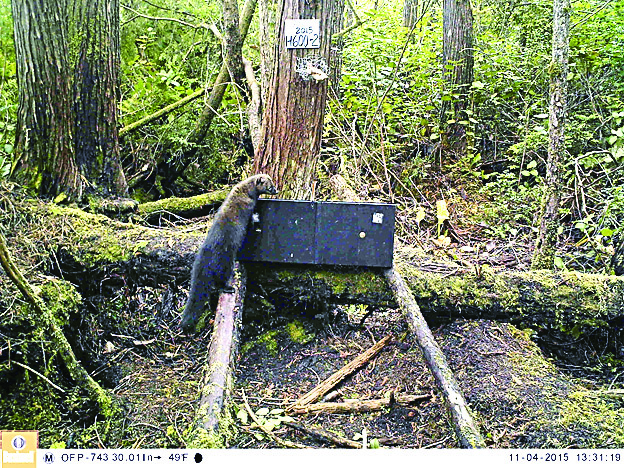
Instead, park biologists have set up DNA traps — baited enclosures that snag fur from the fishers when they go inside them, while strategically-placed cameras snap their photographs.
DNA collected from the hair snares is compared to samples taken from the original “founding” fishers.
“Biologists now are able to build family trees,” said Barb Maynes, park spokeswoman.
The study tells biologists if the fisher habitat is increasing and allows them to see if the population is establishing itself, Happe said.
Both appear to be happening.
Among those that have been tracked are two grand-daughters of founders, Happe said.
Fishers can live up to 10 years in the wild, Happe said.
“We found one that is nine years old,” she said.
“That’s another good sign that this is good habitat for them.”
Fishers eat small mammals such as snowshoe hair, mice and squirrels. In the Olympics, they’ve also come to hunt mountain beaver, a small rodent that is not a true beaver, Happe said.
The Olympic National Park reintroduction was part of a fisher recovery plan that the state Department of Fish and Wildlife released in 2006.
The plan included interventions in the Olympics, the Cascades and the Selkirk Mountains in the eastern part of the state.
Last fall, the first of 80 fishers were released into the south Cascades, where fishers had not been seen for 70 years.
Releases also have been done in Oregon and California, Happe said.
“There’s all this stuff in the works to improve [the situation for] the fishers,” Happe said.
“The population is not going down. It’s going up.
“We’ve improved it and kept it off the [federal] list.”
The state Fish and Wildlife Commission listed fishers as an endangered species in 1998, while the U.S. Fish and Wildlife Service designated the species as a candidate for federal listing under the Endangered Species Act in 2004.
In October 2014, because of new concerns over logging practices and illegal pesticide use by marijuana growers, the federal agency had intensified its consideration, but since has determined those threats weren’t as significant as previously thought.
Instead, the agency said it will continue reintroducing the fisher throughout the coast.
“We arrived at our decision following a comprehensive evaluation of the science and after a thorough review of public input,” Ren Lohoefener, director of the agency’s Pacific Southwest Region, said in a statement.
“The best available science shows current threats are not causing significant declines to the West Coast populations of fisher and that listing is not necessary at this time to guarantee survival.”
A different population of the same animal, however, still is being considered for federal protections in the Northern Rockies.
“We’ll know it’s really successful in a couple of years if we find more fisher habitat,” Happe said.
“The fact that we are finding more and more younger fishers is encouraging.
“People are finding them in their back yards,” she said, adding that one was sighted at the mouth of the Dungeness River.
“There are more fishers out there than we are finding in our study.”
She wants to receive reports of sightings, and photographs if people have them. They can be sent to her at patti_happe@nps.gov.
________
Executive Editor Leah Leach can be reached at 360-417-3530 or at lleach@peninsuladailynews.com.
