
NORDLAND — Septic waste is the leading cause of stream pollution by Escherichia coli, or E. coli, in the northern part of the Quimper Peninsula, and the worst area is Irondale Beach County Park, according to a two-year survey.
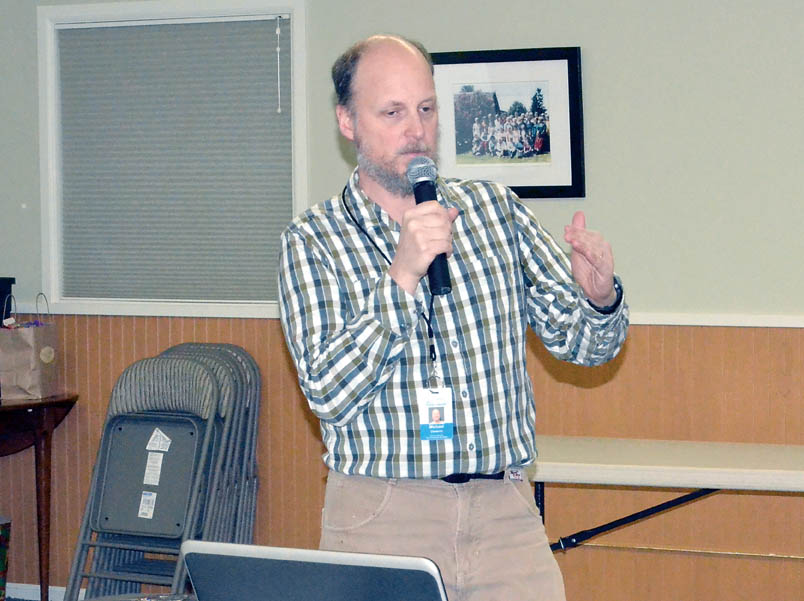
Nevertheless, the study found that much of the area’s water is of high quality, Michael Dawson, lead environmental health specialist for the Jefferson County Water Quality Program, told about 20 people at the Nordland Garden Club last Thursday evening.
Dawson will speak again about the study from 5:30 p.m. to 6:30 p.m. Wednesday at the Jefferson County Public Health office, 615 Sheridan St., Port Townsend.
The test area included Cape George, Port Townsend, Port Hadlock, Marrowstone Island and Oak Bay, with samples taken along 40 miles of shoreline and tested for E. coli bacteria.
E. coli lives in the lower intestines of people and animals and is commonly found in feces.
The survey included 489 septic sites with 72 percent showing no problem at all and the remainder easily addressed, something he said that property owners were willing and eager to do.
“Most of the people contacted were quick to fix the system,” he said.
The study, which was primarily funded by the state Department of Ecology, included sampling Port Townsend stormwater, and comparing the water quality of Marrowstone Island and Indian Island.
The worst pollution was found at Irondale Beach County Park, where Irondale Creek continues to show dangerous E. coli levels and is closed to shellfish harvesting.
Dawson said that the cause of the Irondale Creek pollution is undetermined, but that septic waste is the leading cause of stream pollution in the survey area, well ahead of pet waste, wildlife and livestock, which is uncommon.
Five other beach areas — North Beach, Oak Bay County Park, Indian Island County Park, Mystery Bay and Fort Flagler — showed high levels of E. coli bacteria during some readings but fell to an acceptable level at other times.
E. coli, a naturally occurring bacteria, isn’t always toxic. A safe level is estimated as below 100 parts per 100 milliliters.
Most of Port Townsend has sewer service, although the town contains about 220 septic systems “that we know of,” Dawson said.
Dawson said that he’d like to expand the survey area but that depends on funding availability.
Homeowners with septic systems should pay special attention to their care and maintenance, he said.
Dawson suggested eight tips for a long septic life:
■ Spread laundry activity throughout the week.
■ Fix leaky faucets and running toilets.
■ Avoid liquid fabric softener.
■ Dispose of pet waste in the garbage.
■ Do not use additives.
■ Do not flush chemicals, medications or toxic material.
■ Don’t drive or park on the drain field or transport lines.
■ Landscape the drain field and mound with shallow-rooted plants.
Questions about septic maintenance can be directed to the Jefferson County Public Health Department, 360-385-9444.
For more information, go to www.jeffersoncountypublichealth.org or call Dawson, 360-385-9444.
________
Jefferson County Editor Charlie Bermant can be reached at 360-385-2335 or cbermant@peninsuladailynews.com.
