
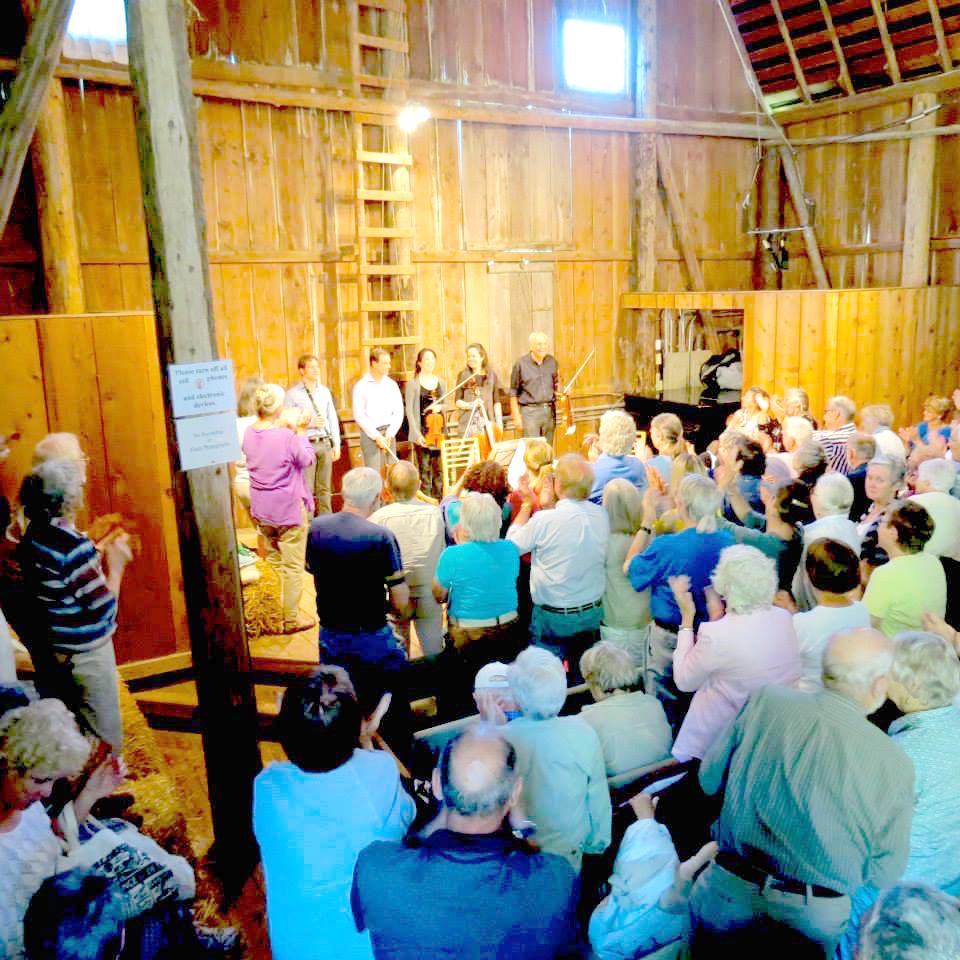
PORT TOWNSEND — After three decades based in a historic Quilcene barn, the Olympic Music Festival will move to Fort Worden State Park for its 33rd season next summer.
Founder Alan Iglitzin in October told the festival’s board of directors he planned to retire as executive director and revert the festival grounds he owns — an iconic barn with hay bale seating for concerts — into private property.
That led to a new partnership with Centrum, a nonprofit organization based at Fort Worden that organizes art festivals, workshops and performances year-round.
Next summer’s festival performances will be held inside the Joseph F. Wheeler Theater at 25 Eisenhower Way.
They will begin at 2 p.m. on Saturdays and Sundays from Aug. 13 through Sept. 11.
“I know all of us in the OMF community will miss the concerts in the barn in Quilcene,” said Julio Elizalde, a renowned pianist and the festival’s artistic director.
“However, the board of directors voted unanimously [in November] to continue presenting world-class performances in honor of our supportive audiences on the Olympic Peninsula, and I am confident that this new partnership will usher in a rich new era for this great organization.”
This partnership “is a natural fit for us, and we look forward to a richly diverse and artistically ambitious year of extraordinary music-making on our campus,” said Robert Birman, Centrum executive director.
“Centrum’s chamber music series is thriving in Port Townsend and Lucinda Carver — Centrum’s chamber music director — our staff and board all agree that working in partnership with OMF can only help broaden interest and appreciation for classical music in our region,” he said.
Moving to a “major cultural center like Port Townsend provides various benefits for our patrons,” Elizalde said.
“Fort Worden is an incredible natural space with beautiful views and plenty of different types of activities such as hiking.”
And, “the convenience of having so many restaurants and accommodations will allow patrons to conveniently make day or weekend trips,” he said.
Same capacity
The Wheeler Theater has virtually the same audience capacity — 280 seats — as the barn in Quilcene, Elizalde said.
“While there will be a visual change to the experience, there are many things that will remain the same in our partnership with the Centrum Foundation,” he said.
“The Wheeler theater has warm and natural acoustics, temperature control and individual seating,” he said.
“The level of artists performing will remain exactly the same and many of the musicians that the audience has grown to love will be returning in 2016.”
And while the new venue does not have the rustic patina of the Quilcene property, “Fort Worden is special in a very different way,” Elizalde said.
“It is an expansive campus with many different types of natural settings that our audience will enjoy,” he said.
“We felt that the collaboration and partnership with Centrum allowed us to continue the tradition of presenting art in a beautifully natural environment.”
Patrons can purchase tickets with reserved seating while continuing the tradition of pre-concert picnics at Fort Worden’s sprawling state park campus, he said.
“We are still exploring the possibility of broadcasting the performance for those who prefer to sit outdoors,” as was done at the Quilcene performances, he said.
“However, we cannot guarantee that this will become a reality for this upcoming season.”
Classical music
Olympic Music Festival performances formerly were hosted inside a century-old barn located on an idyllic 55-acre farm about 18 miles south of Port Townsend at 7360 Center Road.
It was founded in 1984 by Iglitzin, a former violist with the Philadelphia String Quartet.
In 1966, Iglitzin and other members of the quartet moved to Seattle to become the University of Washington’s quartet-in-residence, a position it held until 1982.
Iglitzin also was a resident artist at Centrum and his experiences on the North Olympic Peninsula inspired him to find a local rustic retreat for his string quartet in Quilcene.
The property originally was owned by the Iseri family, Japanese Americans who built the farmhouse and barn.
The Iseris raised cows and grew berries, and for decades provided dairy products and produce to local residents.
After President Franklin D. Roosevelt on Feb. 19, 1942 issued Executive Order 9066, authorizing the deportation and incarceration of Japanese Americans living on the west coast of the United States during the height of World War Two, the Iseris relocated, and never were able to regain ownership of the farm.
Forty-two years later, the barn was repurposed to host the Philadelphia String Quartet, and Iglitzin soon discovered local audiences were immediately drawn to the idea of enjoying live music in such an idyllic setting.
The festival went on to become an established arts organization in the Pacific Northwest, drawing musicians each summer from across the nation to perform.
Since its opening season, the festival has grown from three weekend performances to eleven, with about 5,000 visitors attending concerts in 2015, according to festival officials.
For more information, visit www.olympicmusicfestival.org.
________
Sequim-Dungeness Valley Editor Chris McDaniel can be reached at 360-681-2390, ext. 5052, or cmcdaniel@peninsuladailynews.com.
