
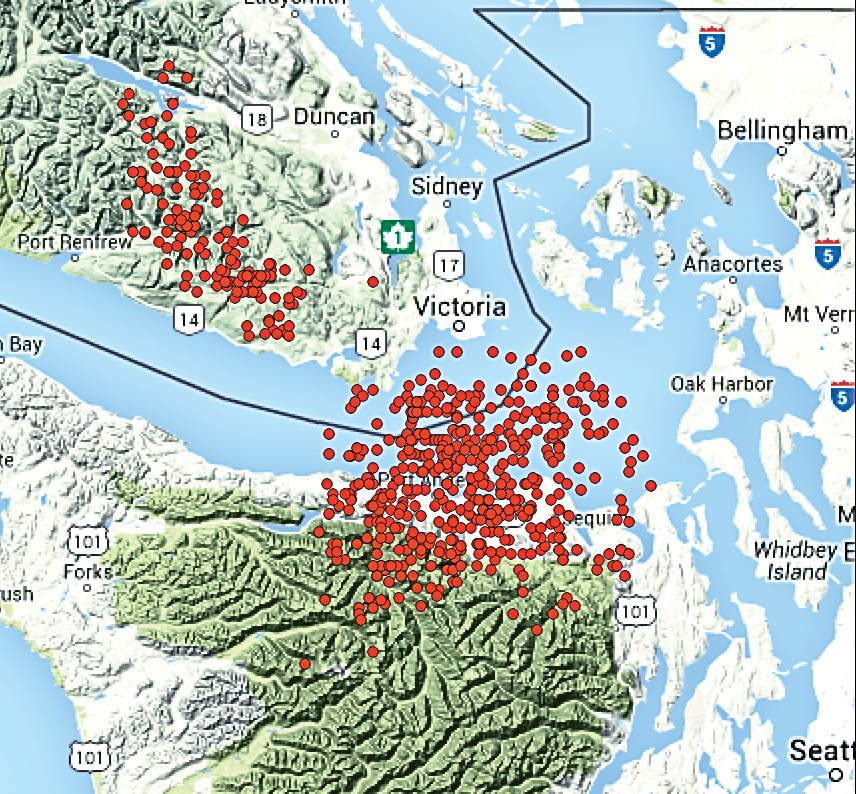
PORT ANGELES — The multitude of slow slip tremors geologists have measured over the past few days in the Pacific Northwest are not unusual and probably don’t portend earthquake activity, experts said.
Since New Year’s Day, the Pacific Northwest Seismic Network has registered over 2,000 of the low slip and tremor events beneath the Peninsula, the Strait of Juan de Fuca and Vancouver Island, according to The Outdoor Society — a online magazine celebrating outdoor recreation based in Olympia.
The tremors began registering Dec. 19 on Vancouver Island north of Victoria, eventually expanding south across the Strait and into Washington state.
On Tuesday, most registered tremors occurred in eastern Clallam County.
Episodic tremor and slip is a seismological phenomenon observed in some subduction zones, including the Cascadia Subduction Zone, which lies beneath the North Olympic Peninsula, according to geologists.
The phenomenon occurs in the Pacific Northwest as part of cyclical 14-month spans and is characterized by non-earthquake seismic rumbling, or tremor, and slow slip along the interface separating the Juan de Fuca and North America plates, they said.
The phenomenon also has been observed by geologists globally in Japan, Mexico and New Zealand.
The recent activity is not necessarily indicative of an impending earthquake, said John Vidale, Pacific Northwest Seismic Network director, from Seattle.
“We don’t think the ongoing tremors [are] dangerous,” he said.
“They might trigger an earthquake, but probably it won’t. If it triggers anything, it probably wouldn’t be anything big.”
And while geologists have “learned never to say it is never going to happen . . . it is certainly nothing to get alarmed about,” he said.
Beginning at 12:15 a.m. Monday, the Pacific Northwest Seismic Network — headquartered at the University of Washington in Seattle — plotted more than 400 slow slip and tremor episodes registered by seismology equipment installed throughout the Pacific Northwest.
The slow slip and tremor episodes were recorded as far southeast as Quilcene, as far west as Joyce and as far north as Hillcrest in British Columbia, according to an interactive map found online at www.pnsn.org/tremor.
Each event is marked with a dot on the map.
“Each dot is actually five minutes of detection, so it is basically a continuous process,” Vidale said.
“It is going to rumble for weeks as the slow slip progresses along the faults. So those dots are not earthquakes; they are just a detection that the fault is rumbling down there at the location from where we think the activity is.”
The vast majority of tremors cannot generally be felt or even observed without very precise equipment, Vidale said.
“This is imperceptible to people,” he said.
The tremors plotted on the map are “something that we see about once a year in this region in an episode that lasts a few weeks or a month, and it indicates that the plate interface is moving maybe an inch, very slowly, but it kind of rumbles while it is moving,” Vidale said.
“Any particular spot moves for a day or two, but it takes a couple of weeks for the episode to run down the length it is going to run.”
And while geologists speculate the tremors “might make it as far south as Olympia, [they] might run out of steam today, for all we know,” Vidale said.
“We are just watching to see what happens.”
The events are not aftershocks of the magnitude-4.8 earthquake that hit northeast of Victoria on Dec. 29, Vidale said.
“We haven’t seen any aftershocks from that earthquake under Vancouver [Island] — not a single one, which is actually not shocking for a deep earthquake,” he said.
“That one was 50 kilometers [31 miles] deep. Those deep events just don’t have many aftershocks.”
However, that earthquake might be the result of a slow slip, he said.
The slow slip “might have triggered that earthquake under Vancouver [Island] because it does shift those stresses a little bit in the region,” Vidale said.
“But we don’t see any effect from the earthquake on the tremor, in this case,” he said.
“That is unusual because usually, a tremor doesn’t trigger much of anything.”
________
Reporter Chris McDaniel can be reached at 360-452-2345, ext. 5074, or cmcdaniel@peninsuladailynews.com.
