
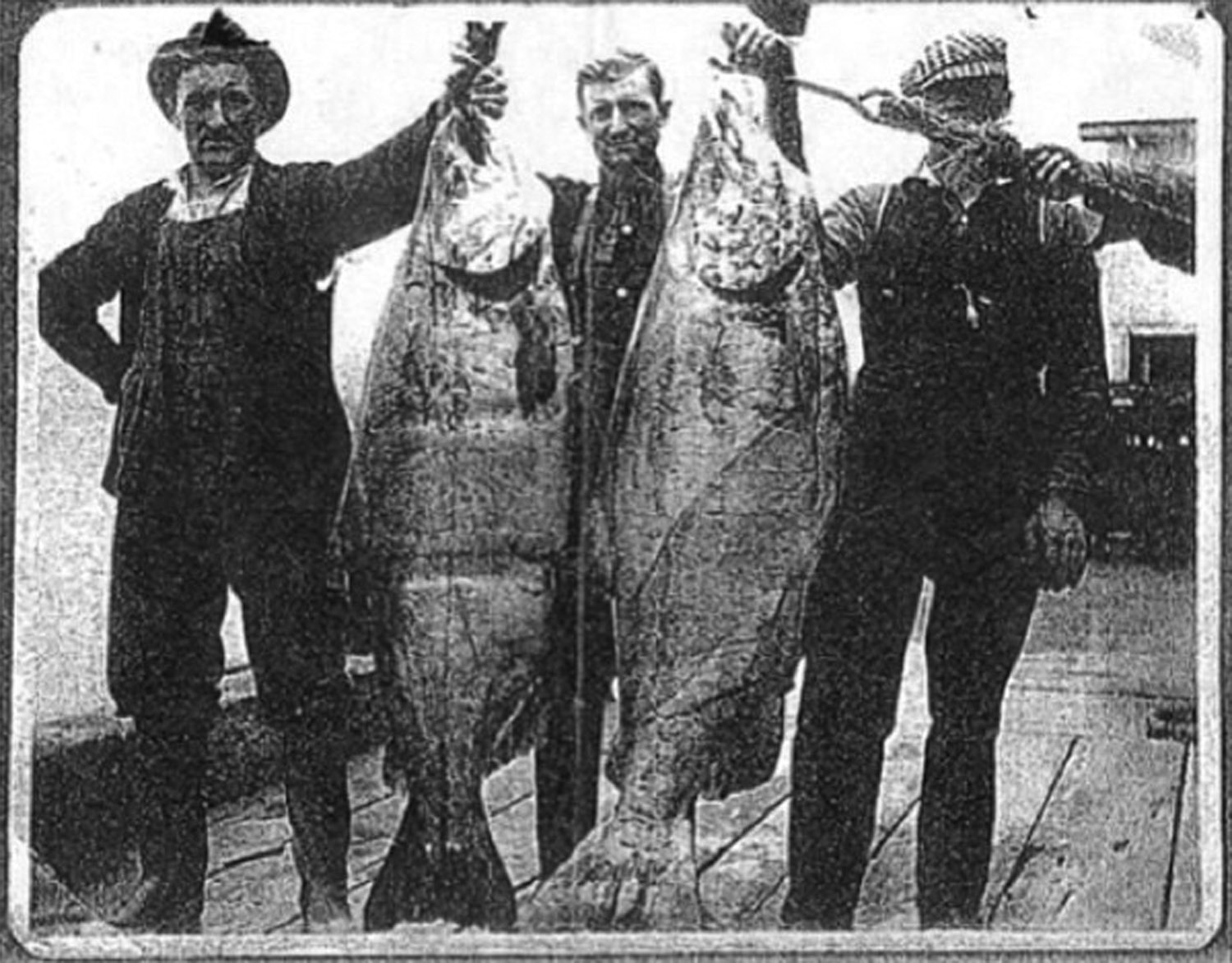
Once tipping the scales at more than 120 pounds, chinook have always been the staple of Southern Resident orcas, according to Deborah Giles, research director and projects manager for The Center for Whale Research in Friday Harbor.
“Today, we think a 30-pound chinook is big,” Giles said, pointing out an old photo of two fishermen in Astoria at the mouth of the Columbia river.
The men in the photo are holding up a pair of chinook, which appear to be more than 4 feet long and easily weigh 110 pounds.
“These are what the Southern Residents evolved to eat,” she added.
According to Giles, these salmon eaters pretty much stick to chinook.
“They don’t really know what to do with pinks or humpies [pink salmon or humpback salmon]; it’s almost like they don’t register them as fish,” Giles said.
“Calves will sort of mouth them, but they don’t really eat them.”
She said studies on orcas’ fecal matter have backed up these observations. Only one Northern Resident orca, the salmon-eating orcas in Canada, showed signs of eating a pink salmon once, she said.
The National Oceanic and Atmospheric Administration’s website lists many salmon species, including chinook, as threatened and endangered.
Chinook are facing habitat loss, overfishing, pollution, global warming, ocean acidification, harmful algae blooms and a general oceanic ecosystem collapse due to ocean temperature shifts, according to Rich Osborne.
Osborn is the former executive director of the Whale Museum and restoration ecologist at the University of Washington Olympic Natural Resources Center in Forks, and is the program director for the Washington Coast Sustainable Salmon Partnership.
Part of the reason for decline of the 2016 runs, according to Osborne, is a severe warm water pattern in the Pacific Ocean that lasted from 2013-15, nicknamed, The Blob.
“The Blob moved prey and disrupted salmon routes for the ocean migrants during that period, affecting those year classes of adult salmon,” Osborne said. “The fish starved those years.”
The Blob’s impact will continue to be felt for the next couple of years, he said.
Chinook runs were extremely low in 2012, and there were very few sightings of J, K and L pods that combined, make up the travel groups of the Southern Resident population. Pods usually consist of five to 30 orcas.
This year, chinook runs are predicted to be even lower than 2012, and according to Giles, as of mid July, only a few matrilines, (mothers and their offspring) amounting to 10 individuals, have been spotted in inland waters.
According to Giles, when there are coast-wide shortages of chinook there are more Southern Residents deaths. In 2012, seven orcas were lost.
“They are breaking into smaller and smaller groups because there isn’t enough salmon to share with their normal larger groups,” Osborne explained.
“They are not following normal patterns because they are on a desperate search for salmon anywhere they can find them.”
Rylee Jensen, a researcher with the team of Rippon College Professor Bob Otis said that when the resident whales were listed in 2005, the population was 85, compared to this year’s count of 83.
In an attempt to help bring chinook back from the brink, many researchers are calling to breach four dams in the lower Snake River, opening up more spawning ground.
The Snake River, according to Giles, is ideal because it has the highest elevation and coldest water of river systems in Washington — cold water being a key feature for salmon to thrive in.
The Snake also feeds into the Columbia River, which was once one of the world’s largest salmon-producing rivers, according to Giles.
“Historically, Columbia chinook were probably the Southern Residents’ mainstay,” Osborne said, adding that they are still an important part of the orca diet.
Tagging data backs this up. Giles said tagging results show Southern Residents frequently loop by the mouth of the Columbia.
Anderson agrees that breaching the lower Snake’s dams would be helpful, but is worried it could take 20 years or more — too long to help the orcas.
“Requiring whale watch boats to stay further back especially along the west side [of San Juan] would have an immediate impact [in helping orcas hunt,]” Anderson said.
“We could see an improvement today.”
Transients are the marine mammal-eating orcas, who hunt seal, sea lions and porpoise.
“If we were to begin researching orcas today, we would think the transients were residents, the ones that lived here, and the residents were transients, only occasionally cruising through,” Giles said, explaining that the baseline for orca research in the Salish Sea is shifting.
Transients, the marine mammal-eating orcas, are currently doing well, despite the fact that due to being higher on the food chain, they have a higher toxin level than the salmon-eating residents.
This, according to Giles, is because seals, sea lions and porpoise are all at record population levels, giving transients plenty to eat.
During fasting and famine situations, when the animals are using the blubber where the toxins are stored, is when problems such as suppressed immune systems occur. That, according to Giles, seems to be what researchers are seeing.
“If Southern Residents had enough food, it [toxins] still would not be good, but it wouldn’t be as bad of an issue,” he said.
The recent resident orca baby boom does not give Giles much comfort.
“K pod has not had any babies since 2011,” Giles said, and while eight of the calves have so far made it, one has not been sighted this summer, and neither has its mother.
Giles also pointed out that 13 females were pregnant in late 2015. Two calves died almost immediately, and two more were never seen, Giles said, and possibly either miscarried, or also died soon after birth.
Anderson pointed out that to increase a population, it takes more than counting heads; what is important are the core viable breeding members. That core of Southern residents is getting smaller and smaller.
He is not hopeless however.
“We thought minkes were a goner when we began studying them. Whales can come back,” Anderson said.
Osborne also believes orcas are resilient, but they “need wild salmon that do not require humans and barges to complete their life cycle.”
Hatcheries and fish farms might be a short-term solution but really only work to provide human food.
“By their existence and peripheral impacts, they only hasten the extinction of wild Pacific salmon,” Osborne said.
For more information, see The Center for Whale Research at www.whaleresearch.com, Orca Relief at www.orcarelief.org, the Whale Museum at www.whalemuseum.org or NOAA at www.noaa.gov.
________
Heather Spaulding is a reporter with the Journal of the San Juans, a Sound Publishing newspaper. Contact her at hspaulding@sanjuanjournal.com or 360-378-5696.
