
NOTE: “Today” and “tonight” refer to Friday, April 1.
LA PUSH — Despite many obstacles throughout the past few centuries, gray whales have managed to survive and even thrive off the coast of Washington.
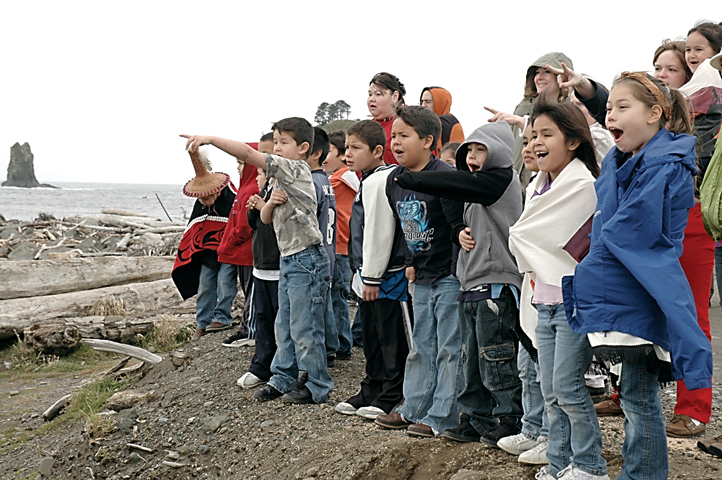
Seeing parallels between these beasts of the sea and the trials and tribulations overcome by their own people, the Quileute tribe today will honor the whales as they return to the Northwest during the ninth annual Welcoming of the Whales ceremony.
The ceremony commences at 10 a.m. on the beach in front of Quileute Tribal School, located at 40 Ocean Drive in La Push.
The free event is open to the public and will include Native song and dance.
“Throughout all this time and being hunted nearly to extinction by commercial whaling, they have survived all that and are still coming through here, so we wanted to recognize the whales’ effort and their continuing migratory paths,” said Rio Jaime, Quileute Tribal Council vice chairman.
“I would say that [the plight of Native Americans] parallels very closely” to that of the whales, Jaime added.
The Eastern North Pacific population of gray whales was listed as an endangered species in 1970 and was removed from the U.S. list of endangered and threatened wildlife in 1994 because their numbers had recovered, according to the National Oceanic and Atmospheric Administration’s National Marine Fisheries Service.
“On behalf of the Quileute people, the Tribal Council and I would like to extend a warm welcome to anyone who can join us for our annual Welcome of the Whales ceremony,” said Chas Woodruff, Quileute Tribal Council chair.
“It is an important community event that is done in conjunction with our Quileute Tribal School and gives our children the opportunity to share our culture. We pay homage to our brethren the whale and welcome them back as our ancestors have done for thousands of years.”
Gifts from the sea
Historically, the Quileute people have relied on the bounty of the ocean to survive and thrive, looking forward each year to the return of whales migrating north for the summer.
“The Quileute people have been whalers since time immemorial,” Jaime said.
“The whale was a great source of wealth for the people — oil and meat — so it was always looked forward to every March and April when the whales started showing up. That indicated the time to go out and harvest the whales for the tribe.”
While the Quileute have not hunted whales since the early 20th century, Jaime said, subsequent generations have never forgotten the importance of the majestic animals who make their home in the ocean.
The gratitude felt by the tribe is expressed during the annual welcoming ceremony, he said.
“We want to go and show respect for the whales, the ocean [and] nature,” he said.
While specifically honoring gray whales, “overall, we are recognizing all the whales that are coming through their migratory path, which includes orcas and fin whales,” Jaime said.
“They [just] may not be as close in as California grays, which have a tendency to come real close in to shore.”
The gray whales currently are migrating 10,000 to 12,000 miles up the Pacific from winter calving lagoons in Baja Mexico to summer feeding grounds in the Bering Sea.
Rebirth of a tradition
When the Quileute people still hunted whales, they celebrated their return much as they will during today’s ceremony, Jaime said.
“They would have gone out there and prayed and sang songs for the whales coming back” before going on to hunt them, he said.
When whaling stopped, the tradition fell out of vogue.
Reviving ceremony
That all changed almost a decade ago, when the administrative staff at Quileute Tribal School decided to revive the welcoming ceremony, Jaime said.
“I happened to be an employee at the school at the time, and our school sits dangerously close to the ocean,” he said.
“One of the perks of sitting so close to the ocean is that it does have a beautiful view” of the annual migration.
“The kids and the teachers kept looking out there, being distracted and excited because it is an awesome thing to see,” he said.
Former Tribal School Superintendent Leon Strom decided to bring the students to the beach with drums to honor the passing whales in a similar manner to what their ancestors had done, and the tradition was reborn.
Day long celebration
At 10 a.m., Marco Black, master of ceremonies, will lead the opening prayer and a moment of silence honoring those who have passed on.
Shortly thereafter, Quileute Tribal School students will sing three songs.
“The students who are involved in the event will be doing traditional songs and dances out to the beach area,” Jaime said.
“After the traditional songs and dances are done, we have some elders and cultural leaders who will be on the beach and will do a prayer song for the whales that are coming through.”
There also will be comments by the Quileute Tribal Council and the Quileute Tribal School Board.
Feeding the whales
Later, high school students will release a raft carrying a king salmon out into the surf as an offering to the whales, Jaime said.
“The kids, every year, make a raft of driftwood, lay some cedar boughs on top of it and offer a king salmon out into the ocean as a spiritual offering to the whales that are going through,” he said.
Finally, there will be whale and wolf songs retelling the ancient myths of the tribe.
“The Quileute people have a lot of songs regarding whales and wolves in our legends,” including how killer whales can walk onto the land and transform into wolves and vice versa, Jaime said.
“There is a parallel between the killer whales and wolves, so a lot of those dances will be brought out.”
Following the conclusion of the ceremony on the beach at about noon, the celebration will be moved uphill to the A-Ka-Lat Center.
“They will come back in and a lunch will be served at the A-Ka-Lat Center, which is up the hill at the gym, and at that time, stories will be [told] by elders and dancing will take place,” Jaime said.
For more information, visit www.quileutenation.org or call 360-374-6163.
________
Reporter Chris McDaniel can be reached at 360-452-2345, ext. 56650, or cmcdaniel@peninsuladailynews.com.
