
SEQUIM — A century after its completion, the Railroad Bridge remains a vital link to both the past and the future, speakers will say at the Dungeness River Festival this weekend.
The Chicago, Milwaukee, St. Paul and Pacific Railroad — also referred to as the Milwaukee Road — built the bridge in the summer of 1915.
The 100th anniversary of the 150-foot-long bridge will be celebrated today during the 16th annual Dungeness River Festival at Railroad Bridge Park, 2151 W. Hendrickson Road. The festival began Friday.
Festival hours will be from 10 a.m. to 4 p.m.
The Dungeness River Audubon Center and its partners — the Jamestown S’Klallam tribe, which owns the park and the bridge, and the Olympic Peninsula Audubon Society, a nonprofit organization headquartered at Railroad Bridge Park — sponsor the annual event.
Plaque unveiled
The main event will be the unveiling of a plaque to mark the bridge’s status as a centenarian. That is planned at 2 p.m. today.
The plaque commemorates the placement of the bridge on the National Register of Historic Places.
Additionally, the Olympic Driftwood Sculptors’ seventh annual art show will be held today and Sunday at the Dungeness River Audubon Center.
Both the festival and art show are free to the public.
100th anniversary club
The bridge is just one of several local entities celebrating a century in existence during this year’s festival.
The others are the Dungeness National Wildlife Refuge, designated as such Jan. 20, 1915; the Klahhane Hiking Club; and the Joyce Railroad Depot, built in 1914, said Lyn Muench, 100th Anniversary Committee chair.
Once an important crossing for timber and other local wares being shipped to markets outside the North Olympic Peninsula, the Railroad Bridge is now an iconic part of the Olympic Discovery Trail, which eventually will traverse almost 130 miles of lowlands to connect Port Townsend in the east with the Pacific Ocean in the west.
Bridge currently closed
The bridge currently is closed to through traffic while construction crews replace the western trestle, which was damaged by flooding in February.
The trestle was constructed in the 1960s.
The bridge itself is a modified Howe through truss, which allowed trains to pass through the middle of the structure.
The designer of the truss was millwright William Howe of Spencer, Mass., said Ken Wiersema, president of the Olympic Peninsula Audubon Society.
Wiersema spoke about the history of the bridge during a presentation Friday at the river center.
Good location for bridge
The site where the bridge was located was seen as a good location “because it was tying together most of the timber and the proposed mill site in Carlsborg” with Port Angeles and Port Townsend where the logs could be loaded onto barges for transport, Wiersema said.
It was important to get goods to market and timber off the Olympic Peninsula, “which was the primary economic engine of this area during the end of the 19th century and the first part of the 20th century,” he said.
And the area is relatively flat.
“Trains don’t climb grades very well, so consequently, you want to have a relatively flat gradient on your track, and that is why they put it across there,” he said.
Grading for the Dungeness River Railroad Bridge began in January 1914 on the west side of the river, with equipment and materials brought by ships and barges to Port Angeles, according to the river center.
One month to complete
Erection of the structure took crews about a month to complete during the summer of 1915.
The lower timbers, referred to as “stringers,” were assembled first and set to grade on pieces of timber to support their weight.
Then the rails were laid.
A train could then carry in the heavy timbers for the vertical portions of the bridge, which were lifted and bolted into place directly from flat cars.
The bridge first supported trains in July 1915.
From 1915 to 1980, the Milwaukee Road operated the rail line from Port Townsend to Port Angeles and then west to connect with several logging railroads.
While the vast majority of cargo was timber, Milwaukee Road did operate a passenger service until the 1930s.
The Milwaukee Road in 1980 sold the line to the Seattle and North Coast Railroad, which abandoned the line in 1985.
The last train crossed the bridge in March 1985.
Volunteers in 1993 began work to replace the railroad planking to create a pedestrian and bike trail.
In recent years, the bridge averaged 100,000-plus crossings annually, according to the Jamestown S’Klallam tribe.
Festival activities
Activities include nature activities and exhibits, model train displays and live entertainment.
Among the nature activities will be watching salmon swim up the river to spawn.
Food concessions will offer Native American fry bread, wraps, soup and salad.
Among the interactive nature exhibits and activities will be demonstrations concerning energy efficiency, water conservation and clean air.
Attractions on the bridge will include a 25-foot-long assessor’s map showing the Milwaukee Road right of way in 1913.
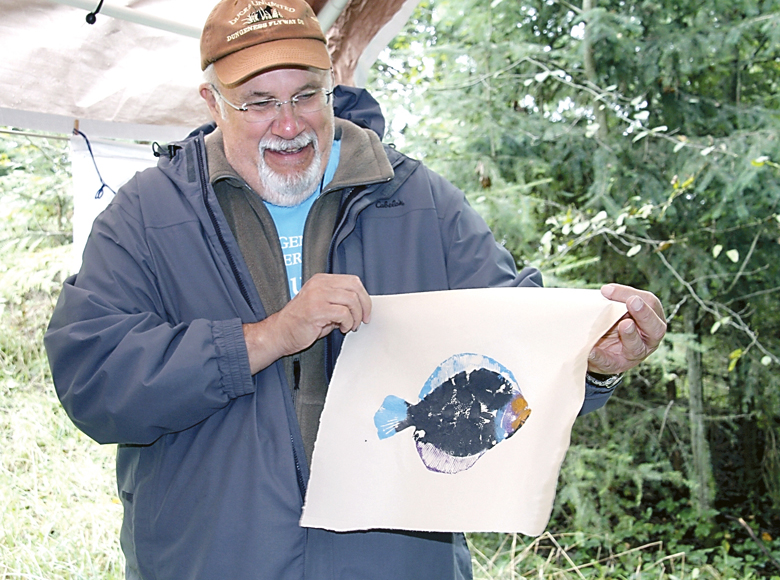
Fish printing — a process in which a mirror image of a fish is transcribed via ink onto parchment or cloth — also will be offered on paper, white T-shirts or pillow cases provided by attendees.
Participants can learn how worms breathe and hold a giant geoduck clam.
Also, those in attendance will be able to try their skills at Animal Olympics when they mimic a specific animal, such as jumping like a frog or creeping like a crab.
Commemorative items for sale will include “Railroad Bridge Red” table wine, a 2012 vintage made from Yakima Valley grapes and hand-crafted by David Volmut, co-owner of Wind Rose Cellars in Sequim.
Fifteen percent of the proceeds from each bottle, or about $3, will be donated to the river center.
Dungeness Bridge anniversary patches and pins also will be available in the river center gift shop.
For more information about the festival, contact the Dungeness River Audubon Center at 360-681-4076 or visit www.DungenessRiverCenter.org.
For more information about the sculpture show, visit www.olympicdriftwoodsculptors.org.
________
Sequim-Dungeness Valley Editor Chris McDaniel can be reached at 360-681-2390, ext. 5052, or at cmcdaniel@peninsuladailynews.com.
