
PORT ANGELES — An intensive scientific study of how storms behave near and on the Olympic Peninsula employed everything from mules to high-altitude “spy planes” to help calibrate a weather satellite.
Initial findings from the Olympic Mountain Experiment, known as OLYMPEX, are scarce.
It will take another grant and years of additional research to “quality control” the data and make changes to the satellite systems, Angela Rowe, a University of Washington atmospheric researcher, told a standing-room-only audience during a presentation Tuesday at the Olympic National Park Visitor Center in Port Angeles.
Once funding is received, the compilation could take two or more years, she said.
During the study, which was from November to January, researchers weathered the extremes of precipitation across the region, as well as such challenges as wild animals and steep terrain, Rowe said.
The project began Nov. 2, flights over the Olympic Peninsula ended Dec. 18 and the ground-based radar made its last scan Jan. 15.
“We rely on a lot of overpasses [of the satellite]. That’s why it took so long to get enough [data] to feel confident with the specifics,” Rowe said.
Weather equipment that has been left in the mountains will continue collecting data until it is removed this spring or summer when the snow melts, she said.
But if equipment stops sending data because of deep snow or a malfunction, crews will no longer hike into the mountains to repair them.
Weather satellite
OLYMPEX is a NASA and UW project to calibrate a new weather satellite, the Global Precipitation Measurement mission’s Core Observatory.
This is done by measuring precipitation across the Olympic Peninsula on the ground and in the air — detailing weather behavior as storms come ashore, then hit the Olympic Mountains.
This was the last in a series of missions to calibrate the satellite’s systems, each set up in a different region to look in detail at different weather behaviors and how the satellite’s algorithm was interpreting them, Rowe said.
Other studies to calibrate the satellite were done for floods in Iowa; tornado season in Kansas and Oklahoma; snowfall in Toronto, Ontario, Canada; extreme cold in Egbert, Ontario; and rain in the Great Smoky Mountains, she said.
The data collected will be compared to what the satellites measure, allowing scientists and engineers to calibrate their systems.
The weather stations, radar and aircraft collected detailed atmospheric data that eventually will be assembled in a three-dimensional picture from the ocean and across the Olympic Mountains.
Rowe said the data will show how the storms change as they come ashore, hit the mountains and lift over them, and what it looks like when the rain changes over to snow.
Initial data startling
Some initial data was startling, she said.
On Nov. 17 a storm produced 8¼ inches of rain in 24 hours at one sensor in the Quinault Valley.
“That’s more than Seattle usually gets in the whole month,” she said.
“It dumped. It was our first really great case, and everything was running.”
The Peninsula typically receives more than 8 feet of rain on the coast, up to about 15 feet of snow in the mountains and has reliable patterns of rainfall as they travel up the valleys, then dry out over the elevations.
Since Peninsula elevation rises from sea level to a peak of 7,980 feet in only 30 miles, the area offered scientists a variety of landforms.
Rowe said the initial hypothesis was that a storm rises above the mountains only when it hits the higher ridges.
“Now we know that as soon as it hits any sort of elevation, it rises,” she said.
Also, she said, scientists were able to see the variations in where the snow melts to rain and how the mountains intensify the rain.
“It’s a good thing we didn’t do this last summer,” Rowe said, referring to the relatively dry winter of 2014-15.
Technology extremes
OLYMPEX flew three aircraft through storms — NASA’s customized DC-8 flying science laboratory, NASA’s Lockheed ER-2 high-altitude aircraft and a Cessna Citation II Research Aircraft owned by the University of North Dakota.
Researchers set up ground radar systems and mobile weather stations deep in the Olympic Mountains — such as Hurricane Ridge, Enchanted Valley and the Quinault Valley — to gain a full picture of how storms behave as they arrive on shore and when they meet the mountains.
The Lockheed aircraft, which once was a military spy plane, was used to study storms from high above them, Rowe said.
While the high-tech plane flew overhead, researchers used a team of mules to set up radar systems and mobile weather stations in difficult-to-access mountain locations.
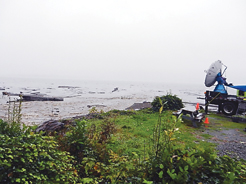
A mobile Doppler radar truck, usually used to chase tornados in the Midwest’s and Great Plains’ Tornado Alley, was erected with its dish pointed up the Quinault River valley.
Team members also deployed 100 old-fashioned weather balloons to cut through the storms, Rowe said.
OLYMPEX adventures
The main radar site and project headquarters was located on a hilltop overlooking the Pacific Ocean on the Quinault tribal land.
It was completely exposed to storms rushing ashore, Rowe said.
“We were on this hill and a storm would come in. The trailer was shaking. It was really something,” she said.
The Doppler radar truck, called the Doppler on Wheels, was parked in a campground on Lake Quinault and became one of the project’s unique experiences.
During heavy winter rain, the lake’s level rose and flooded the site where the truck was parked, Rowe said.
Unable to move the truck to another location, the crews used wooden blocks and the truck’s built-in leveling jacks to raise the truck several feet into the air, she said.
But eventually, the lake rose to the truck’s wheels.
“We had to get creative,” Rowe said.
The crew used a kayak to reach the truck until the lake’s level fell again.
“Landslides were also an issue. Sometimes the trails were just gone and there was too much snow,” Rowe said.
A team of student interns often had to snowshoe miles into the mountains to clear snow from solar panels or repair malfunctioning equipment, she said.
Wild animals
Curious wild animals were another hazard.
Bears investigated snow poles and other sensors. Elk herds often loitered in fields where equipment was installed and blocked access.
The biggest problem was caused by a banana slug that oozed into a computer and shorted out a board.
In addition to NASA and UW, OLYMPEX worked closely with the Quinault Nation, Environment Canada, the National Park Service, the U.S. Forest Service and volunteer rain gauge readers across the Peninsula.
Members of the Quinault tribe who were knowledgeable about the area were instrumental in helping find the perfect locations to place the equipment, Rowe said.
________
Reporter Arwyn Rice can be reached at 360-452-2345, ext. 56250, or at arice@peninsuladailynews.com.
