
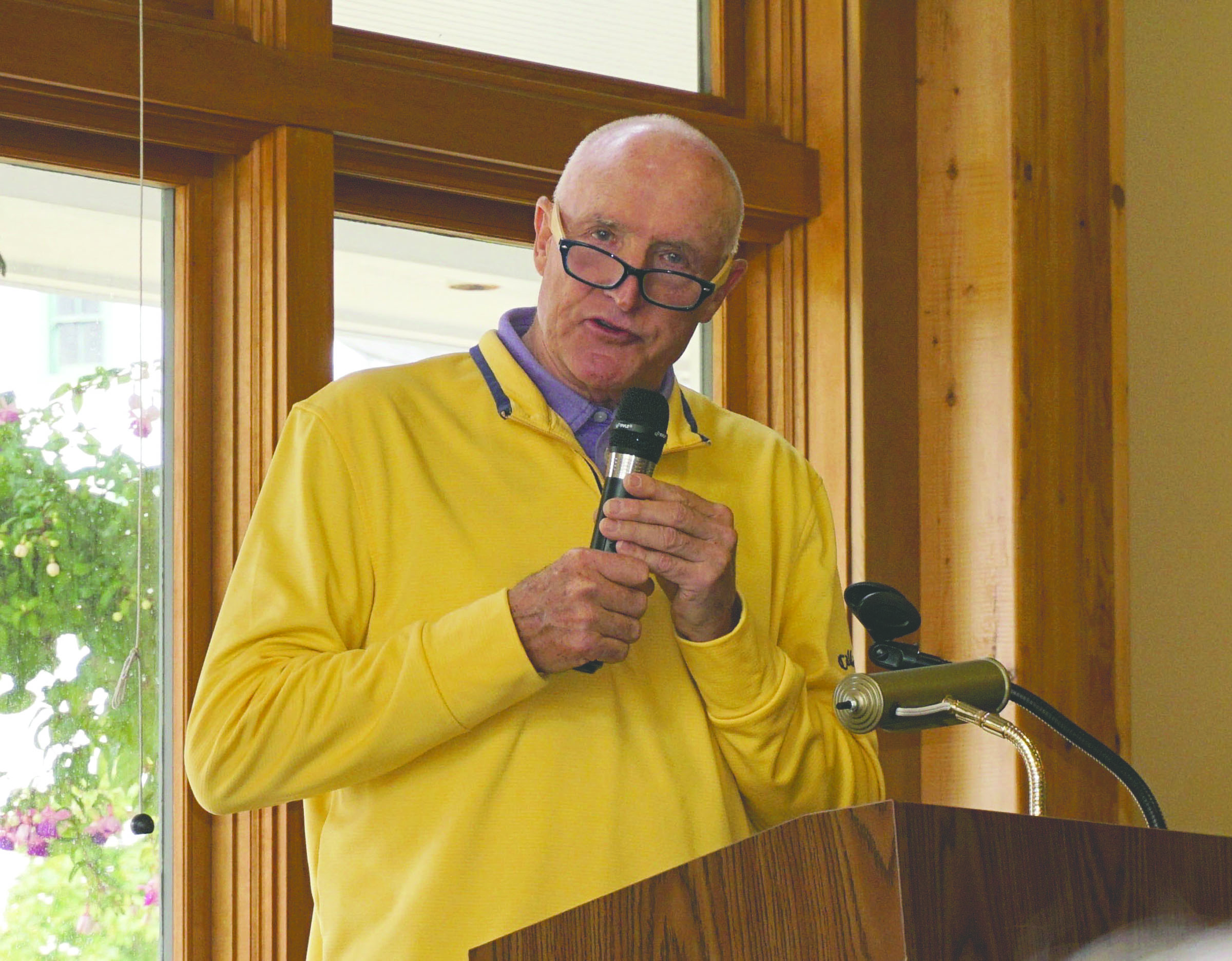
PORT TOWNSEND — Hospice care eased his wife Sally’s last days, Shelton Washburn told the 250 people who gathered at a fundraising breakfast for Jefferson Healthcare Hospice.
“We were blessed to have received such compassion,” he said at Thursday’s breakfast at Fort Worden Commons.
“In my heart, I’m in debt forever.”
Washburn, Port Ludlow Golf Course general manager, said that hospice was essential in combatting “caregiver psychosis.”
“You can get burned out caring for a loved one,” he said.
Washburn was the guest speaker at the breakfast that raised $14,272 for Hospice Foundation for Jefferson Healthcare.
The money will go toward helping to cover services Medicare does not fund, such as grief support, massage, haircuts, music therapy and other non-medical services.
Following the decision to enter his wife into hospice end-of-life care last year, Washburn received a phone call, he told the group.
“They had made all of the arrangements,” he said.
“All of a sudden lights started coming on as to the services that were available.
“There was the bath lady, the nurse that came in every day at 5 p.m. and the volunteers, who all made our lives wonderful.”
“She would take all this medication. Her system would kick in around 5 p.m. which is when I started crashing.”
Hospice would then come in and take over, offering Washburn a respite.
Accepting the need for hospice services is a hard decision to make, said Lisa Holt, executive director of Home Health, Hospice and chief ancillary officer for Jefferson Healthcare.
“Dealing with your own mortality is a challenge,” said Holt, 45, who was diagnosed with Stage 4 breast cancer in her mid-30s.
“I planned my own funeral and was ready to accept hospice if the treatment wasn’t successful. I knew the value it would provide for my family,” she said after the breakfast.
In Holt’s case, it wasn’t needed. Two years of treatment proved successful.
“I am cured,” she said.
However, for others — those who have exhausted all available resources and whose doctor has said there is no possibility of a cure — hospice end-of-life care can be a way to make their remaining time more meaningful.
“If you sign up for the program, it doesn’t mean you are signing your own death sentence,” Holt said.
“Hospice is designed to help people with a terminal diagnosis achieve a high quality of life during the days they have left,” she said.
Each patient receives an individualized program to provide medical, emotional, psychological, financial, social and spiritual care, Holt said.
“The earlier that people accept hospice, the more they will get out of the program,” she said.
“If they enter late, the team has less time to put together a care strategy and treatment plan.”
Holt said that a doctor’s hospice recommendation “doesn’t come with a crystal ball” that can predict when death will occur.
A six-month diagnosis, Holt said, can be shorter or longer than the predicted time.
No matter how long the patient has, “we wish to enable you to come to a fuller awareness of who you are and how much you matter here and now, just as you are, in sickness as in health,” says the hospice website at tinyurl.com/PDN-hospice.
After end-of-life care, Hospice provides 13 months of grief support to family members “because it can be really hard to get past that first anniversary,” Holt said.
The 2015 hospice patient count was 190 while the 2016 year-to-date total is 92, for an average daily count of 30.8.
The organization operates on an $833,000 annual budget, with between 40 and 45 volunteers working at a time, Holt said.
Volunteers visit clients on a regular basis to stay nearby while the primary caregivers run errands or take a break or just to provide conversation and comfort.
Hospice is in constant need of volunteers, who are subject to the same personnel screening process as for hospital employees, including a background check, reference check and blood check before entering an orientation program.
The foundation expects a donation spike after the fundraiser because many people who want to contribute could not attend the event, Holt said.
For more information about hospice, to volunteer or to contribute, call 360-385-0610 or go to tinyurl.com/PDN-hospice.
________
Jefferson County Editor Charlie Bermant can be reached at 360-385-2335 or cbermant@peninsuladailynews.com.
