
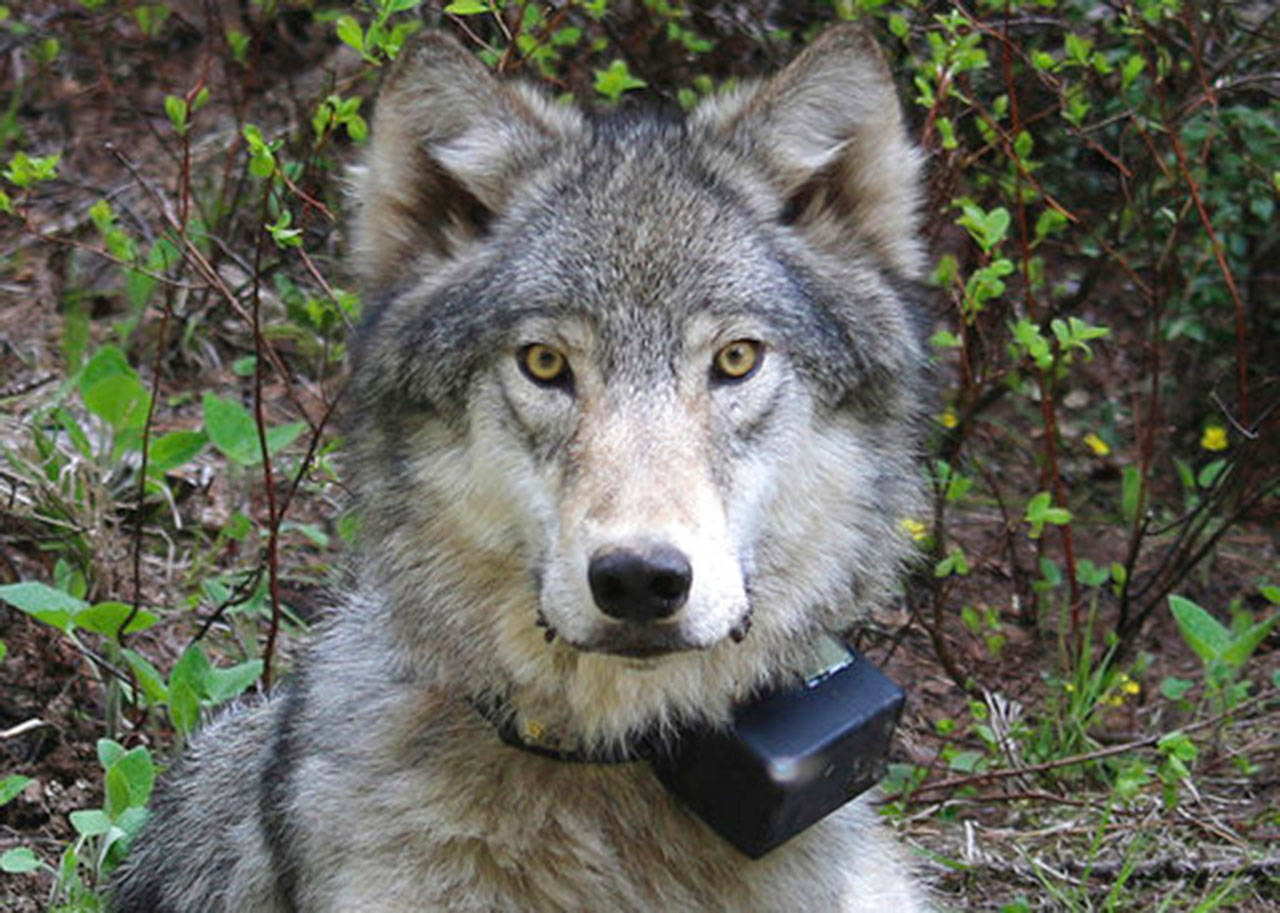
This March 13, 2014, file photo, provided by the Oregon Department of Fish and Wildlife shows a female wolf from the Minam pack outside La Grande, Ore., after it was fitted with a tracking collar. (Oregon Department of Fish and Wildlife via AP, File)

This March 13, 2014, file photo, provided by the Oregon Department of Fish and Wildlife shows a female wolf from the Minam pack outside La Grande, Ore., after it was fitted with a tracking collar. (Oregon Department of Fish and Wildlife via AP, File)

Washington’s wolf population grew by 28 percent last year

  • The Associated Press
  • Wednesday, March 22, 2017 1:30am
  • News

By Nicholas K. Geranios

The Associated Press

SPOKANE — The population of wolves in Washington state grew by 28 percent last year, with at least two new packs, the state Department of Fish and Wildlife has announced.

At the end of 2016, the state was home to a minimum of 115 wolves, 20 packs, and 10 successful breeding pairs. That’s an increase of at least 25 wolves since 2015, despite the confirmed deaths of 14 wolves from various causes.

Those findings, released Friday, draw on information gathered from aerial surveys, remote cameras, wolf tracks, and signals from radio-collared wolves, and are considered minimum estimates, the agency said.

“Washington’s wolf population continues to grow at about 30 percent each year,” said Jim Unsworth, director of Fish and Wildlife.

Wolves were all but eliminated from western states in the last century. But the animals started moving back into Washington from neighboring areas shortly after the turn of this century, sparking some conflicts with ranchers.

Gray wolves are listed under state law as endangered throughout Washington. In the western two-thirds of the state, they are also protected under the federal Endangered Species Act.

All of the documented wolf packs are east of the Cascade Range, with 15 of the 20 packs located in a four-county area in the northeast corner of the state. That is also where most conflicts with livestock have occurred.

The two new packs confirmed last year are the Sherman pack, in northeastern Washington, and the Touchet pack, east of Walla Walla, the agency said.

Unsworth said the concentration of wolves in northeastern Washington “underscores the importance of collaborating with livestock producers and local residents to prevent conflict between wolves and domestic animals.”

There were no conflicts with livestock documented for 16 of the 20 wolf packs, the agency said. Four packs, and one lone wolf, were involved in the death of a cow or calf last year, the agency said.

The largest losses were inflicted by the Profanity Peak pack, which killed or injured at least 10 cattle grazing in the Colville National Forest. The agency killed seven members of the pack last year, prompting protests from conservation groups.

Seven other wolves were also known to have died last year, the agency said.

“We know that some level of conflict is inevitable between wolves and livestock sharing the landscape,” said Donny Mortorello, wolf manager for the agency.

Environmental groups were pleased by the growth in the wolf population.

“It’s great news that wolves have continued to recover, but we still have a long way to go,” said Amaroq Weiss of the Center for Biological Diversity. Wolves need continued federal and state protection, she said.

The Washington Department of Fish and Wildlife paid a total of $77,978 to ranchers last year to compensate them for cattle killed by wolves, the agency said.

More in News

Art Director Aviela Maynard quality checks a mushroom glow puzzle. (Beckett Pintair)
Port Townsend puzzle-maker produces wide range

Christmas, art-history and niche puzzles all made from wood

Food programs updating services

Report: Peninsula sees need more than those statewide

U.S. Rep. Emily Randall, D-Port Orchard.
Randall bill to support military families passes both chambers

ANCHOR legislation would require 45-day relocation notification

x
Home Fund supports rent, utility assistance

St. Vincent de Paul helps more than 1,220 Sequim families

EYE ON THE PENINSULA: Peninsula boards set to meet on Monday

Meetings across the North Olympic Peninsula

Hill Street in Port Angeles is closed due to a landslide. (Dave Logan/for Peninsula Daily News)
Hill Street closed due to landslide

Hill Street is closed due to an active landslide.… Continue reading

Tippy Munger, an employee at Olympic Stationers on East Front Street in Port Angeles, puts out a welcoming display for holiday shoppers just outside the business’ door every day. She said several men have sat there waiting while their wives shop inside. (Dave Logan/for Peninsula Daily News)
Holiday hijinks

Tippy Munger, an employee at Olympic Stationers on East Front Street in… Continue reading

Hospital begins recorded meetings

Board elects new officers for 2026

From left to right, Frank Hill, holding his dog Stoli, Joseph D. Jackson, Arnold Lee Warren, Executive Director Julia Cochrane, monitor Janet Dizick, holding dog Angel, Amanda Littlejohn, Fox and Scott Clark. (Elijah Sussman/Peninsula Daily News)
Winter Welcoming Center has expanded hours

Building provides respite from November through April

Wastewater bypass prompted no-contact advisory

The city of Port Angeles has clarified Monday’s wastewater… Continue reading

A crew from the Mason County PUD, in support of the Jefferson County PUD, works to replace a power pole and reconnect the power lines after a tree fell onto the wires and damaged the pole at the corner of Discovery Road and Cape George Road, near the Discovery Bay Golf Course. Powerful winds on Tuesday and early Wednesday morning knocked out power across the Peninsula. The majority had been restored by Wednesday. (Steve Mullensky/for Peninsula Daily News)
Reconnecting power

A crew from the Mason County PUD, in support of the Jefferson… Continue reading

Port Angeles council passes comp plan update

Officials debate ecological goals, tribal treaty rights