
By Dameon Pesanti
THe Columbian
VANCOUVER, Wash. — Nature doesn’t create a forest in a time frame that fits into humanity’s schedule, but two researchers at Washington State University Vancouver have figured out a way to speed up the process.
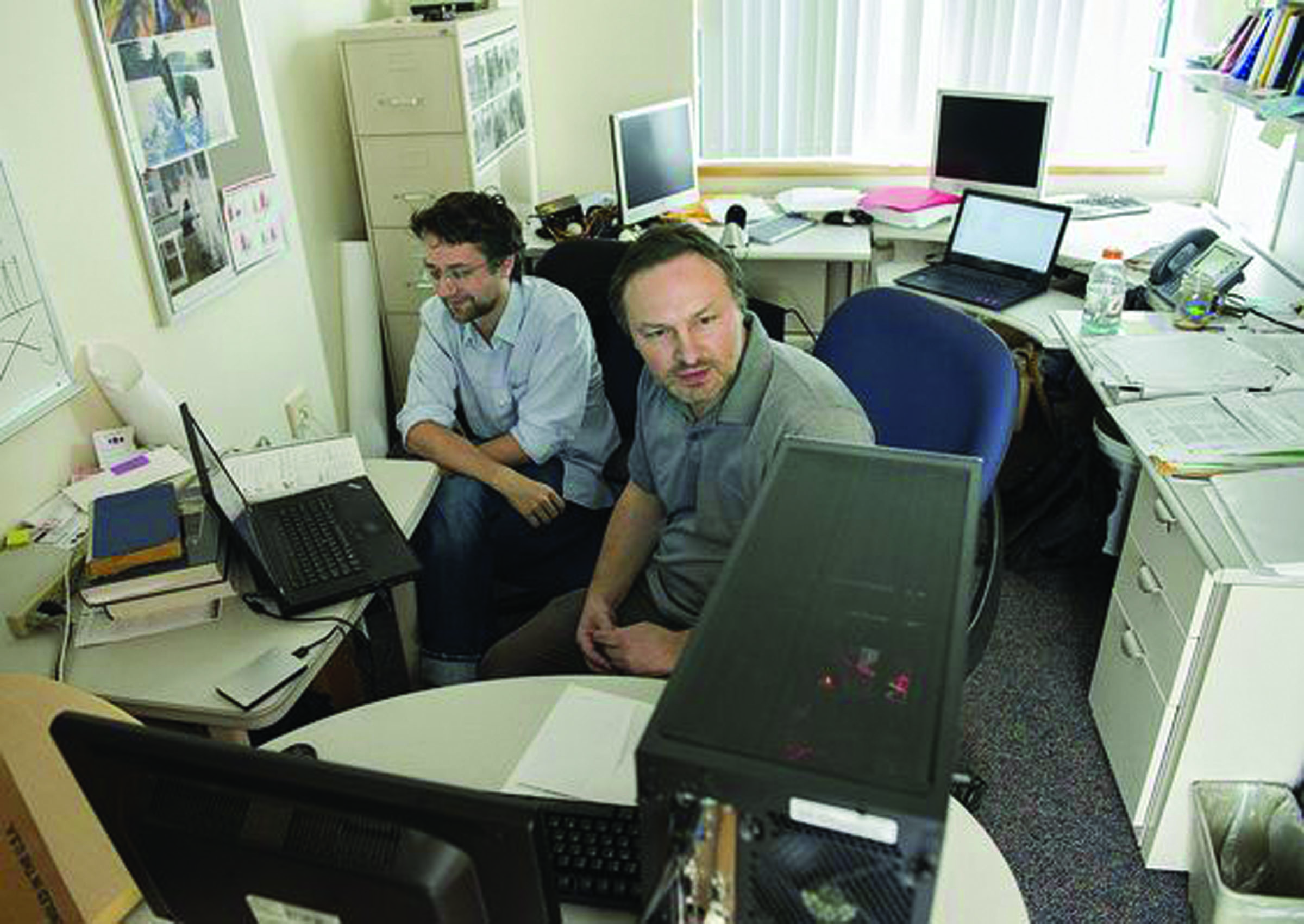
Nikolay Strigul, assistant professor of mathematics and statistics, and Jean Lienard, a mathematics postdoctoral researcher, developed a computer program that grows forests down to the branches, leaves and roots of each individual tree.
By accelerating the growth of a forest over a millennium and a half, they’re able to see how climate changes, wildfires and droughts can impact forests across North America.
“We’re trying to understand how individual trees link to the overall forest,” Strigul said.
They call their model LES, after the Russian word for forest, and they’ve already used it to predict how rising carbon dioxide and warmer temperatures will cause increases in fire rates and affect plant growth in Quebec’s hardwood forests.
Forest recovery
Scientists still don’t fully understand how forests recover after a clearcut, fire or other disturbances.
Monitoring the process can take decades and involves a lot of information.
Now, this new program could help forest managers better understand the process and determine which species of trees and environmental factors will help forests re-establish themselves.
“The fear is that drier conditions in the future will prevent forests in places like Washington from re-establishing themselves after a clearcut or wildfire. This could lead to increasing amounts of once-forested areas converted to desert,” Strigul said.
“Our model can help predict if forests are at risk of desertification or other climate change-related processes and identify what can be done to conserve these systems.”
Computing power
Strigul said computer modeling for forests isn’t anything new; it’s been used by foresters and ecologists for decades.
But until now, computing power was well behind their scientific ambitions. Previous models could only simulate trees at the branches or at the roots, but not both.
“Now we can do it,” Strigul said.
To generate the simulation, Strigul and Lienard work from their offices at WSU Vancouver and use a computer system at WSU’s Pullman campus capable of producing the equivalent of roughly 400 personal computers.
LES digitally grows 100-meter-by-100-meter stands of drought- and shade-tolerant trees that can be scaled up to an actual forest size, but the process still takes three weeks.
LES creates intricate roots and canopy structures where trees struggle for light and water.
Over time, the forest canopy changes as the trees move their leaves to gather more sun.
Shifting shapes, colors
But the forests the computer grows are not like something a person would imagine.
The simulated forest doesn’t look like a three-dimensional landscape with trees growing in hyper lapse.
Instead, Strigul and Lienard’s computer monitors display two separate mosaics of shifting shapes and different colors.
Each color represents a different species of tree. One screen shows the trees’ root structures. The other shows a bird’s-eye view of the tree canopy.
The researchers used data from the U.S. Department of Agriculture Forest Inventory and drone images from particular forests to customize their model to particular forests.
“We use this data to develop 3-D models that have real distributions of space and ecological features,” Lienard said.
In addition to the changes in the weather, climate change is enabling certain diseases and pests such as the destructive Rocky Mountain pine beetle to expand into territories well beyond their native homes.
Strigul said they’re in talks with researchers at the University of California at Davis to add those variables to their computer models.
“But that’s going to take some time,” Strigul said. “You solve one problem and new ones emerge immediately.”
