
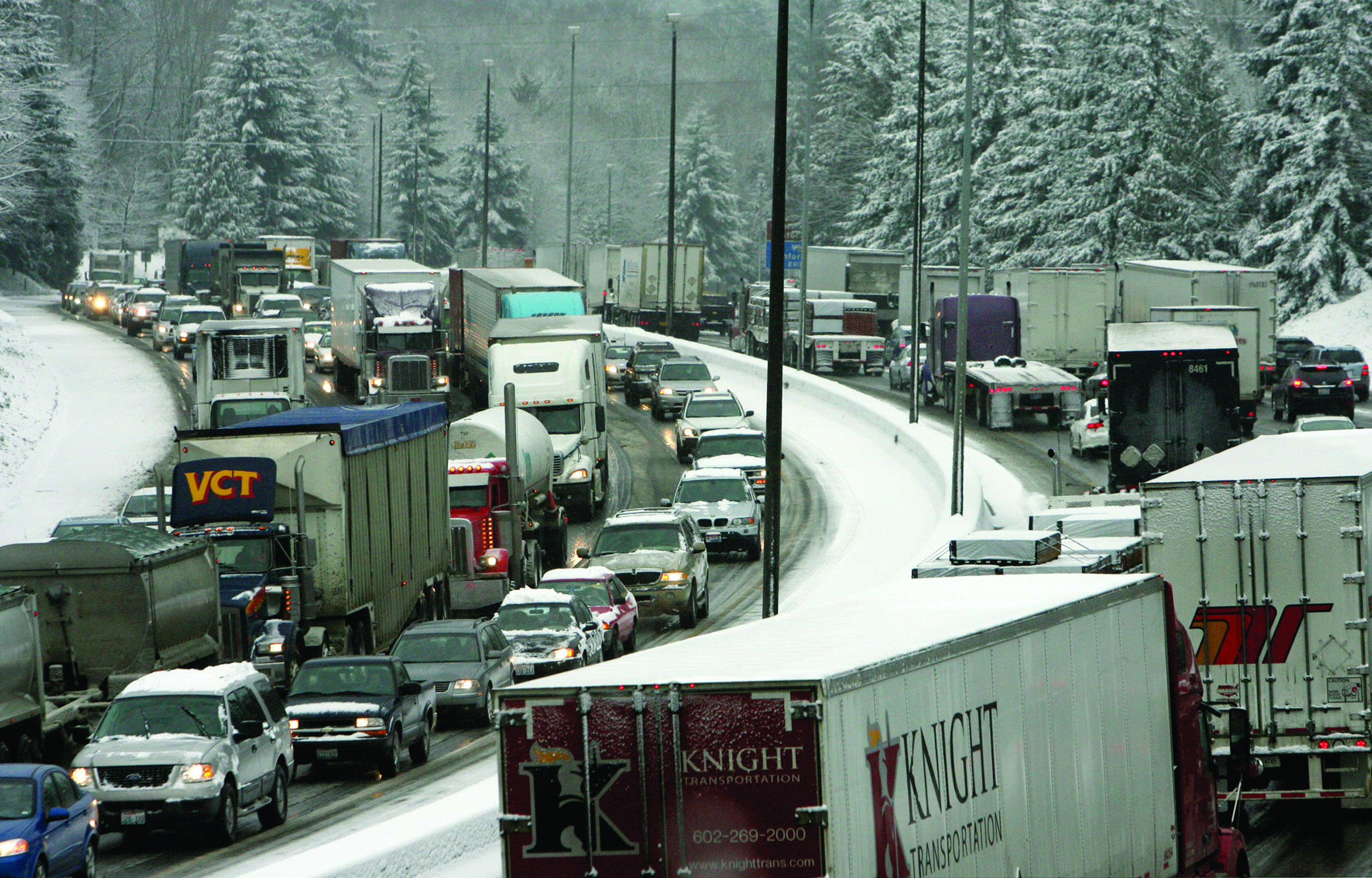
A snow storm leaves a commuting mess on Interstate 5 in Olympia in 2011. Many of the chemicals spread on highways to help winter drivers can damage the environment. Researchers at Washington State University are working on environmentally friendly ways that use less salt. — The Associated Press

A snow storm leaves a commuting mess on Interstate 5 in Olympia in 2011. Many of the chemicals spread on highways to help winter drivers can damage the environment. Researchers at Washington State University are working on environmentally friendly ways that use less salt. — The Associated Press

Washington State University studying greener winter road technology

  • By Nicholas K. Geranios The Associated Press
  • Monday, December 29, 2014 12:01am
  • News

By Nicholas K. Geranios

The Associated Press

SPOKANE — Researchers at Washington State University are working on environmentally friendly ways that use less salt to reduce snow and ice on roads.

Their work comes amid growing concerns about the impact of salt and chemical deicers on the environment, said Xianming Shi, WSU associate professor in civil and environmental engineering.

“We are kind of salt addicted . . . as it’s been so cheap and convenient for the last 50 years,” said Shi, who is assistant director of the new Center for Environmentally Sustainable Transportation in Cold Climates.

It studies cold climate road ecology, a field of study which includes green snow and ice control.

Funded by the U.S. Department of Transportation, the center is a collaborative effort between WSU, the University of Alaska-Fairbanks and Montana State University.

Roadways made slippery by snow and ice are a big problem in the northern United States.

According to The Salt Institute in Alexandria, Va., about 17 million tons of deicing salt is applied to roadways in the U.S. each year.

Every winter, more than 116,000 Americans are injured and some 1,300 are killed as a result of pavement that is covered in snow, slush or ice, according to the institute.

Road salt reduces crashes by 88 to 93 percent, the institute said.

Morton Satin of The Salt Institute said salt will continue to be spread on roads for a long time.

The institute has worked for years on developing methods to reduce the amount of road salt that gets into the environment, Satin said.

The science of clearing snow and ice off roads is very complex, said Ron Wright, who works for the Idaho Transportation Department.

Issues include the temperature at which various products will work, the damage various chemicals cause to vehicles and roadways and the impacts on the environment.

Deicing chemicals also need to have a long shelf life so they can be stockpiled, he said.

“The sodium chloride rock salt has been a long established, well-utilized, functional tool,” said Wright, a member of the Pacific Northwest Snowfighters, an association of state transportation agencies dedicated to ensuring the safety of winter roads by evaluating different products.

It includes the states of Idaho, Washington, Oregon, Montana and Colorado.

The U.S. spends $2.3 billion each year to remove highway snow and ice, plus another $5 billion to mitigate the hidden costs associated with the process, Shi said.

Hidden costs include long-term impacts of salt, sand and chemical deicers on the environment, roads and vehicles.

In Washington state, for example, road crews apply roughly four tons of salt per lane mile per winter season, Shi said.

“With a four-lane highway, you have 16 tons of salt per year in that one mile segment,” he said. “In 50 years, that’s about 800 tons of salt in that one mile — and 99 percent of it stays in the environment. It doesn’t degrade.”

Shi’s research has led to advances like the smart snowplow, which comes loaded with sensors and is already being integrated into winter fleets.

“Ordinary snowplows have at least one sensor to measure pavement temperature,” he said.

“Smart snowplows not only read temperature, but also residual salt from previous applications, the presence of ice and the amount of friction on the road. All of these readings help operators apply less salt.”

At Washington State, Shi’s passion is cooking up green deicers.

“There is a lot of talk about beet and tomato juice deicers that are meant to be less corrosive to vehicles, guard rails, steel bridges and concrete pavement,” Shi said.

“They help, but there is still plenty of room for improvement.”

Shi has developed an ice-melt composed of leftover barley residue from vodka distilleries.

However, most of the green products on the market are blended with chlorides before they are used, Shi said.

He is also testing new types of concrete. Deicer-resistant concrete, for instance, doesn’t break down as quickly in the presence of salt and chemicals, he said.

For ice-free concrete, Shi adds tiny particles that prevent the pavement from bonding with ice.

“Our ultimate goal is to apply the best amount of salt, sand or deicers at the right location at the right time,” Shi said.

More in News

Body found in Bogachiel River likely missing fisherman

A body recovered from the Bogachiel River this weekend is… Continue reading

Sequim’s 2026 budget is about 11 percent less than this year with fewer capital projects and a new cap on municipal funding. Staffing will increase by 1.1 full-time-equivalent employees following retirements, position changes and new hires. (Matthew Nash/Olympic Peninsula News Group)
Sequim approves $51.6M budget

Utility increases to continue for five years

Santa Claus, the Grinch and career and volunteers with Clallam County Fire District 3, IAFF Local 2933 and the Community Emergency Response Team (CERT) will accept food and toy donations this week as part of Santa’s Toy and Food Fire Brigade in Sequim. The food and toy drive will end on Friday at Sequim Walmart with donations accepted from 9 a.m. to 9 p.m., and Santa arriving to hand out candy canes and take photos from 5 p.m. to 8 p.m. (Matthew Nash/Olympic Peninsula News Group)
Toys, food to highlight Sequim Santa Brigade

Program will culminate Friday with booth at Walmart location

Sequim Museum volunteers Bob Stipe, Scott Stipe and executive director Judy Reandeau Stipe stand with Dan Bujok, VFW district commander, and Ken Bearly, Carlsborg 4760 post commander, at the museum’s Veterans Monument. It’s recently been refurbished and organizers welcome past and present veterans and their family members to apply for a tile to be placed on the east side of the wall. (Matthew Nash/Olympic Peninsula News Group)
Museum seeks veterans to add tiles to monument wall

Rededication ceremony tentatively set for early 2026

Weekly flight operations scheduled

There will be field carrier landing practice operations for aircraft… Continue reading

Denny Bellow, left, waves as he departs the Sequim Food Bank to collect food as part of the 15th annual Cranksgiving event on Nov. 22. Cranksgiving drew a record 84 cyclists and resulted in donations to the Sequim Food Bank of more than $6,400 and more than 2,000 pounds of food, Executive Director Andra Smith said. The event was open to riders of all ages and involves swag and prizes donated by local merchants and national bicycle brands. Over the years, it has brought in more than 10 tons of food and more than $27,000 in donations, with participants purchasing food from along Washington Street. (Monica Berkseth/For Olympic Peninsula News Group)
A record-setting Cranksgiving

Annual event benefiting Sequim Food Bank sees highest number of riders

Aaliyah Clark of Poulsbo (378) and Monica Castleberry of Lacey (21) lead a young runner at the start of the Jamestown S'Klallam Glow Run in Blyn late Saturday afternoon. The race had a record-breaking 900 participants this year. (Michael Dashiell/Jamestown S'Klallam Tribe)
RUN THE PENINSULA: Record-setting crowd at Jamestown Glow Run

A record-setting huge crowd of nearly 900 people ran in… Continue reading

U.S. Rep. Emily Randall.
US Rep. Randall speaks on House floor about insurance

Example of fictional family shows premium increase of more than 1,000 percent

Spending patterns led to pool audit

Office identifies $33K in unsupported payments

Comments oppose plan against Port Townsend zoning changes

Option would increase maximum limit on units per 40,000 square feet

x
Sequim program uses grant for utilities, rent

Community support through Peninsula Home Fund gives $10,000 to organization

Firefighters Tyler Gage and Tatiana Hyldahl check out the light connections on the 1956 fire truck that will travel the streets of Port Angeles during the 41st Operation Candy Cane beginning Monday. Santa and his helpers will pass out candy canes to those who donate food items or cash. The runs will begin at 5:30 p.m. and include the following areas: Monday, west of I street and M street; Tuesday, I and L streets to C street; Wednesday, C Street to Lincoln Street; Thursday, Chase Street to Chambers Street; Friday, Jones Street to Golf Course Road; Dec. 13, above Lauridsen Boulevard. It will be stationary from 5:30 p.m. to 7 p.m. on Dec. 14 at the Port Angeles Grocery Outlet and during the same time on Dec. 15 at Lower Elwha Food and Fuel. (Dave Logan/for Peninsula Daily News)
Operation Candy Cane

Firefighters Tyler Gage and Tatiana Hyldahl check out the light connections on… Continue reading