
By Manuel Valdes
The Associated Press
SNOQUALMIE PASS — Before descending the Cascade Mountains on its final stretch to Seattle, Interstate 90 cuts through a mountain pass of old growth forests and wetlands.
For countless wildlife species, the busy highway is a border, constraining their movements and posing a fatal risk should they dare to cross it.
“Everything from an elk down to a small salamander, they need to move to find food, to find mates, to find new places to live as their populations expand or just when conditions change, like a fire breaks out,” said Jen Watkins of Conservation Northwest.
Soon, animals will have a safer option for crossing the road: They’ll be able to go above it.
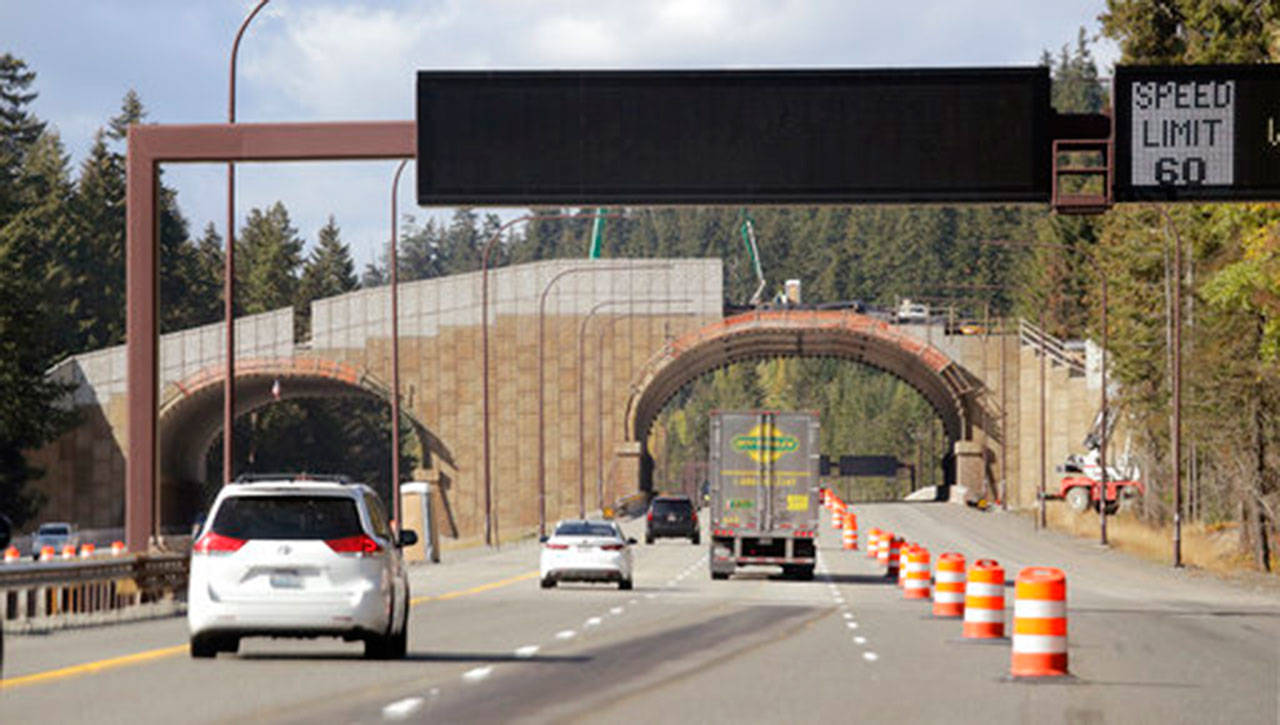
Washington state is finishing work on its largest wildlife bridge. The 35-foot-tall, 66-foot-wide structure emerges from the forest and forms two arches above the highway, one for each direction of traffic.
Fencing and landscaping will be installed to guide animals across the bridge, and 8-foot walls will block car noise.
At least one animal has already used it.
The state Department of Transportation tweeted last week that a wildlife camera captured video of a coyote scampering over I-90 on the new structure.
“Excited to see what other species cross!” the agency wrote.
Scientists pinpointed the area as part of a natural migration route from the Cascades to Keechelus Lake, about 60 miles east of Seattle, said Meagan Lott, spokeswoman for the project.
Animals, especially elk, move to the lower lands as the seasons change and the mountains get colder and snowier.
“Providing habitat reconnection will prevent some of the wildlife from accessing I-90 and keep drivers safe,” she said.
The I-90 bridge is part of a growing number of wildlife crossings across the U.S.
The crossings — a combination of fencing, overland bridges and underpasses — aim to keep drivers and animals away from each other as increased human population, a boom in the number of deer and development encroaching on natural habitat have meant more cars on roads and more crashes with animals.
A 2008 U.S. Transportation Department study found collisions between animals and humans have steadily increased, totaling 5 percent of all crashes nationwide and, at the time, costing about $8 billion to the economy, including everything from car repairs to emergency room visits and carcass disposal.
But Renee Callahan of the Montana-based Center for Large Landscapes Conservation said driver-animal collisions remain vastly under reported.
She pointed to a 2017 study by Virginia’s transportation agency that showed law enforcement tallies of deer-driver collisions were 8.5 times lower than the number of carcass removals.
An adjusted tally showed deer collisions ranked fourth among the 14 types of costliest collisions in Virginia, adding up to more than $500 million per year.
“This is an issue that’s perennially undermeasured, and that means it’s not ranked properly among priorities,” Callahan said.
Collisions between animals and drivers are rarely fatal to people but often deadly to wildlife.
The 2008 federal study also found 21 endangered or threatened species in the U.S. are affected by vehicle hits.
Along a stretch of Colorado’s state Highway 9, which winds through forests and mountains west of Denver, spring melt used to unveil a grim toll. The carcasses of mule deer, which winter in the area, would emerge on the roadside under melting snow, said Michelle Cowardin, a Colorado Parks and Wildlife biologist.
On average, more than 55 deer would be hit by drivers each winter.
But then a local ranch, nearby municipalities and a matching state grant raised $45 million for several crossings.
The first two years of monitoring showed the number of hits down to about eight per winter.
“We’ve had 22,000 successful movements of mule deer across seven structures. Those aren’t individual deer, but the way I like to think about it, that’s 22,000 times a deer wasn’t crossing a highway and potentially causing an accident with a motorist,” Cowardin said.
In Canada’s Banff National Park, research has found bridges, underpasses and fencing cut the area’s animal-driver collisions by 80 percent.
Another set of crossings and fencing in Wyoming built for a pronghorn migration has seen drops beyond 85 percent.
All but four of the two dozen overland wildlife bridges are in Western states, but dozens of other locations have been pinpointed as needing corridors, Callahan said.
“The No. 1 obstacle is funding,” said Watkins, whose organization has helped campaign for animal crossings.
Biologist Patty Garvey-Darda of the U.S. Forest Service has worked on the I-90 crossing from the beginning. She said the $6 million bridge will pay for itself when the highway is not fully or partially closed by animal hits.
“If you shut down Interstate 90, you shut down interstate commerce,” Garvey-Darda said.
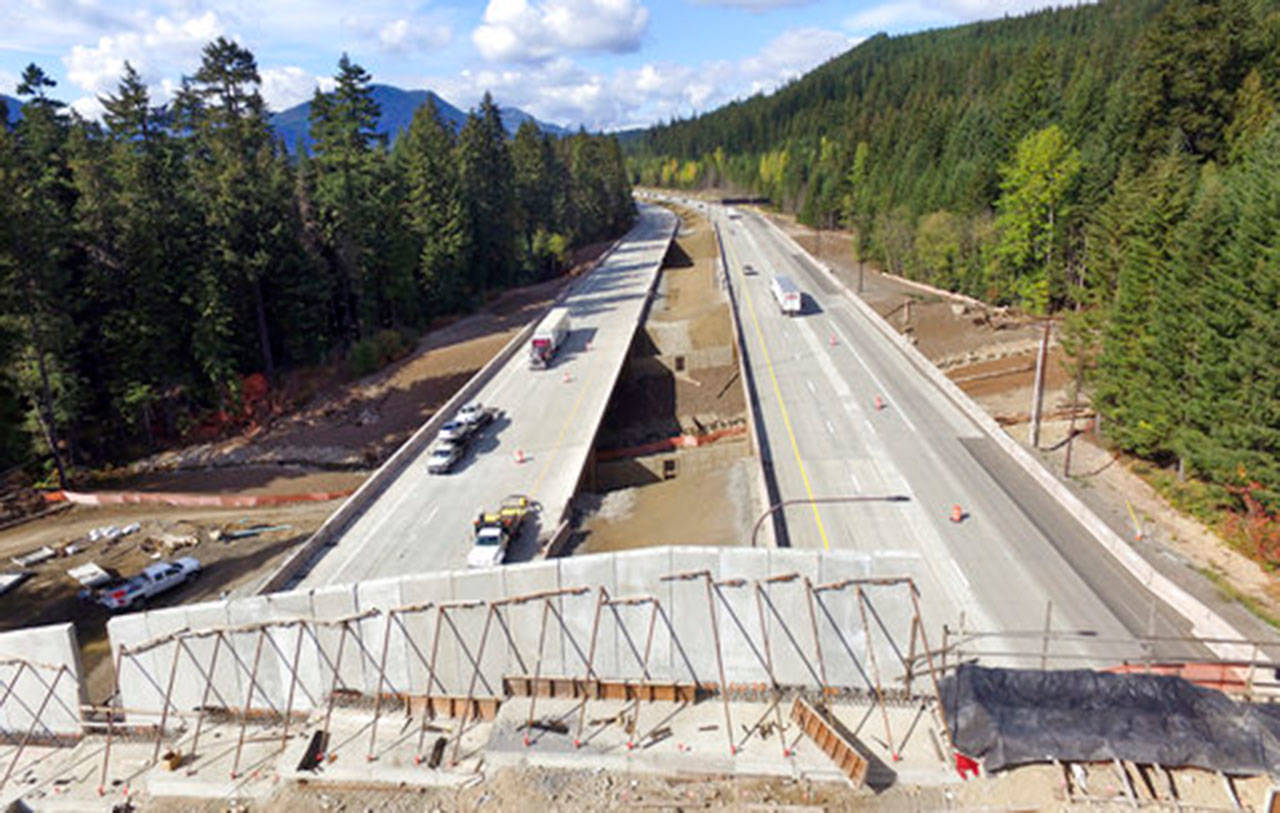
In this photo taken Oct. 4, traffic is shown passing beneath a wildlife bridge under construction in Snoqualmie Pass on Interstate 90 traffic. (Elaine Thompson/The Associated Press)
