
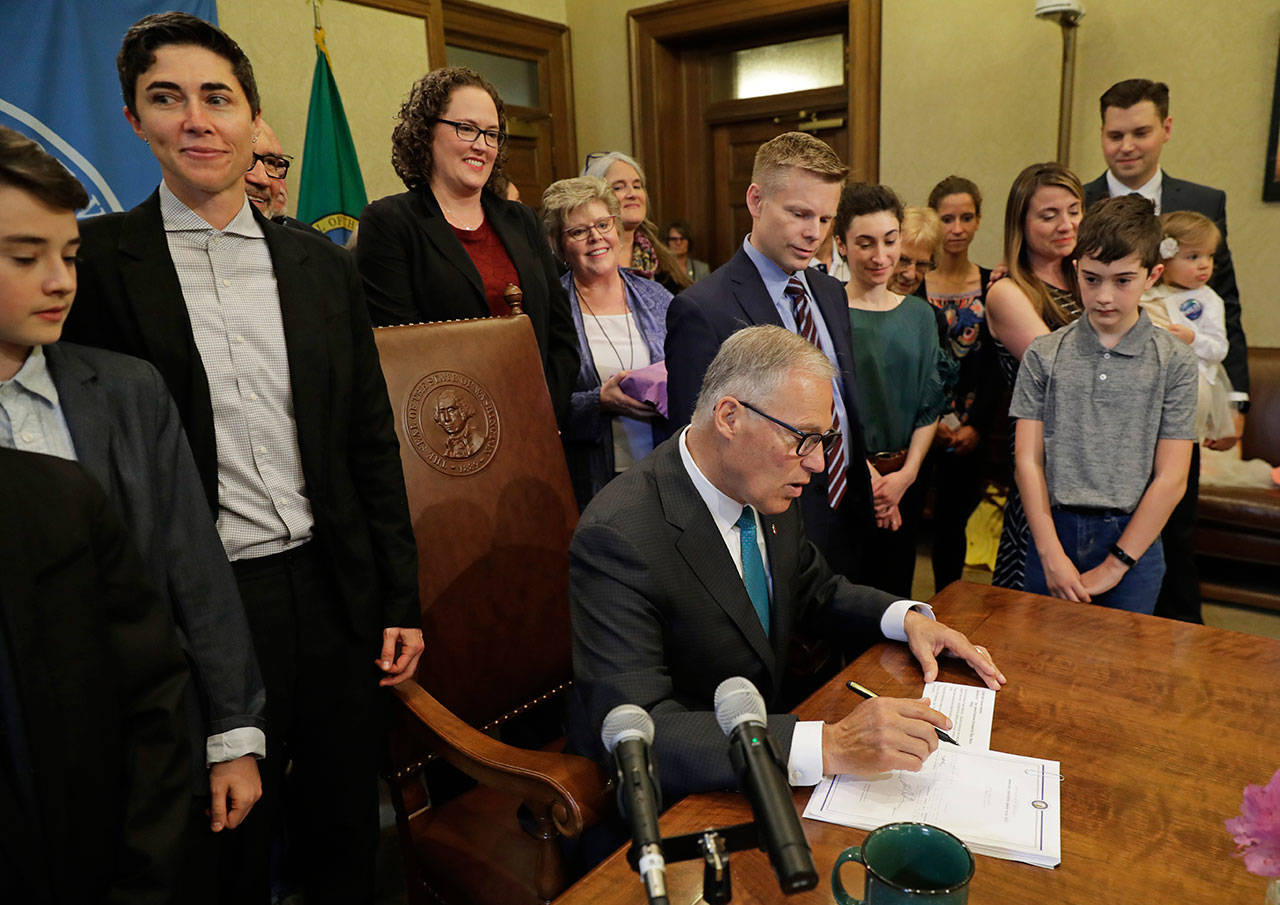
Katrina Spade, upper left, the founder and CEO of Recompose, a company that hopes to use composting as an alternative to burying or cremating human remains, looks on Tuesdayas Gov. Jay Inslee, center, signs a bill into law at the Capitol in Olympia that allows licensed facilities to offer “natural organic reduction,” which turns a body, mixed with substances such as wood chips and straw, into soil in a span of several weeks. (Ted S. Warren/The Associated Press)

Katrina Spade, upper left, the founder and CEO of Recompose, a company that hopes to use composting as an alternative to burying or cremating human remains, looks on Tuesdayas Gov. Jay Inslee, center, signs a bill into law at the Capitol in Olympia that allows licensed facilities to offer “natural organic reduction,” which turns a body, mixed with substances such as wood chips and straw, into soil in a span of several weeks. (Ted S. Warren/The Associated Press)

Washington first state to allow composting of human bodies

  • By Gene Johnson The Associated Press
  • Thursday, May 23, 2019 1:30am
  • News

By Gene Johnson

The Associated Press

SEATTLE — Gov. Jay Inslee has signed legislation making Washington the first state to approve composting as an alternative to burying or cremating human remains.

The measure signed Tuesday allows licensed facilities to offer “natural organic reduction,” which turns a body, mixed with substances such as wood chips and straw, into about two wheelbarrows’ worth of soil in a span of several weeks.

Loved ones are allowed to keep the soil to spread, just as they might spread the ashes of someone who has been cremated — or even use it to plant vegetables or a tree.

“It gives meaning and use to what happens to our bodies after death,” said Nora Menkin, executive director of the Seattle-based People’s Memorial Association, which helps people plan for funerals.

Supporters have said the method is an environmentally friendly alternative to cremation, which releases carbon dioxide and particulates into the air, and conventional burial, in which people are drained of their blood, pumped full of formaldehyde and other chemicals that can pollute groundwater, and placed in a nearly indestructible coffin, taking up land.

“That’s a serious weight on the earth and the environment as your final farewell,” said Sen. Jamie Pedersen, the Seattle Democrat who sponsored the measure.

He said the legislation was inspired by his neighbor: Katrina Spade, who was an architecture graduate student at the University of Massachusetts, Amherst, when she began researching the funeral industry. She came up with the idea for human composting, modeling it on a practice farmers have long used to dispose of livestock.

She tweaked the process and found that wood chips, alfalfa and straw created a mixture of nitrogen and carbon that accelerates natural decomposition when a body is placed in a temperature- and moisture-controlled vessel and rotated.

A pilot project at Washington State University tested the idea last year on six bodies, all donors who Spade said wanted to be part of the study.

In 2017, Spade founded Recompose, a company working to bring the concept to the public. It’s working on raising nearly $7 million to establish a facility in Seattle and begin to expand elsewhere, she said.

State law previously dictated that remains be disposed of by burial or cremation. The law, which takes effect in May 2020, added composting as well as alkaline hydrolysis, a process already legal in 19 other states.

The latter uses heat, pressure, water and chemicals like lye to reduce remains.

Cemeteries across the country are allowed to offer natural or “green” burials, by which people are buried in biodegradable shrouds or caskets without being embalmed. Composting could be a good option in cities where cemetery land is scarce, Pedersen said. Spade described it as “the urban equivalent to natural burial.”

The state senator said he has received angry emails from people who object to the idea, calling it undignified or disgusting.

“The image they have is that you’re going to toss Uncle Henry out in the backyard and cover him with food scraps,” Pedersen said.

To the contrary, he said, the process will be respectful.

Recompose’s website envisions an atrium-like space where bodies are composted in compartments stacked in a honeycomb design. Families will be able to visit, providing an emotional connection typically missing at crematoriums, the company said.

“It’s an interesting concept,” said Edward Bixby, president of the Placerville, Calif.-based Green Burial Council. “I’m curious to see how well it’s received.”

More in News

Hill Street reopens after landslide

Hill Street in Port Angeles has been reopened to… Continue reading

Tom Malone of Port Townsend, seeks the warmth of a towel and a shirt as he leaves the 46-degree waters of the Salish Sea on Saturday after he took a cold plunge to celebrate the winter solstice. “You can’t feel the same after doing this as you did before,” Malone said. (Steve Mullensky/for Peninsula Daily News)
Solstice plunge

Tom Malone of Port Townsend, seeks the warmth of a towel and… Continue reading

Tribe, Commerce sign new agreement

Deal to streamline grant process, official says

Jefferson Healthcare to acquire clinic

Partnership likely to increase service capacity

Joe McDonald, from Fort Worth, Texas, purchases a bag of Brussels sprouts from Red Dog Farm on Saturday, the last day of the Port Townsend Farmers Market in Uptown Port Townsend. The market will resume operations on the first Saturday in April 2026. (Steve Mullensky/for Peninsula Daily News)
End of season

Joe McDonald of Fort Worth, Texas, purchases a bag of Brussels sprouts… Continue reading

Clallam requests new court contracts

Sequim, PA to explore six-month agreements

Joshua and Cindy Sylvester’s brood includes five biological sons, two of whom are grown, a teen girl who needed a home, a 9-year-old whom they adopted through the Indian Child Welfare Act, and two younger children who came to them through kinship foster care. The couple asked that the teen girl and three younger children not be fully named. Shown from left to right are Azuriah Sylvester, Zishe Sylvester, Taylor S., “H” Sylvester, Joshua Sylvester (holding family dog Queso), “R,” Cindy Sylvester, Phin Sylvester, and “O.” (Cindy Sylvester)
Olympic Angels staff, volunteers provide help for foster families

Organization supports community through Love Box, Dare to Dream programs

Sequim City Council member Vicki Lowe participates in her last meeting on Dec. 8 after choosing not to run for a second term. (Barbara Hanna/City of Sequim)
Lowe honored for Sequim City Council service

Elected officials recall her inspiration, confidence

No flight operations scheduled this week

There will be no field carrier landing practice operations for… Continue reading

Art Director Aviela Maynard quality checks a mushroom glow puzzle. (Beckett Pintair)
Port Townsend puzzle-maker produces wide range

Christmas, art-history and niche puzzles all made from wood

Food programs updating services

Report: Peninsula sees need more than those statewide