
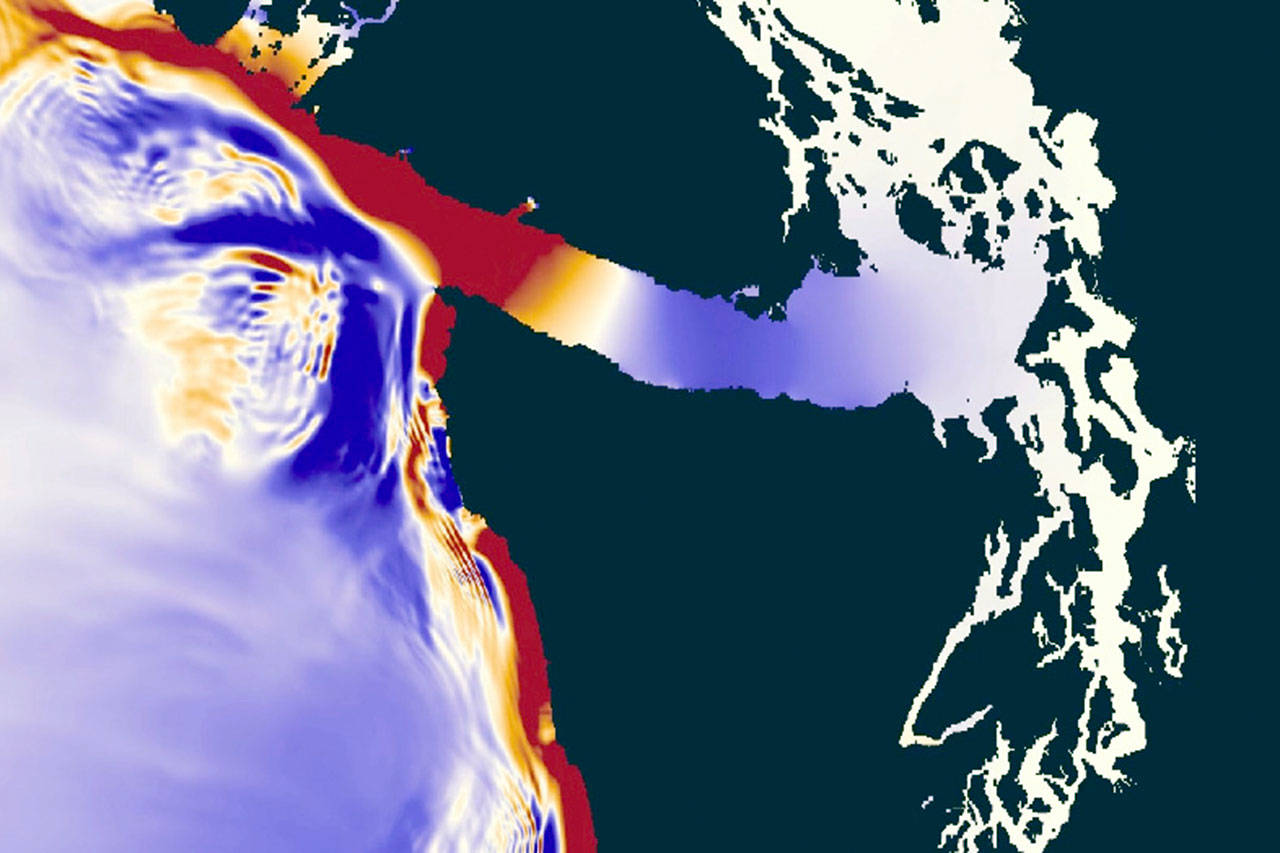
PORT ANGELES — When a catastrophic magnitude 9.0 earthquake strikes the Cascadia Subduction Zone, those on Washington’s coast will have only minutes to find higher ground, according to new simulations released by the state this week.
Scientists used detailed tsunami models to simulate the height and speed of waves that are expected to reach Washington state communities minutes after the earthquake.
The simulation shows waves greater than 10 feet crashing against the Olympic Peninsula’s coast about 15 minutes after the earthquake strikes off the coast. The tsunami then will pass through the Strait of Juan de Fuca, projected to hit Port Angeles about 50 minutes after the earthquake and to strike Port Townsend within 90 minutes.
Local officials said the simulation makes clear that residents on the North Olympic Peninsula need to be aware that waves of 10 feet or higher will continue to crash against coastlines for several hours after the quake.
“We know tsunamis will hit our state. It’s a question of when, not if, which means we need to prepare now,” Commissioner of Public Lands Hilary Franz said in a statement.
“Our hope is that these stark videos drive home the need for communities to take action to become more secure and resilient.”
According to the Department of Natural Resources, the last magnitude 9.0 Cascadia Subduction Zone earthquake struck in 1700 and produced a tsunami that left sand deposits and drowned forests.
The geologic records shows that the 600-mile Cascadia Subduction Zone — the offshore area where the Juan de Fuca tectonic plate pushes under the larger North American plate — produces megathrust quakes every 300 to 600 years.
Clallam County Undersheriff Ron Cameron said that for people who are preparing for the earthquake there’s nothing surprising in the simulation, but it does make very clear that the waves will continue to impact the coast for many hours after the earthquake hits.
“It’s really an eye-opener to see the impact we’re going to see in the Strait,” he said. “People have to have a plan and escape routes. This is a very real threat.”
He said the earthquakes — such as the 6.3 magnitude earthquake that struck Thursday off Oregon’s coast — that strike in the eastern Pacific Ocean are constant reminders of the risk.
For Jefferson County Emergency Management Director Willie Bence, the most important message is that the first wave that hits won’t be the last and it may not even be the biggest.
“They will continue for several hours afterwards,” he said. “After the first wave people will want to run back and check on their belongings, but once you get to high ground it’s important to stay there.”
He said East Jefferson County is lucky that the first wave won’t strike for about 90 minutes, but that doesn’t mean people should waste any time getting to higher ground.
When an earthquake hits it will be a challenge to get resources anywhere on the Peninsula and people need to be prepared, he said. That is especially true on the coast, he said.
“[The simulation] drives home the reality of living here in Jefferson County,” Bence said. “It’s interesting and fascinating, but it’s a wake up call.”
He is urging people to make sure they have emergency supplies and to talk with their families about plans for if an earthquake strikes.
Anne Chastain, Clallam County Emergency Operations Center coordinator, said the state is actively working with all coastal counties to prepare for an earthquake and tsunami. That includes increasing the number of tsunami sirens.
“We get a lot of questions from people who can’t hear the tsunami sirens,” Chastain said. “The tsunami siren is not your warning. The warning is the shaking.”
She said that if people feel shaking, they should not wait for the sirens to go off. She said the sirens — which are louder during a real tsunami than they are during the monthly test — are primarily for tsunamis that travel from other areas.
She urged those with questions to contact their county’s emergency management department. For more information visit clallam.net, www.co.jefferson.wa.us or dnr.wa.gov.
The videos are available on the Department of Natural Resources’ YouTube channel at bit.ly/2UakcB8.
________
Reporter Jesse Major can be reached at 360-452-2345, ext. 56250, or at jmajor@peninsuladailynews.com.
