
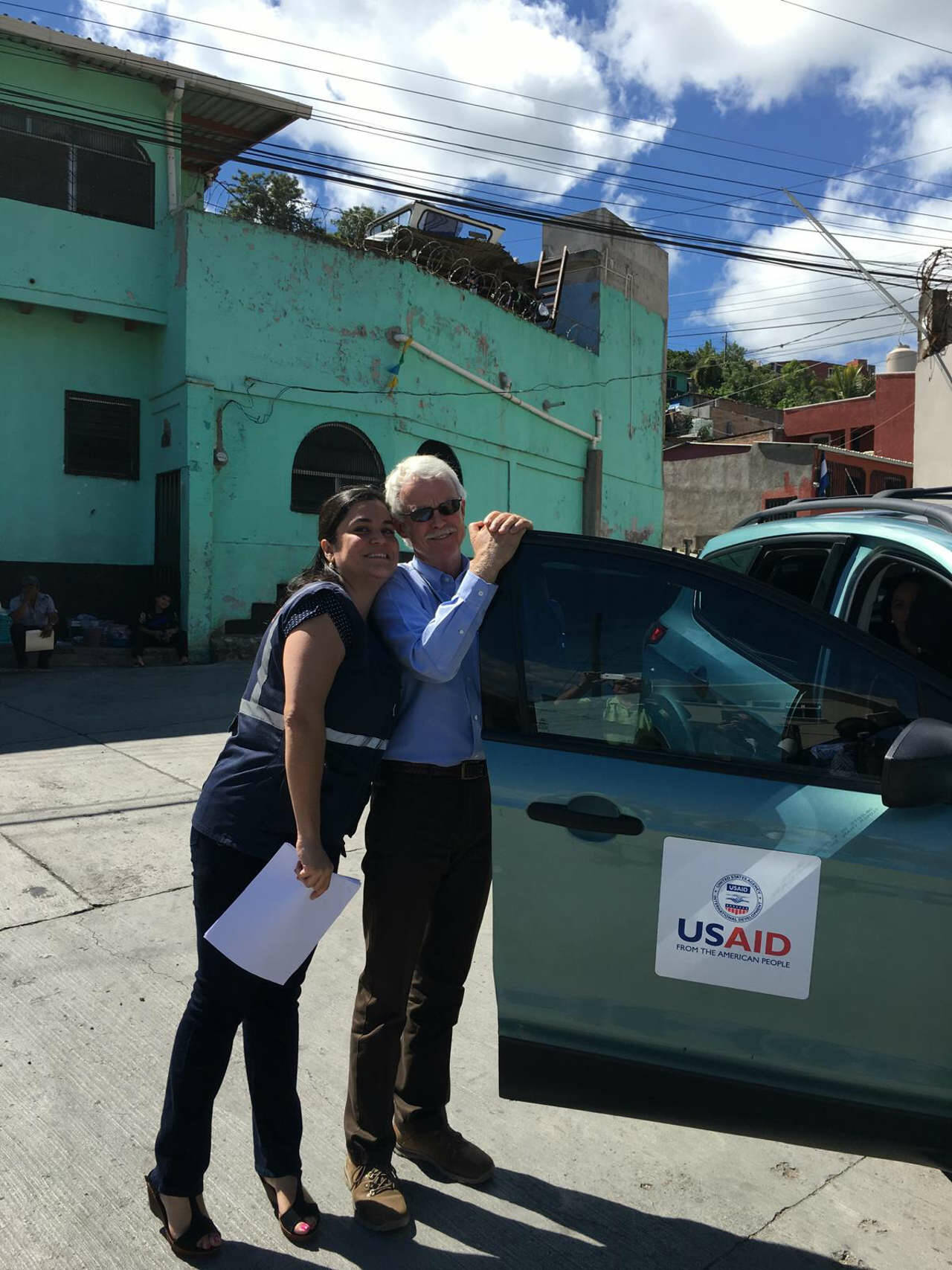
SEQUIM — Miguel Reabold was inside a Sequim bank with his wife Sandra when he checked his phone and saw he had received an email. He opened the message to find that he had been fired.
A senior transition advisor for USAID, Reabold and his colleagues at the United States Agency for International Development knew they were in the crosshairs of President Donald Trump and billionaire Elon Musk’s Department of Government Efficiency (DOGE) as they seek to reduce federal spending, but their abrupt dismissals were shocking nonetheless.
Created by President John F. Kennedy in 1961, USAID was intended to unite several foreign assistant programs under one agency. During its 64-year existence, USAID had been responsible for administering civilian foreign aid and development assistance.
While Musk and his team of people might seem like the gang that couldn’t shoot straight — with judges in some cases ordering that fired federal employees be reinstated and a federal judge ruling that DOGE likely violated the Constitution with its actions against USAID — it appears to have succeeded in putting a tag on the agency’s toe.
On March 28, the State Department formally notified Congress that it was effectively dissolving the agency and moving some of its functions under the department’s umbrella.
Reabold, who was going to retire this year, will be OK, but he worries about colleagues, some of whom are raising families and are now unemployed. As someone who devoted years to USAID, Reabold is concerned about the impacts of the agency’s dissolution, not just to the countries that received aid but also to the United States.
He said gutting USAID threatens America’s national security and its standing in the world. USAID gave America “soft power,” he said. The agency helped other communities in other countries thrive and, in doing so, cut down on America’s immigration problem and the flow of illicit drugs into the country.
Now, all of those efforts have been wiped out.
Sitting outside Hurricane Coffee Co. on a recent sunny day, Reabold detailed his concerns. He expressed that while he wants people to grasp the significance of what has happened, he did not want to sound “too political.”
“I just want to really help people to understand what a huge loss this was,” he said, adding that, contrary to popular belief, less than 1 percent of the federal budget has gone to international assistance.
“It really is a failure to understand how interwoven we are at every single level, from the family to the town to your street to your business to your state. We are all interwoven, and we all need each other.”
USAID is just one of many federal agencies and services to have been decimated or targeted for significant cuts by DOGE. On April 5, Port Angeles, Sequim and Port Townsend were among hundreds of cities across all 50 states that held “Hands Off!” demonstrations as part of a global mass-action protest against what some view as an assault on the U.S. government, the economy and Americans’ rights and freedoms.
Reabold’s belief that he has a responsibility to help those who are less fortunate dates back to Catholic school, he said.
“Just by virtue of being born in America, we won the lottery,” he said. “And I always recognized that as a young person. I didn’t do anything to earn this at all, and so I feel a responsibility to share. That’s my personal view, and that’s why I got on this career path.”
In 1976, Reabold earned a bachelor of science degree from Rutgers University’s Cook College of Animal Husbandry and went on to earn a master of science degree in International Agricultural Development from California Polytechnic State University. He spent time working for the Peace Corps in two countries and worked for non-government organizations before he joined USAID in 2007.
With USAID, Reabold spent time in Colombia and Honduras, which has been a major source of undocumented migrants to the United States.
“USAID has always been about foreign policy objectives,” he said, noting that in 2011 Honduras had the highest murder rate in the world, mostly because of gangs.
USAID’s program in Honduras focused on working with law enforcement and residents, bringing them together in a way that empowered them, which resulted in less control by gangs. Before USAID, residents and law enforcement weren’t just scared of the gangs, they were also scared of each other, Reabold said.
“They were living in absolute fear,” he said, but then they learned to trust each other and work together toward the same goals.
“The homicide rate had fallen dramatically,” Reabold said. “We had pulled in the police to be a partner in this, and they expanded that to make it a national program. If the police and the community are not linked, then the gangs (have) control.”
Improving conditions in Honduras meant fewer people felt “the desperate need to migrate,” Reabold said. “So, that’s one example of USAID supporting U.S. foreign policy.”
Societal problems often are complex, Reabold said, but people can be brought together to solve them.
“If I know you as a person, I am less likely to feel negatively about you,” he noted.
Reabold said Kennedy created USAID at the same time he created the Peace Corps.
“There was the Cold War, and there (were) a lot of people who looked at us with great suspicion and fear,” he said. “AID was an attempt to humanize us. We are people. We are your neighbors.”
Although some support DOGE’s money-saving efforts, Reabold fears they may not fully understand why the agency has been important to national security.
“When there is a time of need, we will need people to help us,” he said. “We have these linkages that we have built and nourished over decades. Decades. So, basically, that’s what AID is. It’s about relationships — our relationships with the world. And so now, by cutting it off, we have lost that. All we are now is hard power. We’ve got the most amount of guns. That is who we are. We’re the biggest economy. We can punish you.”
Over its 60-plus years, USAID created and nurtured an ecosystem of aid and humanity that created goodwill and increased the likeliness that other countries will assist us or come to our aid, Reabold said, noting as examples the 9/11 terrorist attacks and the importance of sharing information about diseases that can mutate.
“We’ve lost that,” he said. “It was so important, and it took us decades to build and nourish and billions of dollars, and it’s all gone. We are now suspicious. We have thrown so many people overboard.”
“If governments and people are better disposed towards us — our people and our country — then they are less disposed to cooperate with people who don’t have our best interest at heart,” he continued.
“We want people to like us. We want people to help us, look out for us, and we will look after them. It’s a mutual benefit society that we are busily chopping to smithereens and thinking because we are the richest country, that we don’t need anybody. We absolutely need everybody.”
Reabold can no longer bring people together through USAID. Forced into retirement earlier than he had planned, he is concentrating on volunteer efforts that help Sequim, where he has lived for the past several years. His wife arrived in Sequim first, in 2017.
But his first days of retirement have carried sadness and fear instead of pride over a career that led to meaningful and lasting change.
“God, we’ve done such damage to ourselves,” Reabold said. “It’s a self-inflicted wound. It hopefully won’t be fatal, but it’s a self-inflicted wound. We are going to be paying the price, and the price will become evident over time.”
________
Kathy Cruz is the editor of the Sequim Gazette of the Olympic Peninsula News Group, which also is composed of other Sound Publishing newspapers Peninsula Daily News and Forks Forum. She can be reached by email at kathy.cruz@sequimgazette.com.
