
By Qassum Abdul-Zahra and Zeina Karam, The Associated Press
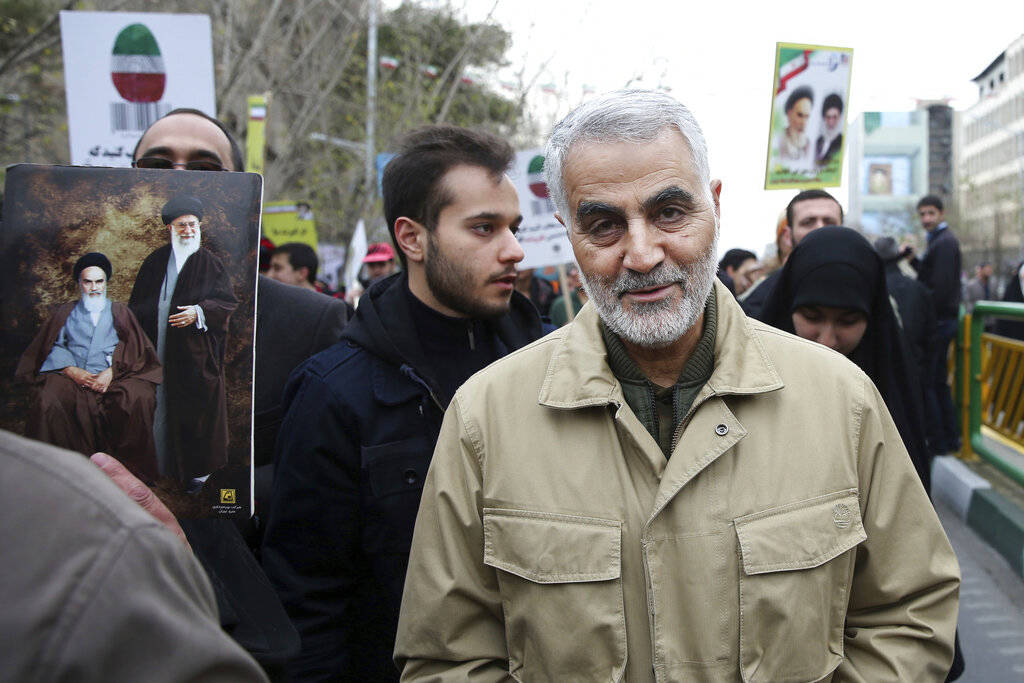
BAGHDAD — The United States killed Iran’s top general and the architect of Tehran’s proxy wars in the Middle East in an airstrike at Baghdad’s international airport early on Friday, an attack that threatens to dramatically ratchet up tensions in the region.
The targeted killing of Gen. Qassem Soleimani, the head of Iran’s elite Quds Force, could draw forceful Iranian retaliation against American interests in the region and spiral into a far larger conflict between the U.S. and Iran, endangering U.S. troops in Iraq, Syria and beyond.
The Defense Department said it killed Soleimani because he “was actively developing plans to attack American diplomats and service members in Iraq and throughout the region.” It also accused Soleimani of approving the attacks on the U.S. Embassy in Baghdad earlier this week.
Iran’s Supreme Leader Ayatollah Ali Khamenei warned that a “harsh retaliation is waiting” for the U.S.
Iranian state TV carried a statement by Khamenei also calling Soleimani “the international face of resistance.” Khamenei declared three days of public mourning for the general’s death.
Also, an adviser to Iran’s President Hassan Rouhani warned President Donald Trump of retaliation from Tehran. “Trump through his gamble has dragged the U.S. into the most dangerous situation in the region,” Hessameddin Ashena wrote on the social media app Telegram. “Whoever put his foot beyond the red line should be ready to face its consequences.”
Iranian state television later in a commentary called Trump’s order to kill Soleimani “the biggest miscalculation by the U.S.” in the years since World War II. “The people of the region will no longer allow Americans to stay,” the TV said.
The airport strike also killed Abu Mahdi al-Muhandis, deputy commander of Iran-backed militias in Iraq known as the Popular Mobilization Forces, and five others, including the PMF’s airport protocol officer, Mohammed Reda, Iraqi officials said.
Trump was vacationing on his estate in Palm Beach, Florida, but sent out a tweet of an American flag.
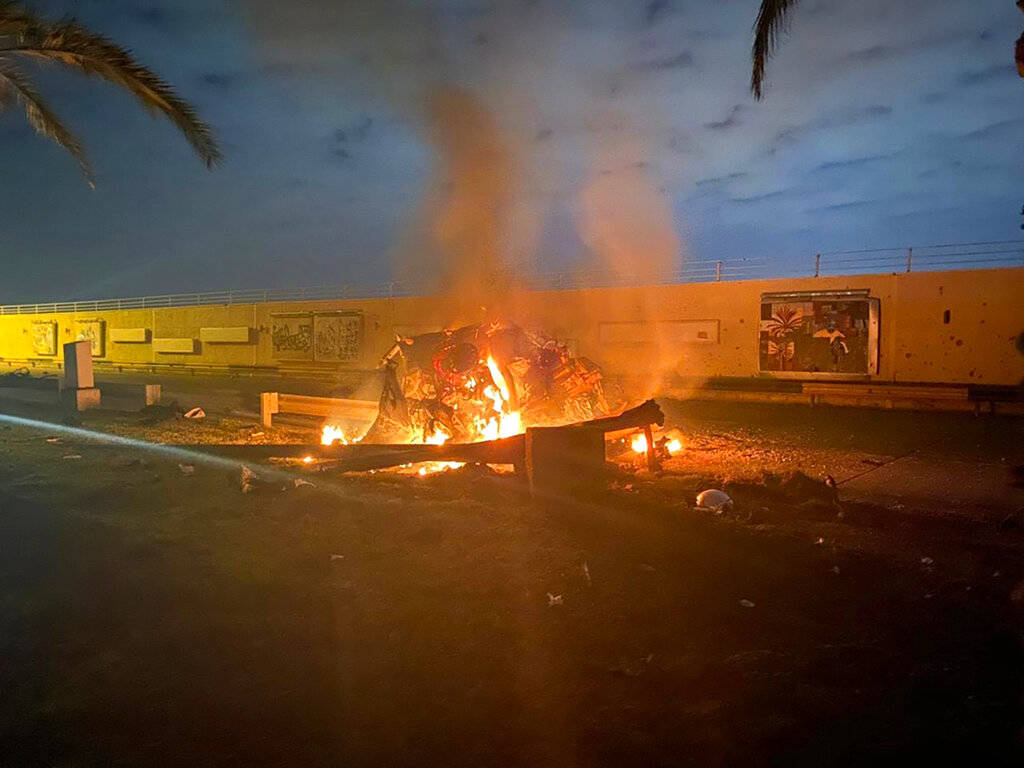
This photo released by the Iraqi Prime Minister Press Office shows a burning vehicle at the Baghdad International Airport following an airstrike in Baghdad, Iraq, early Friday, Jan. 3, 2020. The Pentagon said Thursday that the U.S. military has killed Gen. Qassem Soleimani, the head of Iran’s elite Quds Force, at the direction of President Donald Trump. (Iraqi Prime Minister Press Office via AP)
The dramatic attack comes at the start of a year in which Trump faces both a Senate trial following his impeachment by the U.S. House and a re-election campaign. It marks a potential turning point in the Middle East and represents a drastic change for American policy toward Iran after months of tensions.
Tehran shot down a U.S. military surveillance drone and seized oil tankers. The U.S. also blames Iran for a series of attacks targeting tankers, as well as a September assault on Saudi Arabia’s oil industry that temporarily halved its production.
The tensions take root in Trump’s decision in May 2018 to withdraw the U.S. from Iran’s nuclear deal with world powers, struck under his predecessor, Barack Obama.
The 62-year-old Soleimani was the target of Friday’s U.S. attack, which was conducted by an armed American drone, according to a U.S. official. His vehicle was struck on an access road near the Baghdad airport.
A senior Iraqi security official said the airstrike took place near the cargo area after Soleimani left his plane and joined al-Muhandis and others in a car. The official said the plane had arrived from either Lebanon or Syria.
Two officials from the PMF said Suleimani’s body was torn to pieces in the attack, while they did not find the body of al-Muhandis. A senior politician said Soleimani’s body was identified by the ring he wore.
The officials spoke on condition of anonymity because they were not authorized to give official statements.
It’s unclear what legal authority the U.S. relied on to carry out the attack. American presidents claim broad authority to act without the approval of the Congress when U.S. personnel or interests are facing an imminent threat. The Pentagon did not provide evidence to back up its assertion that Soleimani was planning new attacks against Americans.
Democratic Connecticut Sen. Richard Blumenthal said Trump owes a full explanation to Congress and the American people. “The present authorizations for use of military force in no way cover starting a possible new war. This step could bring the most consequential military confrontation in decades,” Blumenthal said.
But Trump allies were quick to praise the action. “To the Iranian government: if you want more, you will get more,” tweeted South Carolina Sen. Lindsey Graham.
For Iran, the killing represents more than just the loss of a battlefield commander, but also a cultural icon who represented national pride and resilience while facing U.S. sanctions. While careful to avoid involving himself in politics, Soleimani’s profile rose sharply as U.S. and Israeli officials blamed him for Iranian proxy attacks abroad.
While Iran’s conventional military has suffered under 40 years of American sanctions, the Guard has built up a ballistic missile program. It also can strike asymmetrically in the region through forces like Lebanon’s Hezbollah and Yemen’s Houthi rebels. The U.S. long has blamed Iran for car bombings and kidnappings it never claimed.
As the head of the Quds, or Jersualem, Force of Iran’s paramilitary Revolutionary Guard, Soleimani led all of its expeditionary forces and frequently shuttled between Iraq, Lebanon and Syria. Quds Force members have deployed into Syria’s long war to support President Bashar Assad, as well as into Iraq in the wake of the 2003 U.S. invasion that toppled dictator Saddam Hussein, a longtime foe of Tehran.
Soleimani rose to prominence by advising forces fighting the Islamic State group in Iraq and in Syria on behalf of the embattled Assad.
U.S. officials say the Guard under Soleimani taught Iraqi militants how to manufacture and use especially deadly roadside bombs against U.S. troops after the invasion of Iraq. Iran has denied that. Soleimani himself remains popular among many Iranians, who see him as a selfless hero fighting Iran’s enemies abroad.
Soleimani had been rumored dead several times, including in a 2006 airplane crash that killed other military officials in northwestern Iran and following a 2012 bombing in Damascus that killed top aides of Assad. Rumors circulated in November 2015 that Soleimani was killed or seriously wounded leading forces loyal to Assad as they fought around Syria’s Aleppo.
Soleimani’s killing follows the New Year’s Eve attack by Iran-backed militias on the U.S. Embassy in Baghdad. The two-day embassy attack, which ended Wednesday, prompted Trump to order about 750 U.S. soldiers deployed to the Middle East.
It also prompted Secretary of State Mike Pompeo to postpone his trip to Ukraine and four other countries “to continue monitoring the ongoing situation in Iraq and ensure the safety and security of Americans in the Middle East,” State Department spokeswoman Morgan Ortagus said Wednesday.
The breach at the embassy followed U.S. airstrikes Sunday that killed 25 fighters of the Iran-backed militia in Iraq, the Kataeb Hezbollah. The U.S. military said the strikes were in retaliation for last week’s killing of an American contractor in a rocket attack on an Iraqi military base that the U.S. blamed on the militia.
U.S. officials have suggested they were prepared to engage in further retaliatory attacks in Iraq.
“The game has changed,” Defense Secretary Mark Esper said Thursday, telling reporters that violent acts by Iran-backed Shiite militias in Iraq — including the Dec. 27 rocket attack that killed one American — will be met with U.S. military force.
___
Karam reported from Beirut. Associated Press writers Robert Burns and Zeke Miller in Washington, Jon Gambrell in Dubai, United Arab Emirates, Nasser Karimi in Tehran, Iran, and Bassem Mroue in Beirut contributed reporting.
