
By ELAINE KURTENBACH
and KRISTIN J. BENDER
The Associated Press
EDITOR’S NOTE — A 30-year-old woman in a boat built in Port Townsend is attempting to enter the record books and become the first woman to row alone across the Pacific Ocean.
She set out on Sunday from a port east of Tokyo headed for San Francisco, hoping to finish the 6,000-mile journey by late September.
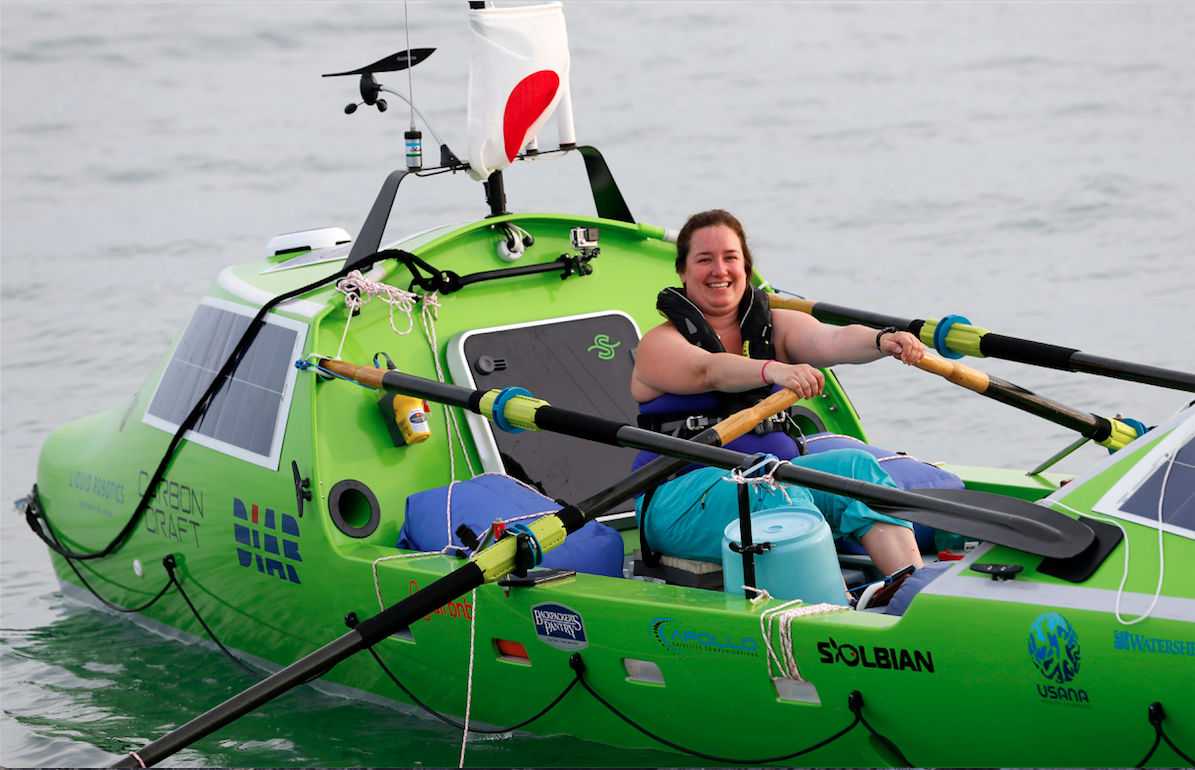
Sonya Baumstein, originally hails from Orlando, Fla., spent the past several months in Port Townsend building her boat, Icha, at SpinDrift Ocean Rowing before she left for Japan.
Her adventure can be tracked in real time at http://tinyurl.com/PDN-track. Her Facebook page is www.facebook.com/SonyaBaumstein.
See PDN’s May 22 story on her plans: “Rowing it alone on the Pacific: Adventurer in Port Townsend-built boat hopes to make record-setting journey” — https://giftsnap.shop/article/20150521/NEWS/305219986.%3C/I%3E
CHOSHI, Japan — The best part of being on the ocean for weeks at a time, says Sonya Baumstein, is the stars.
The worst? Being wet, all the time.
Baumstein waited for weeks to set out in her custom-designed rowboat built from Choshi, a port east of Tokyo, headed for San Francisco.
With a few last-minute adjustments to her supplies and a brief call to her parents, she rowed out of the marina on Sunday, a tiny sliver on the glittering horizon, hoping to finish the 6,000-mile journey by late September and become the first woman to row solo across the Pacific.
Only three other rowboats have made the journey, and no woman has ever done it alone.
Having already rowed the Atlantic to the Caribbean, the 30-year-old has a pretty clear idea of what all those weeks at sea will be like.
“It’s very cool to see wildlife, but to watch the passing of the stars, because I row all night if it’s good weather. To see the complete Milky Way,” she said.
It’s the paradox of modern-day adventuring that with new, extra-lightweight materials, solar panels and high-tech telecommunications, explorers and other extreme athletes can skate ever closer to survival’s edge, under skeins of stars most of us rarely see.
Baumstein’s rowboat, the Icha, short for an Okinawan phrase meaning “once we meet we’re family,” is a lime-green, 23-foot-long vessel that weighs less than 660 pounds. It has no motor or sail.
When the weather allows, Baumstein plans to row 14-16 hours a day, breaking her sleep to check her location — she hopes to stay within the 62-mile-wide Kuroshio current that arcs across the Pacific, at least for the first part of the journey.
Baumstein rowed competitively in high school and at the University of Wisconsin but was sidelined by a bad car accident.
After recovering, she joined three men in rowing the mid-Atlantic from the Canary Islands to Barbados in January 2012.
She has kayaked from Washington state to Alaska, stand-up paddle-boarded across the Bering Strait and bicycled 1,800 miles from the Mexican border to Seattle.
She likens the Pacific challenge to “climbing K-12 without oxygen.”
But she’s determined.
“I worked three years of my life for this,” she said Sunday. “It’s 6,000 miles. It’s going to get bad at times. I just keep my eyes on the prize.”
Andrew Cull, founder of Remote Medical International, which provides medical training and equipment to hard-to-reach places, says he believes she has the physical, emotional and mental strength to pull off the adventure despite the potentially perilous weather and conditions of the North Pacific.
“What’s gotten her across oceans and to this point is sheer drive and willpower,” said Cull, who is a sponsor and trained Baumstein for the paddleboard feat.
“I was impressed by her drive and intrigued by her extremely intense and long adventures. I remember our second call; she was on a rowing machine for 24 hours straight with a partner while Skyping sponsors to sort out logistics,” Cull said.
Baumstein is not having a boat follow her for support.
The cost would have been prohibitive, and the fuel spent contrary to the green-energy nature of her endeavor, she says. Instead she has a team providing support remotely from shore via satellite phone and GPS.
As she travels, equipment on her boat will take samples and measure water conditions to help understand climate change and other phenomena.
A weather router in the U.S. is helping her keep tabs on conditions; she expects to know at least 24 hours before she might need to tie everything down, adjust the ballast in her boat and take cover in the tiny cabin where she will eat and sleep.
But even without extreme weather, Baumstein knows to expect plenty of hardship. The worst, she says, are moonless nights when she can’t tell where the waves are coming from or when they will smash into her.
“It’s really frustrating because you have waves coming at you from every direction and you can’t anticipate by seeing them. So your oars are popping around and hitting your body. You end up getting soaked a lot and hurt more often,” she said.
Whatever the conditions, she knows she’ll be wet.
“Constantly wet. Different versions of sticky wet from salt, with no control over it,” Baumstein said. “A 60-degree splash at least 30 times a day. Sometimes the waves can knock the wind out of you. They’re so hard, they throw me out of the seat.”
Whatever the headwinds or tail winds, though, conditions are constantly changing.
“That really is what’s at play out there. Time. It either feels like it’s going incredibly slowly — those are the hard days — or it goes quickly. It changes every time you’re rowing. It changes minute to minute,” she said.
“Both fair weather times, really perfect rowing, and the feeling of survival in bad weather, those are the two things that drive me to do this stuff,” she said. “It feels like I’m living to my fullest ability.”
