
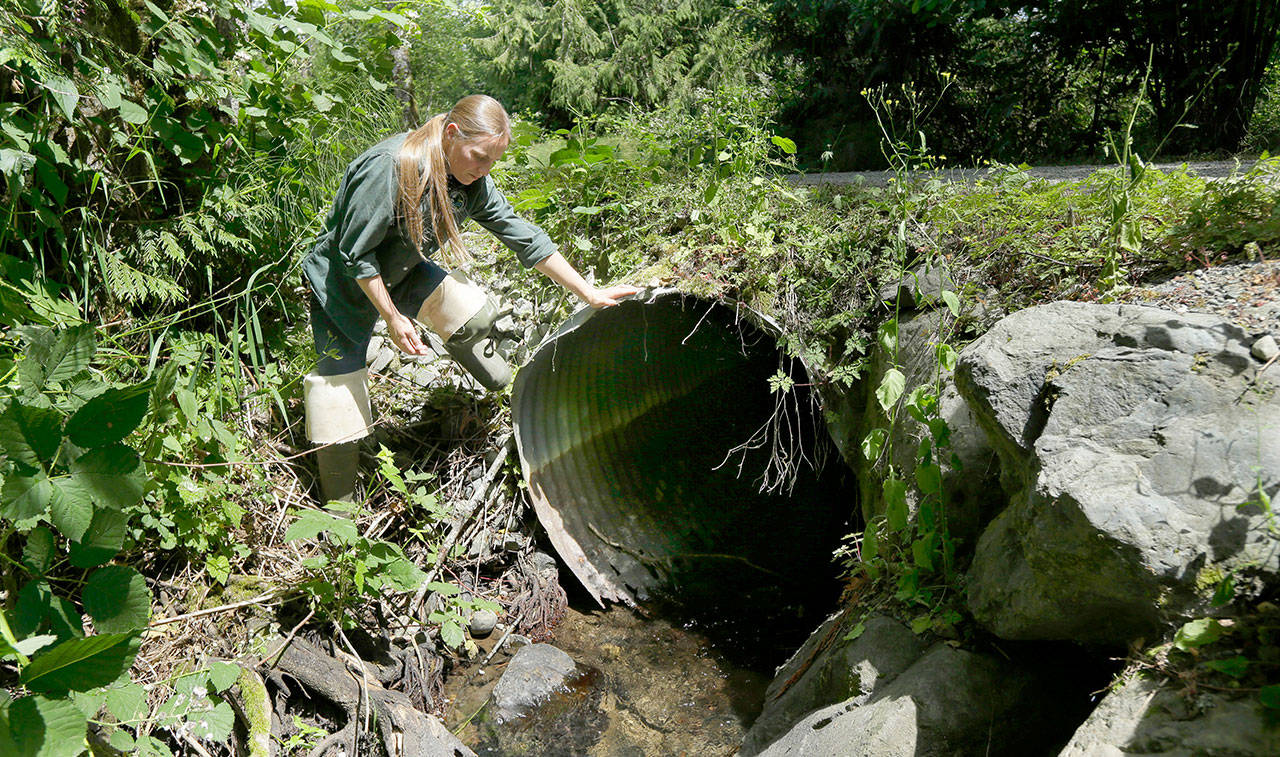
Melissa Erkel, a fish passage biologist with the Washington Department of Fish and Wildlife, looks at a culvert, a large pipe that allows streams to pass beneath roads but block migrating salmon, along the north fork of Newaukum Creek near Enumclaw. The Supreme Court is leaving in place a court order that forces Washington to restore salmon habitat by removing barriers that block fish migration. The justices divided 4-4 Monday in the long-running dispute that pits the state against Indian tribes and the federal government. (AP Photo/Ted S. Warren, file)

Melissa Erkel, a fish passage biologist with the Washington Department of Fish and Wildlife, looks at a culvert, a large pipe that allows streams to pass beneath roads but block migrating salmon, along the north fork of Newaukum Creek near Enumclaw. The Supreme Court is leaving in place a court order that forces Washington to restore salmon habitat by removing barriers that block fish migration. The justices divided 4-4 Monday in the long-running dispute that pits the state against Indian tribes and the federal government. (AP Photo/Ted S. Warren, file)

U.S. Supreme Court tie favors state culvert replacement

By Phuong Le

The Associated Press

SEATTLE — Washington state must continue restoring salmon habitat by removing barriers that block fish migration after the U.S. Supreme Court on Monday left in place a lower court order.

The justices divided 4-4 in the long-running dispute that pits the state against Northwest Native Indian tribes and the federal government. The tie serves to affirm a lower court ruling in favor of the tribes.

Justice Anthony Kennedy stepped aside from the case because he participated in an earlier stage of it when he served on the 9th U.S. Circuit Court of Appeals.

At issue is whether Washington state must pay billions of dollars to fix or replace hundreds of culverts — large pipes that allow streams to pass beneath roads but can block migrating salmon if they become clogged or if they’re too steep to navigate.

Leaders of several western Washington tribes cheered the decision Monday, calling it a victory that affirms their treaty rights while protecting salmon central to their way of life.

Jay Julius, chair of the Lummi Indian Business Council, called the decision a win for treaty rights, river rights and salmon.

“This is not just about tribes’ treaty right to fish, but also the inherent right to harvest from a plentiful, healthy supply of salmon,” he said in a statement.

Lorraine Loomis, chair of the Northwest Indian Fisheries Commission, said the decision would “open hundreds of miles of high quality salmon habitat that will produce hundreds of thousands more salmon annually for harvest by Indians and non-Indians.”

The Supreme Court in April heard the state’s appeal of a ruling by the 9th U.S. Circuit Court of Appeals. That court affirmed a lower court order in 2013 requiring the state to fix or replace hundreds of the highest-priority culverts within 17 years.

Washington has argued that its treaties with the tribes created no obligation to restore salmon habitat. It said the ruling would force it to perform work that wouldn’t benefit salmon because other barriers might completely block fish, and it would also make the state’s taxpayers responsible for fixing problems created by the federal government when it specified the design for the state’s old highway culverts.

“It is unfortunate that Washington state taxpayers will be shouldering all the responsibility for the federal government’s faulty culvert design,” state Attorney General Bob Ferguson said in a statement.

He said salmon can’t reach many state culverts because they are blocked by culverts owned by others, such as counties and the federal government.

“The Legislature has a big responsibility in front of it to ensure the state meets its obligation under the court’s ruling,” Ferguson said.

In seeking a Supreme Court review, Ferguson was at odds with other state officials, including Public Lands Commissioner Hilary Franz.

“It is time to stop fighting over who should do what,” Franz said Monday.

The U.S. government sued Washington in 2001 on behalf of the 21 tribes to force it to replace the culverts with structures that allow fish to pass through. Because the pipes block salmon from reaching their spawning grounds, they deprive the tribes of fishing rights guaranteed by treaty, the lawsuit said.

In 2013, U.S. District Judge Ricardo Martinez ordered Washington to fix or replace more than 1,000 culverts blocking access to 1,600 miles of salmon habitat.

The state transportation department has so far fixed 319 barriers, according to a 2017 report.

“It will be a big victory for fisheries,” said Bob Anderson, a law professor and director of the Native American Law Center at the University of Washington.

He said that since 1905, the court has consistently upheld the tribal position that they have a right to a fair share of the salmon, and implied rights that go along with that. “This case is a logical extension of those prior decisions.”

Fawn Sharp, president of the Quinault Nation, said the “decision marks seven generations of conflict in our struggle to fully exercise and protect the Pacific Northwest salmon resource the way our ancestors envisioned.”

State Sen. Reuven Carlyle, chairman of the Senate Energy, Environment and Technology Committee, said Monday’s ruling was “a forcing function to double down on every level to re-prioritize our approach to salmon.”

Carlyle said that while he doesn’t think the Legislature needs an immediate special session to address the ruling, work will be done ahead of the next legislative session that begins in January.
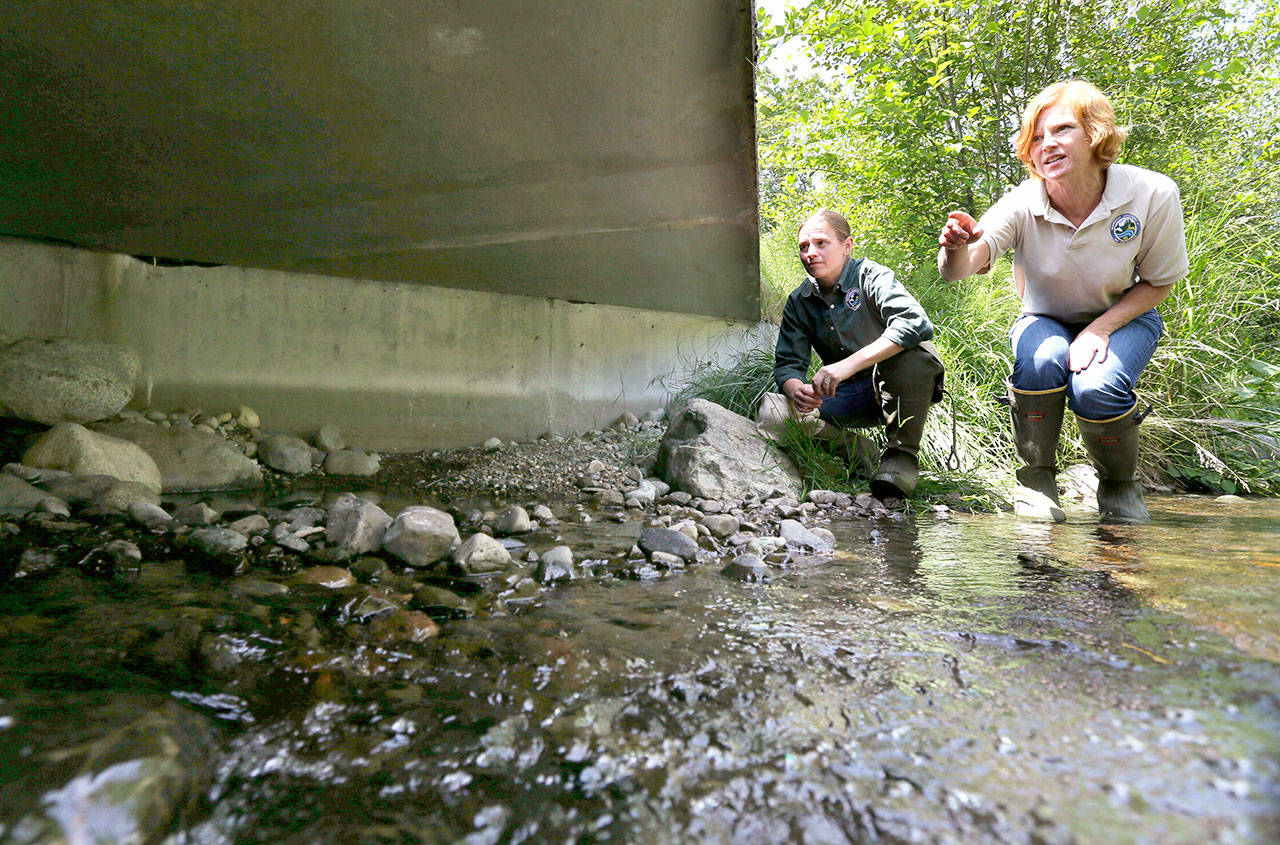
Julie Henning, right, division manager of the Washington Department of Fish and Wildlife ecosystem services division habitat program, and Melissa Erkel, left, a fish passage biologist, look at a wide passageway for the north fork of Newaukum Creek near Enumclaw. The Supreme Court is leaving in place a court order that forces Washington to restore salmon habitat by removing barriers that block fish migration. The justices divided 4-4 Monday in the long-running dispute that pits the state against Indian tribes and the federal government. (AP Photo/Ted S. Warren, file)

Julie Henning, right, division manager of the Washington Department of Fish and Wildlife ecosystem services division habitat program, and Melissa Erkel, left, a fish passage biologist, look at a wide passageway for the north fork of Newaukum Creek near Enumclaw. The Supreme Court is leaving in place a court order that forces Washington to restore salmon habitat by removing barriers that block fish migration. The justices divided 4-4 Monday in the long-running dispute that pits the state against Indian tribes and the federal government. (AP Photo/Ted S. Warren, file)

More in News

Sue Long, left, Vicki Bennett and Frank Handler, all from Port Townsend, volunteer at the Martin Luther King Day of Service beach restoration on Monday at Fort Worden State Park. The activity took place on Knapp Circle near the Point Wilson Lighthouse. Sixty-four volunteers participated in the removal of non-native beach grasses. (Steve Mullensky/for Peninsula Daily News)
Work party

Sue Long, left, Vicki Bennett and Frank Handler, all from Port Townsend,… Continue reading

Portion of bridge to be replaced

Tribe: Wooden truss at railroad park deteriorating

Kingsya Omega, left, and Ben Wilson settle into a hand-holding exercise. (Aliko Weste)
Process undermines ‘Black brute’ narrative

Port Townsend company’s second film shot in Hawaii

Jefferson PUD to replace water main in Coyle

Jefferson PUD commissioners awarded a $1.3 million construction contract… Continue reading

Scott Mauk.
Chimacum superintendent receives national award

Chimacum School District Superintendent Scott Mauk has received the National… Continue reading

Hood Canal Coordinating Council meeting canceled

The annual meeting of the Hood Canal Coordinating Council, scheduled… Continue reading

Bruce Murray, left, and Ralph Parsons hang a cloth exhibition in the rotunda of the old Clallam County Courthouse on Friday in Port Angeles. The North Olympic History Center exhibit tells the story of the post office past and present across Clallam County. The display will be open until early February, when it will be relocated to the Sequim City Hall followed by stops on the West End. The project was made possible due to a grant from the Clallam County Heritage Advisory Board. (Dave Logan/for Peninsula Daily News)
Post office past and present

Bruce Murray, left, and Ralph Parsons hang a cloth exhibition in the… Continue reading

This agave grew from the size of a baseball in the 1990s to the height of Isobel Johnston’s roof in 2020. She saw it bloom in 2023. Following her death last year, Clallam County Fire District 3 commissioners, who purchased the property on Fifth Avenue in 2015, agreed to sell it to support the building of a new Carlsborg fire station. (Matthew Nash/Olympic Peninsula News Group file)
Fire district to sell property known for its Sequim agave plant

Sale proceeds may support new Carlsborg station project

As part of Olympic Theatre Arts’ energy renovation upgrade project, new lighting has been installed, including on the Elaine and Robert Caldwell Main Stage that allows for new and improved effects. (Olympic Theatre Arts)
Olympic Theatre Arts remodels its building

New roof, LED lights, HVAC throughout

Weekly flight operations scheduled

Field carrier landing practice operations will be conducted for aircraft… Continue reading

Workers from Van Ness Construction in Port Hadlock, one holding a grade rod with a laser pointer, left, and another driving the backhoe, scrape dirt for a new sidewalk of civic improvements at Walker and Washington streets in Port Townsend on Thursday. The sidewalks will be poured in early February and extend down the hill on Washington Street and along Walker Street next to the pickle ball courts. (Steve Mullensky/for Peninsula Daily News)
Sidewalk setup

Workers from Van Ness Construction in Port Hadlock, one holding a grade… Continue reading