
LAPUSH — Concrete from a 65-foot-long dock pushed into the Pacific Ocean by a powerful tsunami in Japan and driven by currents some 4,000 miles to a remote North Olympic Peninsula beach may end up under the tires of American drivers.
Removal of the dock that lodged on a narrow, wave-lashed shore south of LaPush in December could be finished today if the weather holds, said Barb Maynes, Olympic National Park spokeswoman.
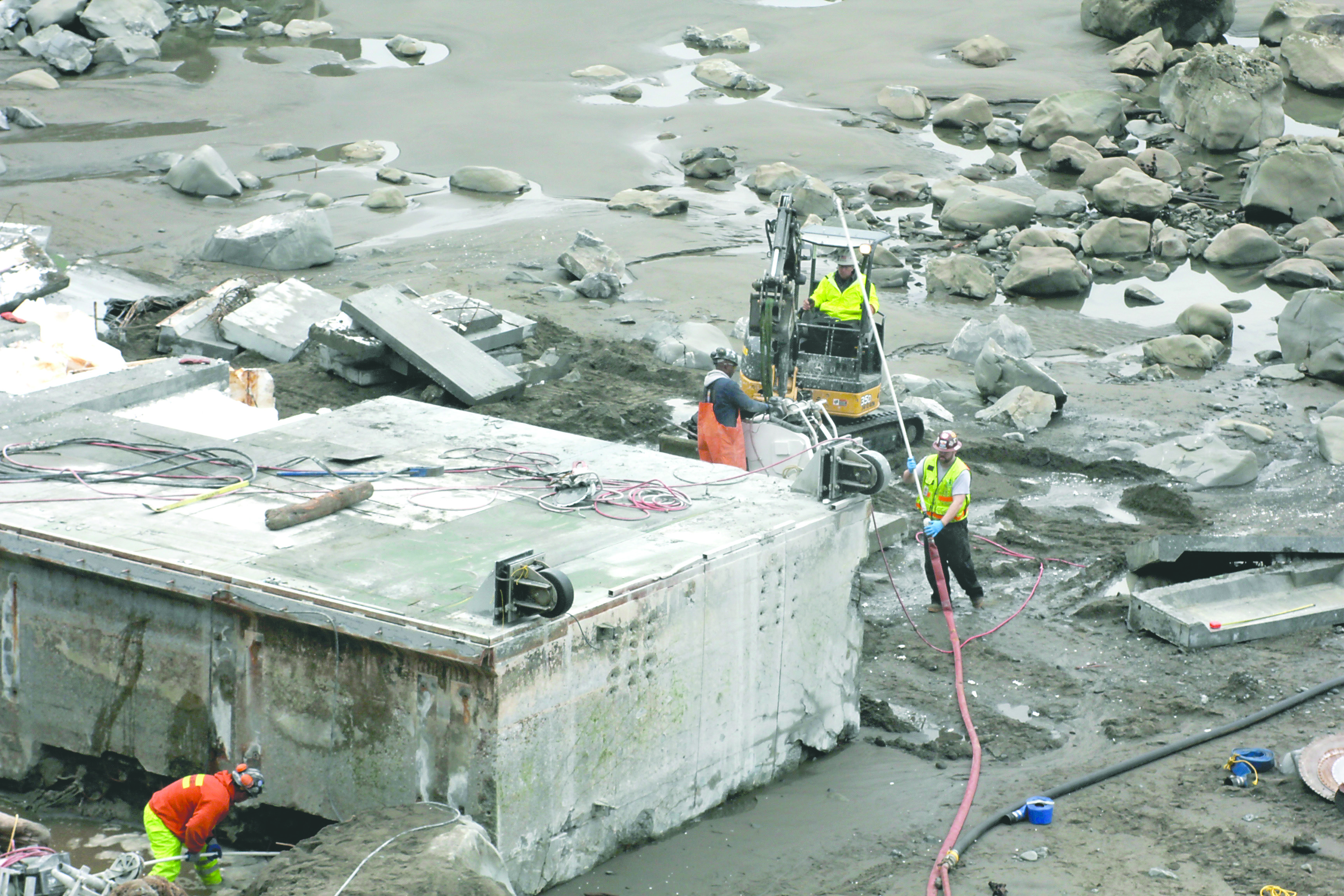
Crews with The Undersea Co., a diving and salvage service based in Port Townsend, are taking apart the 7½-foot tall structure — which is on the beach of both Olympic National Park and Olympic Coast National Marine Sanctuary — and loading the pieces on helicopters that airlift them to a nearby landing field on Rayonier property, Maynes said.
From there, the material is trucked to a waste transfer station near LaPush, she said.
But that doesn’t mean that all of it will necessarily end up as garbage.
Although it is up to the Undersea Co. owners, concrete from the 185-ton dock eventually may be ground up for road material.
“I’m not sure what contractor will end up doing with it,” Maynes said.
“Quite often, concrete is able to be recycled into road material.
“That’s what is being done with the [concrete from] the dams” as they are removed from the Elwha River, in a $325 million National Park Service project to restore fish passage.
The contractor has referred all comment to the National Oceanic and Atmospheric Administration, whose spokeswoman was not immediately available.
Undersea Co. workers have been able to work only during the lowest of tides and the best of weather to take apart the 65-foot-long structure near the mouth of Mosquito Creek.
That meant that work begun last Sunday was put on hold Wednesday because of high winds and dangerous seas, and the effort was only resumed Thursday after the weather calmed, according to state Department of Ecology officials.
If good weather holds throughout the weekend, workers expected to finish dismantling the dock today, Maynes said.
Weather conditions truncated the work window March 16, but toward the end of the day, workers managed to set up equipment and safety supplies near the dock made of plastic foam encased in concrete, Ecology officials said.
During a long day last Sunday, workers tore into the structure with concrete saws.
On Monday and Tuesday they pried the plastic foam from the concrete hull and loaded it into Helicopters Northwest aircraft.
That material will not be recycled, Maynes said.
But the steel rebar found within the dock is likely to be, she said.
The dock has to be taken apart because it has been damaged since it washed ashore and cannot be towed off the beach at high tide.
It can’t be sunk to serve as an artificial reef because of the threat the plastic foam poses to the environment.
It was cleansed of non-native species — marine plants and animals not found in the United States but native to Japan — in early January.
Workers removed more than 400 pounds of plant and animal life and washed the dock with a diluted bleach solution to prevent the spread of invasive species (some 30 to 50 species were found).
The Japanese government identified the dock through a serial number as coming from Misawa, a northern fishing port that sustained extensive damage from the March 2011 tsunami.
A dock nearly 70 feet long from Misawa washed up near Newport, Ore., last summer.
Japan is paying most of the $628,000 cost of the removal of this dock, providing $478,000, while NOAA’s Office of National Marine Sanctuaries and the National Park Service are paying $75,000 each.
The park has closed the coastal area between Goodman Creek and Jefferson Cove to the public.
________
Managing Editor/News Leah Leach can be reached at 360-417-3531 or at leah.leach@peninsuladailynews.com.
Reporters Arwyn Rice and Jeremy Schwartz contributed to this report.
