
BY Roger Oakes
WE ARE FORTUNATE on the North Olympic Peninsula to have spectacular rivers flowing through a rich habitat.
While all have been impacted (“disturbed”) to some degree by human activity, there is growing awareness that we have wonderful opportunities to preserve and restore them and the lands which surround them.
None of the various strategies, one might think, would apply to all rivers nor be without controversy.
Whether removing dams on the Elwha or making decisions regarding conservation and use of the waters of the Dungeness, consideration needs to be given to fish, wildlife, habitat, economics and development, tribal concerns and recreational activities.
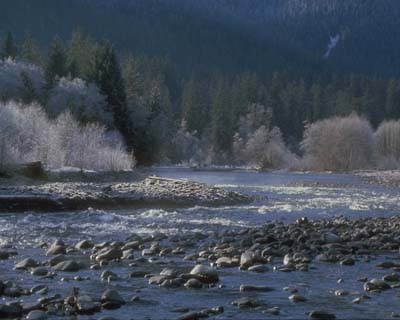
One unique approach to restoration has been employed along the Hoh River in West Jefferson County.
Through initial philanthropy organized by Western Rivers Conservancy and the Wild Salmon Center working with Rayonier Inc., lands were purchased starting in 2004 and creating a significant corridor along the Hoh.
The nonprofit Hoh River Trust was created to manage the lands.
Although quite controversial at its inception, by balancing restoration efforts with economic activities as well as recreational access to the lands and river, there has been wide acceptance in the local community.
The Hoh River has been called “a last great American river.”
It is home to one of the healthiest native salmon and steelhead runs in the continental U.S., and famous for its huge trees and rain forests.
It remains untouched by dams, major river diversions or significant hatchery influence.
The Hoh River is one of the larger river systems on the Peninsula, with headwaters on Mount Olympus, then coursing almost 60 miles to the Pacific Ocean.
The first 30 miles and the mouth are protected within Olympic National Park.
And now the 26 miles outside the park are largely protected with conservation easements on state, federal and private lands as well as almost 7,000 acres owned by the Hoh River Trust.
The mission of the Hoh River Trust is to preserve and enhance lands forming a corridor along the river while maintaining public access for fishing, hunting, hiking and boating.
By using established principles of restoration ecology on these previously logged lands, the goal is to accelerate the development of late-stage seral forests that can provide habitat for endangered and threatened species, such as the northern spotted owl, marbled murrelet, bald eagle and bull trout.
Improvements to the many tributaries of the Hoh are enhancing the native fishery as well.
This work involves removing invasive weed species as well as pre-commercial thinning, tree planting, culvert removal, bridge building and stream rehabilitation.
Also, within its approved land management plan, the trust has just completed a small commercial thinning and has more planned.
The trust has many collaborative partners, including the U.S. Fish and Wildlife Service, the state Department of Natural Resources, the Hoh tribe, the Pacific Coast Salmon Coalition and the Jefferson Land Trust.
Most of its projects are done in collaboration with these entities.
The trust lands are managed under a conservation easement through the state DNR and monitored by the Jefferson Land Trust.
So what about the economics of all this?
About $12 million have gone into purchasing the lands, most having been previously logged.
Monies have come from private donations as well as governmental funding mainly through the Endangered Species Act.
An additional $2.5 million has come through various grants and spent on restoration projects.
One project readily visible to the public is restoration of Pole Creek, including a new bridge on the road to the Hoh Rain Forest.
This was done with several partners, particularly the Pacific Coast Salmon Coalition.
All of these projects have been done with local contractors and workers.
And what of the future?
The trust has just completed a strategic planning retreat.
There may be a few more land purchases to enhance current properties.
The goal is to reach a stage of structural and functional forest that reliably presages natural old growth.
At that point, with a forest at about 70 years of age, adaptive management comes into play, and the trust will shift its mission more to educational and recreational opportunities.
________
This is a Peninsula Daily News “Point of View” guest opinion column. Roger Oakes, a retired Port Angeles physician, is a board member of the Hoh River Trust.
For more information, and to subscribe to the trust’s email newsletter, go to the group’s website, www.hohrivertrust.org.
