
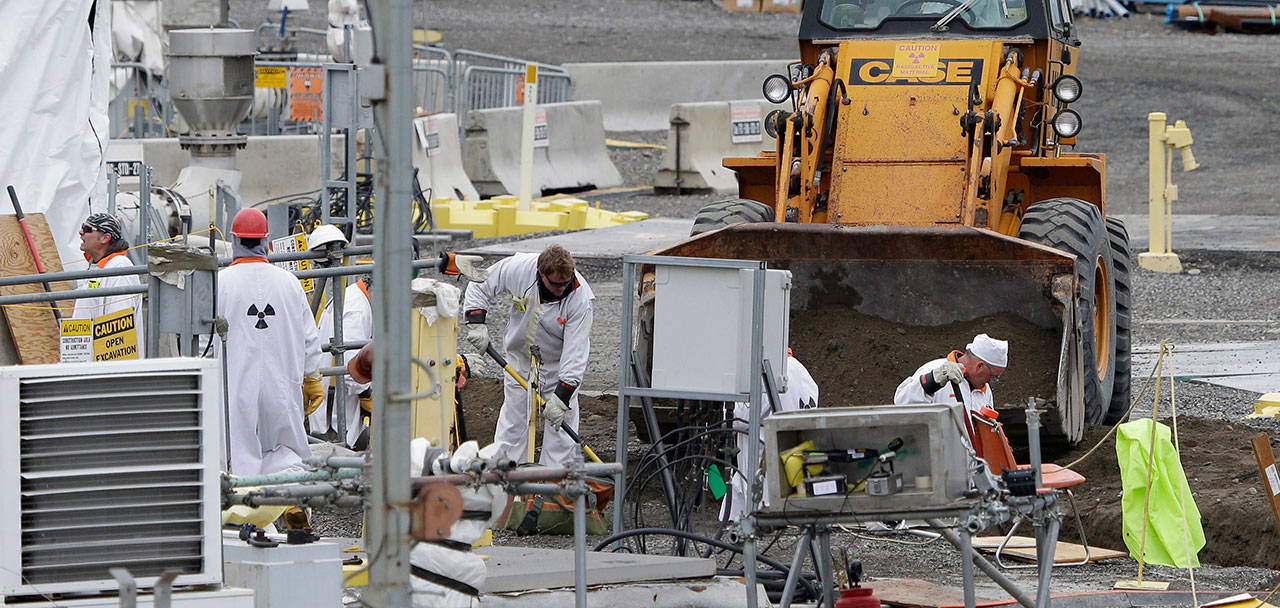
In this March 6, 2013 file photo, workers are shown at the ‘C’ Tank Farm at the Hanford Nuclear Reservation, near Richland. (Ted S. Warren/The Associated Press)

In this March 6, 2013 file photo, workers are shown at the ‘C’ Tank Farm at the Hanford Nuclear Reservation, near Richland. (Ted S. Warren/The Associated Press)

Trump plan to reclassify nuke waste alarms environmentalists

  • By NICHOLAS K. GERANIOS Associated Press
  • Tuesday, December 11, 2018 2:14pm
  • News

By Nicholas K. Geranios

The Associated Press

SPOKANE — The Trump administration wants to reclassify some radioactive waste left from the production of nuclear weapons to lower its threat level and make disposal cheaper and easier.

The proposal by the U.S. Department of Energy would lower the status of some high-level radioactive waste in several places around the nation, including the Hanford Nuclear Reservation in Washington state — the most contaminated nuclear site in the country.

Reclassifying the material to low-level could save the agency billions of dollars and decades of work by essentially leaving the material in the ground, critics said.

The proposal joins a long list of Trump administration efforts to loosen environmental protections.

Just last week, the Environmental Protection Agency acted to ease rules on the sagging U.S. coal industry.

Tom Carpenter of Hanford Challenge, a nuclear watchdog group, said it wants a thorough cleanup of the Washington state nuclear site, which is half the size of Rhode Island.

That includes building a national repository somewhere else to bury the waste once it has been stabilized.

“The cleanup of the site is really at stake,” Carpenter said about the proposed change. He noted that Hanford is in an environmentally sensitive site adjacent to the Columbia River and susceptible to earthquakes, volcanoes and flooding.

Hanford was established by the Manhattan Project in World War II to make plutonium, a key ingredient in the atomic bomb dropped on Nagasaki, Japan.

The plant went on to produce most of the plutonium for the nation’s nuclear arsenal.

As a result, the site also contains the nation’s largest collection of nuclear waste.

The most dangerous is stored in 177 aging underground tanks, some of which have leaked.

The tanks hold some 56 million gallons of radioactive and hazardous chemical wastes waiting to be treated for permanent disposal.

Cleanup efforts at Hanford have been underway since the late 1980s and cost about $2 billion a year.

Current law defines high-level radioactive waste as resulting from processing irradiated nuclear fuel that is highly radioactive.

The Energy Department wants to reclassify some of the waste that meets highly technical conditions.

The agency said the change could save the federal government $40 billion in cleanup costs across the nation’s entire nuclear weapons complex, which includes the Savannah River Plant in South Carolina and Idaho National Laboratory.

Environmental groups and the state of Washington, which has a legal commitment with the Energy Department to oversee the Hanford cleanup, said the proposal is a concern.

“They see it as a way to get cleanup done faster and less expensively,’” said Alex Smith of the Washington state Department of Ecology.

Carpenter said there “is not much point in doing much else if they don’t clean up the high-level waste.”

At the request of U.S. Sen. Ron Wyden, an Oregon Democrat, the agency extended the public comment period on the proposal to Jan. 9. The agency can make the change without the approval of Congress.

“No one disputes the difficulty of retrieving and treating high-level waste from Hanford’s aging storage tanks,” Wyden wrote to the DOE.

“However, lowering the bar for level of protection of future generations and the environment by changing the definition of what has always been considered high-level waste requiring permanent disposal is a significant change.”
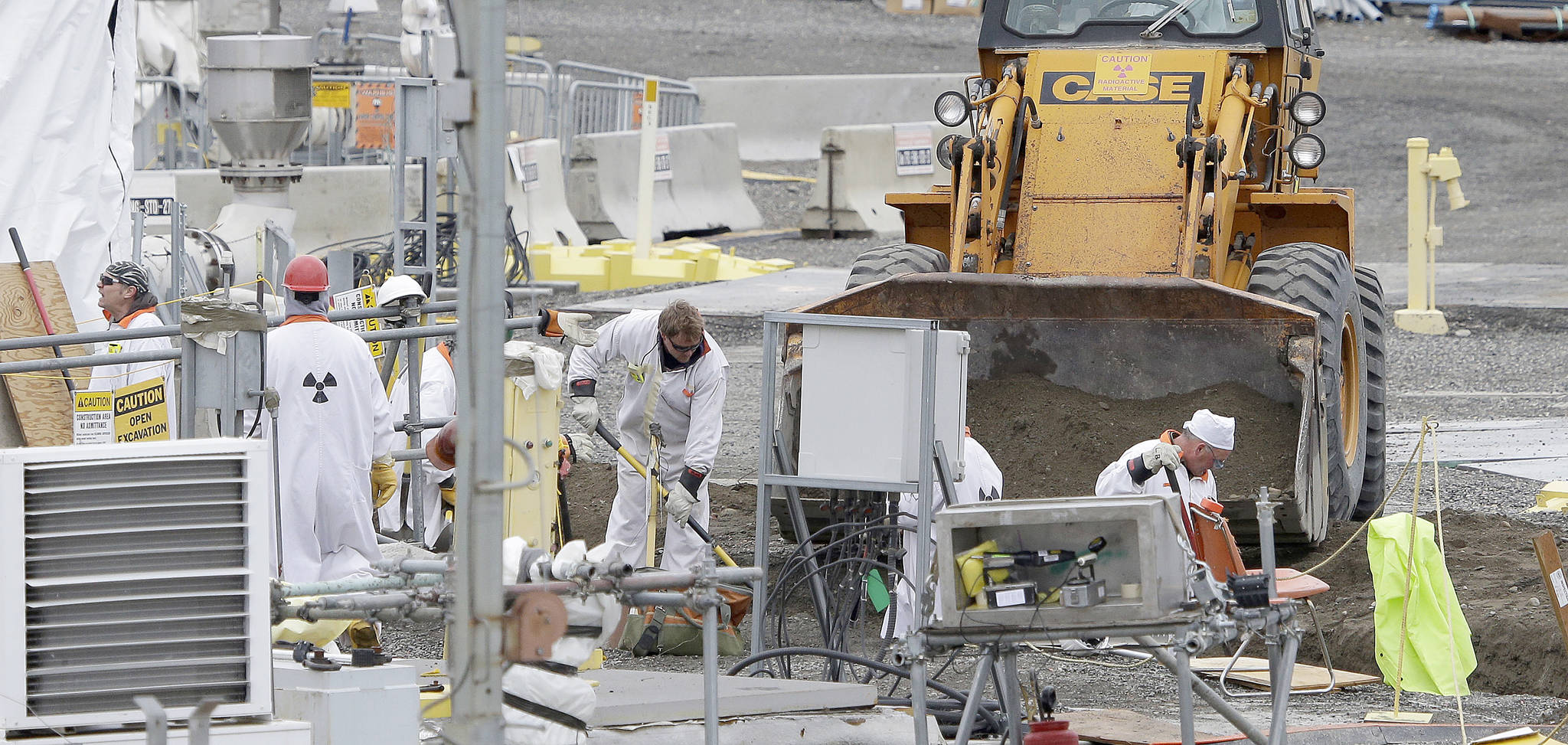
<strong>Ted S. Warren</strong>/The Associated Press                                In this March 6, 2013 file photo, workers are shown at the ‘C’ Tank Farm at the Hanford Nuclear Reservation, near Richland.

Ted S. Warren/The Associated Press In this March 6, 2013 file photo, workers are shown at the ‘C’ Tank Farm at the Hanford Nuclear Reservation, near Richland.

More in News

Sue Long, left, Vicki Bennett and Frank Handler, all from Port Townsend, volunteer at the Martin Luther King Day of Service beach restoration on Monday at Fort Worden State Park. The activity took place on Knapp Circle near the Point Wilson Lighthouse. Sixty-four volunteers participated in the removal of non-native beach grasses. (Steve Mullensky/for Peninsula Daily News)
Work party

Sue Long, left, Vicki Bennett and Frank Handler, all from Port Townsend,… Continue reading

Portion of bridge to be replaced

Tribe: Wooden truss at railroad park deteriorating

Kingsya Omega, left, and Ben Wilson settle into a hand-holding exercise. (Aliko Weste)
Process undermines ‘Black brute’ narrative

Port Townsend company’s second film shot in Hawaii

Jefferson PUD to replace water main in Coyle

Jefferson PUD commissioners awarded a $1.3 million construction contract… Continue reading

Scott Mauk.
Chimacum superintendent receives national award

Chimacum School District Superintendent Scott Mauk has received the National… Continue reading

Hood Canal Coordinating Council meeting canceled

The annual meeting of the Hood Canal Coordinating Council, scheduled… Continue reading

Bruce Murray, left, and Ralph Parsons hang a cloth exhibition in the rotunda of the old Clallam County Courthouse on Friday in Port Angeles. The North Olympic History Center exhibit tells the story of the post office past and present across Clallam County. The display will be open until early February, when it will be relocated to the Sequim City Hall followed by stops on the West End. The project was made possible due to a grant from the Clallam County Heritage Advisory Board. (Dave Logan/for Peninsula Daily News)
Post office past and present

Bruce Murray, left, and Ralph Parsons hang a cloth exhibition in the… Continue reading

This agave grew from the size of a baseball in the 1990s to the height of Isobel Johnston’s roof in 2020. She saw it bloom in 2023. Following her death last year, Clallam County Fire District 3 commissioners, who purchased the property on Fifth Avenue in 2015, agreed to sell it to support the building of a new Carlsborg fire station. (Matthew Nash/Olympic Peninsula News Group file)
Fire district to sell property known for its Sequim agave plant

Sale proceeds may support new Carlsborg station project

As part of Olympic Theatre Arts’ energy renovation upgrade project, new lighting has been installed, including on the Elaine and Robert Caldwell Main Stage that allows for new and improved effects. (Olympic Theatre Arts)
Olympic Theatre Arts remodels its building

New roof, LED lights, HVAC throughout

Weekly flight operations scheduled

Field carrier landing practice operations will be conducted for aircraft… Continue reading

Workers from Van Ness Construction in Port Hadlock, one holding a grade rod with a laser pointer, left, and another driving the backhoe, scrape dirt for a new sidewalk of civic improvements at Walker and Washington streets in Port Townsend on Thursday. The sidewalks will be poured in early February and extend down the hill on Washington Street and along Walker Street next to the pickle ball courts. (Steve Mullensky/for Peninsula Daily News)
Sidewalk setup

Workers from Van Ness Construction in Port Hadlock, one holding a grade… Continue reading