
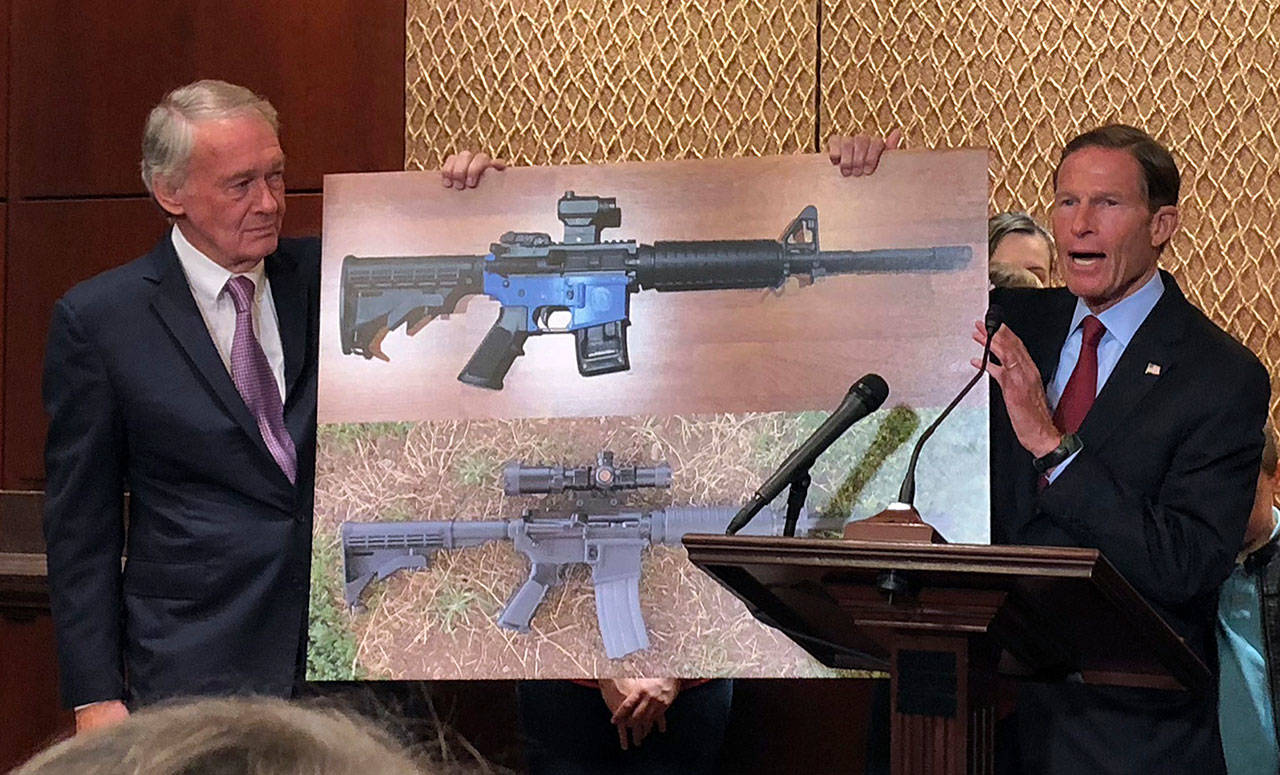
WASHINGTON — President Donald Trump came under heavy pressure Tuesday to block blueprints for 3D printers to make deadly plastic guns, stepping into the dispute after his administration agreed to allow plans for guns that could be easy to conceal and difficult to trace.
Trump tweeted he was “looking into” the issue and consulting with the National Rifle Association.
The election-year headache is a problem of the administration’s own making. After a yearslong court battle, the State Department in late June settled a case against a Texas company that wants to provide directions that would allow people to computer-print their own guns.
The settlement, which took gun-control advocates by surprise, allowed Austin-based Defense Distributed to resume posting blueprints for the hard-plastic guns at the end of July.
Those plans were put on hold late Tuesday after a federal judge in Seattle issued a temporary restraining order to stop the release of the blueprints.
U.S. District Judge Robert Lasnik issued the order Tuesday after eight Democratic attorneys general filed a lawsuit Monday seeking to block the settlement allowing the plans to be made available online. They said the plastic weapons are a boon to terrorists and criminals and threaten public safety.
Hours before the restraining order was issued, Democrats sounded the alarm, warning about “ghost guns” that can avoid detection and pose a deadly hazard.
“All you need is a little money and you can download a blueprint from the internet to make a gun at home,” said Senate Minority Leader Chuck Schumer. “No background check. No criminal history check.”
The company’s website said downloads would begin today, but blueprints for at least one gun — a plastic pistol called the Liberator — have been posted on the site since Friday. A lawyer for the company said he didn’t know how many blueprints had been downloaded since then.
Outrage over the administration’s decision is putting gun control back into the election-year political debate, but with a high-tech twist.
The president seemed to express surprise. He said on Twitter he was looking into the idea of a company providing plans to the public for printing guns, and he said it “doesn’t seem to make much sense!”
Democrats agreed and said Trump had the power to stop it.
Sen. Edward Markey of Massachusetts said Trump has boasted that he alone can fix problems afflicting the country.
“Well, fix this deadly mistake that once again your administration has made,” Markey said.
Connecticut Sen. Richard Blumenthal went further, saying that if Trump does not block the open printing of 3D guns, “Blood is going to be on his hands.”
Some Republicans also expressed concern.
“Even as a strong supporter of the Second Amendment — this is not right,” Alaska Sen. Lisa Murkowski tweeted, linking to a news story on the guns.
Rep. Ed Royce, R-Calif., chairman of the House Foreign Affairs Committee, said he was concerned that distribution of the blueprints could allow terrorists and international criminal organizations to manufacture guns that can’t be detected.
“It is critical that our laws keep pace with technology. We can’t give terrorists or violent criminals an easier path to obtaining deadly weapons,” Royce said in a letter to Trump. “I stand ready to help support your administration in efforts to bolster our national security.”
The NRA said in a statement that “anti-gun politicians” and some members of the news media wrongly claim that 3D printing technology “will allow for the production and widespread proliferation of undetectable plastic firearms.”
In truth, “undetectable plastic guns have been illegal for 30 years,” said Chris W. Cox, executive director of the NRA’s political arm. A federal law passed in 1988 — crafted with NRA support — bars the manufacture, sale or possession of an undetectable firearm.
Trump spokesman Hogan Gidley made much the same point, saying the administration supports the law against wholly plastic guns, including those made with a 3D printer.
And Texas Sen. John Cornyn, the second-ranking Republican, said, “People shouldn’t be under the impression they can download this and make an undetectable firearm.”
But Democrats called the law weak and said gun users can get around it by using weapons with a removable metal block that the gun doesn’t need in order to function.
Markey, Blumenthal and other Democrats filed legislation that would prohibit the publication of a digital file online that allows a 3D printer to manufacture a firearm. Democrats also filed a separate bill to require that all guns have at least one non-removable component made of metal.
The second measure is intended to ensure that even guns primarily made of plastic can be discovered by metal detectors.
Sen. Mike Lee, R-Utah, blocked a Democratic request to bring the bill straight to the Senate floor, citing First Amendment free speech concerns.
People can use the blueprints to manufacture plastic guns using a 3D printer. But industry experts have expressed doubts that criminals would go to the trouble, since the printers needed to make the guns can cost thousands of dollars, the guns themselves tend to disintegrate quickly and traditional firearms are easy to come by.
Unlike traditional firearms that can fire thousands of rounds in a lifetime, the 3D-printed guns normally last only a few rounds before they fall apart, experts say. They usually hold a bullet or two and then must be manually loaded. And they’re not usually very accurate.
Chris Knox, communications director for The Firearms Coalition, a gun-rights group, called the Liberator handgun a “very crude … zip gun” and said the growing debate over 3D printed guns was an overreaction.
Cody Wilson, the founder of Defense Distributed, first published downloadable designs for a 3D-printed firearm in 2013. The plans were downloaded about 100,000 times until the State Department ordered him to cease, contending the effort violated federal export laws since some of the blueprints were downloaded by people outside the United States.
The State Department reversed course last month, agreeing to allow Wilson to resume posting the blueprints.
The company filed its own suit in Texas on Sunday, asserting that it’s the victim of an “ideologically fueled program of intimidation and harassment” that violates the company’s First Amendment rights.
Meanwhile, Defense Distributed agreed to temporarily block Pennsylvania residents from downloading the plans after state officials went to federal court in Philadelphia on Sunday seeking an emergency order. The company said it had also blocked access to users in New Jersey and Los Angeles.
