
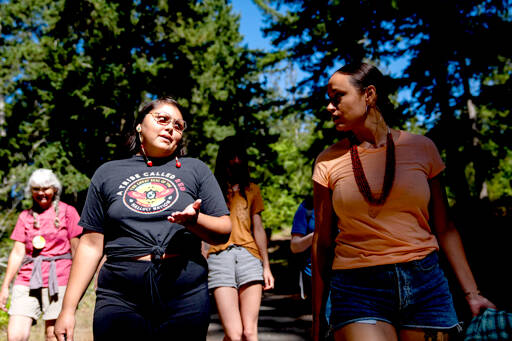
PORT ANGELES — Jeanette Kiokun, the tribal clerk for the Qutekcak Native Tribe in Alaska, doesn’t immediately recognize the shriveled, brown plant she finds on the shore of the Salish Sea or others that were sunburned during the long, hot summer. But a fellow student at a weeklong tribal climate camp does.
They are rosehips, traditionally used in teas and baths by the Skokomish and other tribes.
“It’s getting too hot, too quick,” Alisa Smith Woodruff, a member of the Skokomish Tribe, said of the sun-damaged plant.
Tribes suffer some of the most severe impacts of climate change in the U.S. but often have the fewest resources to respond, which makes the intensive camps on combatting the impact of climate change a vital training ground and community-building space.
People from at least 28 tribes and intertribal organizations attended this year’s camp in August at NatureBridge, west of Port Angeles, to hear from tribal leaders and scientists.
More than 70 tribes have taken part in similar camps organized by the Affiliated Tribes of Northwest Indians across the U.S. since 2016.
They learned about a clam garden that is combatting ocean acidification.
They visited the Elwha River, where salmon runs were recently restored after the Lower Elwha Klallam Tribe fought to have two dams torn down.
They also learned how to make the most of newly available federal funds to add climate staff, restore habitats and reduce carbon emissions.
And they set aside time to focus on cultural practices, such as cedar weaving, to unwind from the harsh realities of climate change.
“(What) this camp has done for us is to help us know that there is the network, there is a supporting web out there, that we can help one another,” said Jonny Bearcub Stiffarm, a member of the climate advisory board for the Fort Peck Assiniboine and Sioux Tribes in Montana. “So we make new songs. We make new stories. We make new visions that we embrace for the positive outcome of our people. We make new warrior societies, new climate warrior societies.”
Knowledge sharing between tribes is not new. There were trade routes across North America before colonization. During first contact, tribes on the East Coast would send runners as far west as possible to share the news, said Amelia Marchand, citizen of the Confederated Tribes of the Colville Reservation.
“This is kind of like a revitalization and an extension of that,” she said.
Kiokun is one of only three full-time employees for the Qutekcak Native Tribe. In 2022, a landslide cut off a major road and hurled debris into a bay, damaging a popular fishing spot for tribal elders, said Jami Fenn, the tribe’s financial grant manager.
Out of last year’s camp came a group made up of tribes and Native villages across the Chugach region in Alaska, including the Qutekcak Native Tribe, focused on responding to climate change.
The group is now working to get a National Oceanic and Atmospheric Administration grant so they can rebuild fish habitats ruined by the landslides and add liaisons with federal entities on climate change issues.
Camp participants include those first starting to consider actions to counter the effects of climate change to those who have long had plans in place.
The Jamestown S’Klallam Tribe in Blyn attended for the first time last year. Soon after, they added a staff member focused on climate change, installed their first solar panels and kicked off a friendly competition with the Confederated Tribes of the Umatilla Indian Reservation to see which could become carbon neutral by 2032.
This year, the tribe co-hosted the camp.
Loni Greninger, Jamestown S’Klallam Tribe vice chair, said a comment from a participant last year had stuck with her, about how the Western red cedar — which is central to the tribe’s cultural identity — could die off in the Pacific Northwest because of excessive heat due to climate change.
“To think about a world where there wouldn’t be cedar anymore, where I can’t smell it, where I can’t touch it, where I can’t work with it, where I can’t weave with it, where I can’t use it anymore. That caught my attention,” she said. “I don’t want to be in a world like that.”
This year’s camp had added urgency. The federal government has granted more than $720 million through the Inflation Reduction Act to help tribes plan and adapt to climate change.
But Marchand, from the Affiliated Tribes of Northwest Indians, said navigating these opportunities can be “overwhelming” for tribal staff juggling many responsibilities.
The training helps tribes see “what the low-hanging fruit is … where they can leverage their energy,” she said.
Near the end of the camp, each tribal team presented projects they were working on and discussed the impact of climate change.
The Confederated Salish and Kootenai Tribes in Montana was among the first tribes in the U.S. to develop a climate response plan, and the tribe’s climate change advisory committee chairman willingly shared that with other camp attendees.
“You don’t have to steal it; it’s yours,” Michael Durglo Jr. told the group. “Everything I have is yours.”
The Qutekcak Native Tribe is planning a tribal youth climate camp in Alaska, and Durglo has already agreed to teach part of the six-week program.
Kiokun, the tribe’s tribal clerk, also plans to help with this work.
“I think I’ve found a new passion,” she said.
________
Associated Press climate and environmental coverage receives support from several private foundations.
