
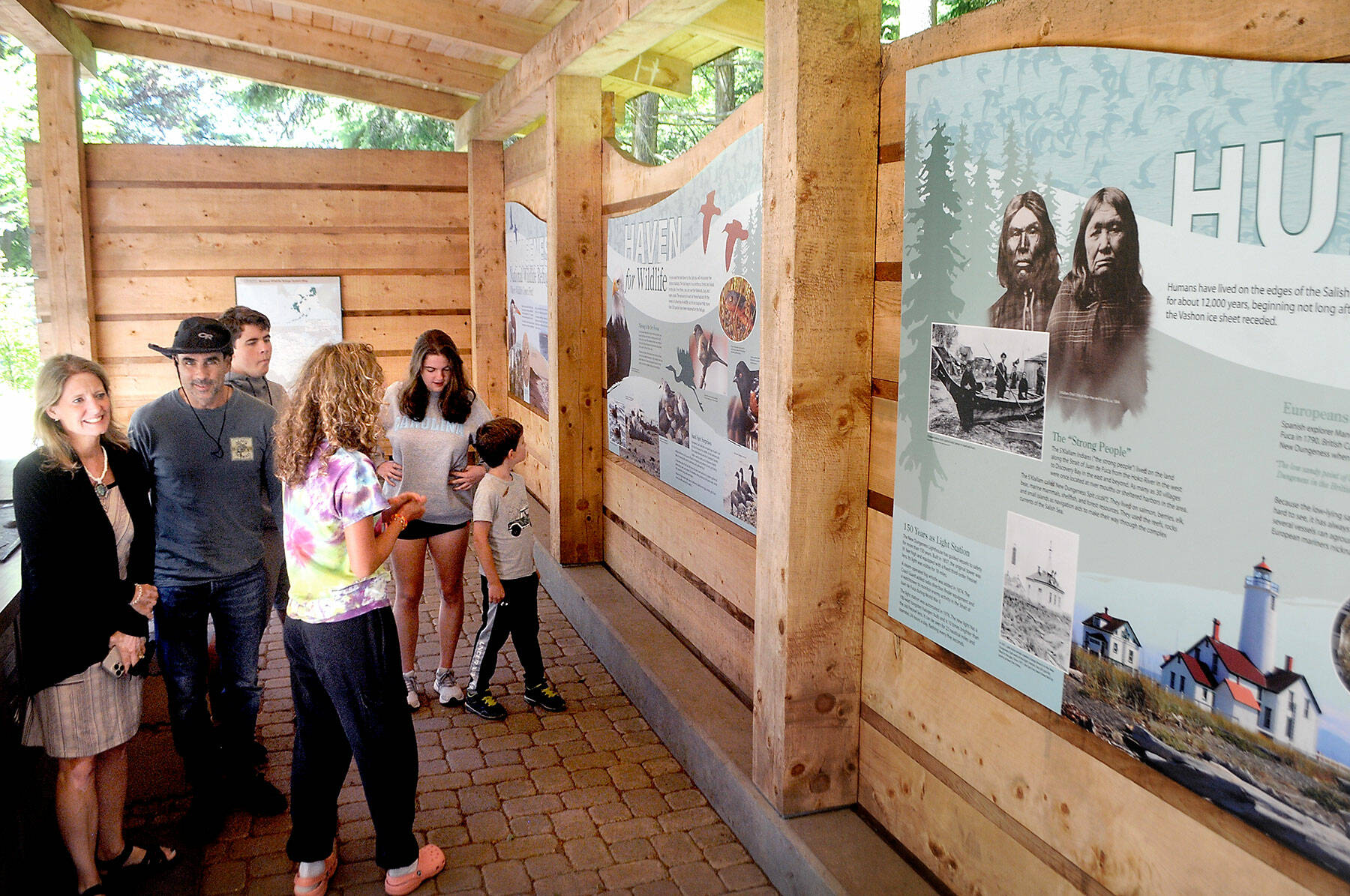
SEQUIM — The Jamestown S’Klallam Tribe is in negotiations with the U.S. Fish and Wildlife Service to lead operations at both the Dungeness and Protection Island national wildlife refuges.
W. Ron Allen, the tribe’s CEO and tribal chairman, along with fish and wildlife officials, said the Dungeness National Wildlife Refuge would remain open to the public while Protection Island National Wildlife Refuge would remain closed to visitors.
Allen said the tribe is negotiating a two-year renewable agreement that he expects will be signed on Aug. 16.
The Jamestown S’Klallam Tribe’s interest in taking over management of the refuges came in a confluence of events, Allen said, stemming from the tribe’s work to clean up pollution as it prepared operations for its 50-acre oyster farm in Dungeness Bay.
“We had to jump through a lot of hoops in 13 years, trying to clean up the pollution problems,” Allen said.
“In doing that, we ran into a buzzsaw with the refuge. They tried to make the argument that we don’t know about stewardship of the refuge. [But] we were the original stewards of the habitat and environment [there].
“We had a sharp difference [of opinion]. We said, ‘We could run this refuge better than you.’”
At the same time, Allen said, U.S. Secretary of the Interior Deb Haaland was pushing for more protection of public lands, making investments with numerous tribal communities and facilitating more U.S.-tribal government co-management programs.
“A lot of these issues are lining up at the same time,” Allen said. “The [Dungeness] refuge was in our backyard; our original village was there. We have a strong nexus to the refuge and we want to manage it.”
He said the tribe already has a grant worth about $200,000 to help with refuge improvements at the Dungeness site.
“We can bring a lot more resources,” he said.
The whole process of requesting consideration of management of the refuges took about two years, Allen said.
Limited potential changes
Tribal management would oversee the Dungeness and Protection Island national wildlife refuges’ including habitat, wildlife and cultural resource management, visitor services, county and state partnerships and volunteer opportunities along with the refuge Friends group and other partners according to the Comprehensive Conservation Plans, said Megan Nagel of the office of communications with the U.S. Fish and Wildlife Service’s Pacific Region.
“The refuge would remain a refuge,” she said.
Allen said the tribe had to agree to the USFW’s plan, which included the Dungeness refuge remaining open to the public.
“None of those were problems for us,” he said.
“The facilities themselves [at Dungeness] are in pretty good shape,” he said.
The tribe is looking at adding more accommodations, such as tiny homes, to help provide housing for volunteers during the summers, when a lot of work needs to be done.
Allen also noted the tribe is looking at adding properties adjacent to the Dungeness refuge with the possibility of expanding it.
Tribe officials also are looking to partner with Clallam County as the county seeks to improve access at its adjacent 216-acre Dungeness Recreation Area.
He said the tribe also will look to link efforts between the Dungeness refuge and the Dungeness River Nature Center, helping provide more education to the community and volunteer services between those two sites.
“I see the two collaborating a lot; we have a lot of the same overlapping volunteers,” Allen said.
Meanwhile, Protection Island National Wildlife Refuge would remain closed to the general public, Nagel said.
“Visitors may view the island by boat, but a 200-yard off-shore buffer is enforced to ensure adult birds are not flushed from their nests,” she said.
The tribe also would participate in local and regional planning and conservation efforts, Nagel said, including the Straits Ecosystem Recovery Network, Dungeness River Management Team, Oil Spill Response Task Force, Salmon Recovery Council, Washington Sea Grant Crab Team and Protection Island Aquatic Reserve, as well as “monitoring and research activities associated with climate change, oil spill response, removal of derelict fishing gear and other activities that may impact refuge resources and habitats.”
Four staffers currently work at the refuges as part of the Washington Maritime National Wildlife Refuge Complex. Nagel said those employees would focus entirely on the other four refuges in the complex — Flattery Rocks, Quillayute Needles, Copalis and San Juan Islands national wildlife refuges — while under a potential management agreement the Jamestown S’Klallam Tribe would be responsible for staffing Dungeness and Protection Island refuges.
Allen said the tribe already has hired a couple of those staffers to stay on at the Dungeness site.
Jamestown S’Klallam Tribe leaders did not ask to take over management of the four other refuge sites within the Washington Maritime National Wildlife Refuge Complex, Allen said, as they are outside of the tribe’s traditional lands.
Nagel said no other entities have requested management of the refuges.
About the refuges
More than 770 acres in size, the Dungeness National Wildlife Refuge contains within it the 5.5-mile-long Dungeness Spit — the longest natural sand spit in the United States — along with Graveyard Spit and portions of Dungeness Bay.
It was designated a National Wildlife Refuge in January 1915 by President Woodrow Wilson.
According to the USGS Northern Prairie Wildlife Research Center, the refuge is home to 250 species of birds and 41 species of land mammals.
Protection Island National Wildlife Refuge was designated in 1982. About 70 percent of the nesting seabird population of Puget Sound and the Strait of Juan de Fuca nest on the island, which includes one of the largest nesting colonies of rhinoceros auklets in the world and the largest nesting colony of glaucous-winged gulls in Washington.
