

By Gene Johnson
The Associated Press
EVERETT — Jurors heard during opening statements about the mysterious final days of a young Canadian couple killed in 1987 — as well as the novel method authorities used to finally make an arrest three decades later.
William Earl Talbott II was arrested last year and charged with aggravated murder after authorities said they used genetic genealogy to identify him as the person who left his DNA on the clothing of one of the victims. The practice involves identifying suspects by entering crime-scene DNA profiles into public databases that people have used for years to fill out their family trees.
Opening statements began Friday with a prosecutor describing how 18-year-old Tanya Van Cuylenborg and her boyfriend, 20-year-old Jay Cook, left their hometown of Saanich, B.C., near Victoria, traveling on the MV Coho ferry to Port Angeles for what was supposed to be an overnight trip to Seattle in November 1987.
When they didn’t return, their families began a frantic search for them, including renting a plane to try to spot the copper-colored Ford van they had been driving.
About a week later, Van Cuylenborg’s body was found down an embankment in rural Skagit County, north of Seattle.
She was naked from the waist down and had been shot in the back of the head.
Hunters found Cook dead two days later in brush near a bridge over the Snoqualmie River in Monroe — about 60 miles from where his girlfriend was discovered. He had been beaten with rocks and strangled with twine and two red dog collars, authorities said.
The couple’s van was found in Bellingham near a bus station. Van Cuylenborg’s pants were in it; investigators found semen on the hem and said it matched that on her body.
Detectives investigated hundreds of leads in the ensuing decades and tested the DNA against criminal databases, to no avail. But Snohomish County sheriff’s detective Jim Scharf learned about Parabon Labs in Reston, Va., which was using a new DNA processing method to extract more information from samples.
Last year, CeCe Moore, a genealogist there who is known for her work on the public television series “Finding Your Roots,” used the public genealogy database GEDmatch to find distant cousins of the person who left the DNA. She built a family tree and determined the source must be a male child of William and Patricia Talbott of Monroe.
William Talbott II, now 56, was their only son. He was 24 at the time of the killings and lived near where Cook’s body was found.
Genetic genealogy has taken off as an investigative tool in the past year, since police in California revealed that they used it to arrest and charge a man suspected of being the sadistic attacker known as the Golden State killer, who killed 13 people and raped nearly 50 women during the 1970s and 1980s.
Since then, authorities have used the DNA method to identify more than 60 cold-case suspects across the country. Talbott was one of the first.
Deputy prosecutor Justin Harleman told jurors that once Talbott became a suspect, investigators tailed him, saw him discard a coffee cup and then tested the DNA from the cup, confirming it matched evidence from the crime.
Genetic genealogy, he said, “simply gave law enforcement a tip, like any other tip that they follow up on.”
Privacy advocates have expressed concerns about whether the technique violates the rights of suspects and whether its use by law enforcement should be restricted, but Talbott’s attorneys agreed that how detectives found him is irrelevant, and they didn’t challenge it.
Instead, attorney Jon Scott told jurors in his opening statement Friday that the presence of the DNA doesn’t make his client a killer. He offered no explanation of how Talbott’s DNA got there, and said the evidence doesn’t explain how the couple spent their final days or with whom.
Scott described his client as a “blue-collar guy” who had worked in construction and as a truck driver and lived a “quiet, unremarkable life.”
“He’s just lived and worked, and that’s all he’s done,” Scott said.
Relatives of both victims attended the beginning of the trial, which is expected to last four weeks. Cook’s mother, Leona Cook, said it’s still difficult to hear of the killings, but added: “It’s been 32 years. My heart’s been hardened, I think.”
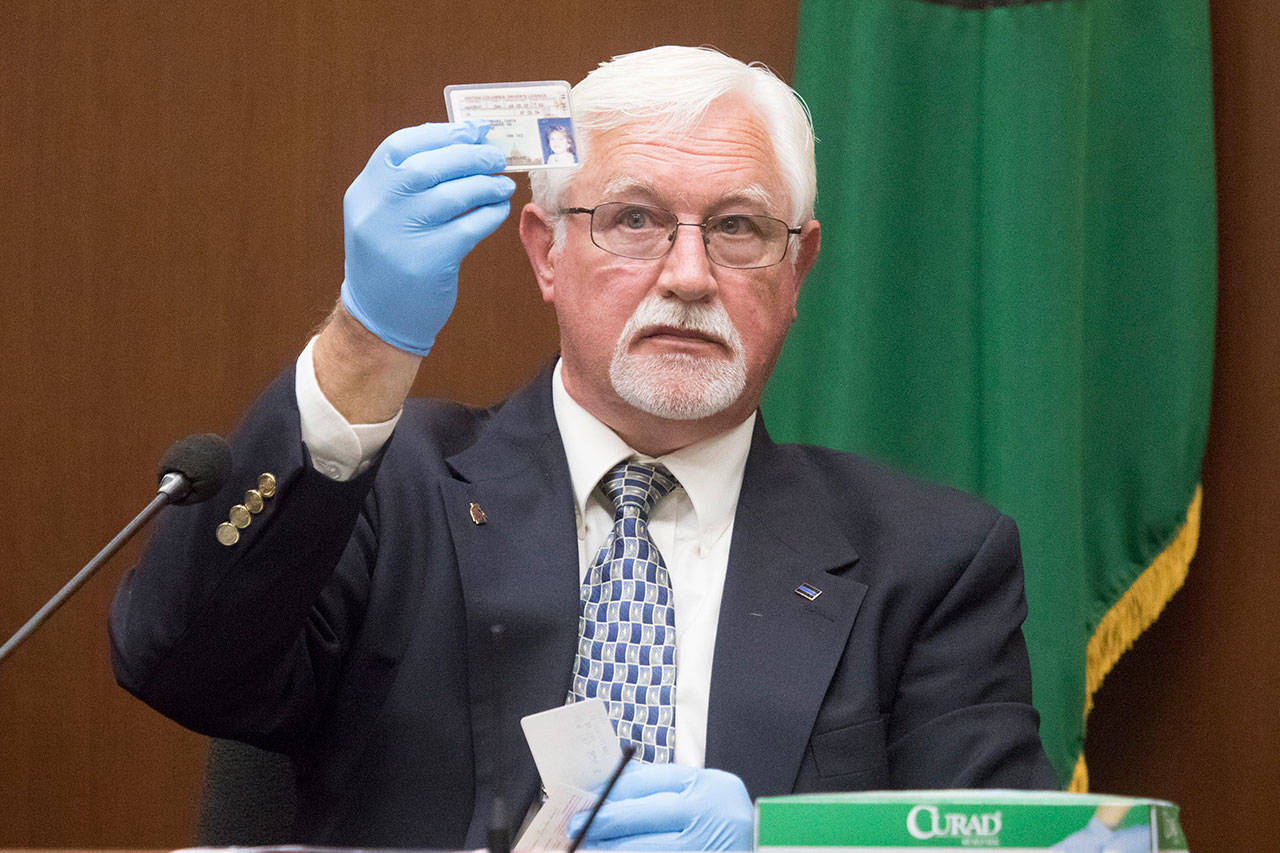
Retired Bellingham Police Sgt. David Richards holds up the identification card of Tanya Van Cuylenborg during William Talbott II’s trial for double-murder Friday at the Snohomish County Courthouse in Everett. (Andy Bronson/The Herald via AP, Pool)
