
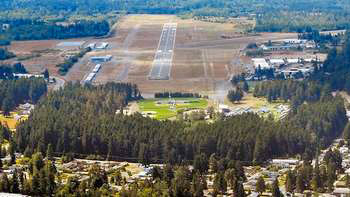
PORT ANGELES — City and Port of Port Angeles officials expect to meet soon to discuss tree-cutting options for Lincoln Park that, according to Mayor Cherie Kidd, could include a temporary fix:
Simply topping those trees that obstruct the port’s William R. Fairchild International Airport runway.
But Kidd also said city officials, before selecting a preferred option, want to know the value of an aerial navigation easement — also called an avigation easement — that the port would acquire from the city that would allow aircraft to fly in airspace above the city-owned park.
The options decided upon will be presented to the Federal Aviation Administration, which will pay for 90 percent of the tree mitigation costs, including an upcoming environmental assessment.
The FAA will flesh out the options in assessment and rank them by preference.
But that must happen before the easement is negotiated between port and city officials, interim Port Executive Director Ken O’Hollaren said Monday at the port commission’s regular meeting.
O’Hollaren gave port Commissioners John Calhoun and Paul McHugh a brief report on Thursday’s meeting in Renton between FAA and port officials — including Calhoun — to discuss the next steps for addressing the park’s runway-obstructing fir trees.
Port Commissioner Jim Hallett was on vacation Monday.
“We discussed what the scope of the environmental assessment may be,” O’Hollaren said.
“This relates back to [the city of Port Angeles’] park plan.”
The city and the port “just need to focus on one element of that plan having to do with the option of removing a certain amount of trees to take advantage of the existing runway,” O’Hollaren told the commissioners.
“The negotiation of the [aerial navigation] easement is premature,” he added, asserting that negotiating an easement would presume that a preferred alternative has been selected.
But the value of the easement “is very important to us,” said Kidd, who was not at Monday’s port meeting.
“We need that information before we can make any final decisions,” she said in a later interview.
“We have asked for the value of the avigation easement.
“If it’s premature, that keeps us on hold before we make any final choices.
“That is information we specifically need for our decision-making process.”
Kidd said there are “a lot of options” to address the port’s concerns.
Topping the tallest trees to clear the flight path would delay more drastic action from two to five years.
“There are lots of options on the table,” Kidd added.
About 350 runway-obstructing trees were cut down in Lincoln Park in 2008, mostly in a former campground.
But a petition against cutting down more trees attracted 2,000 signatures earlier this year.
Calhoun addressed those concerns at Monday’s meeting — but also reiterated the port commissioners’ long-held stance.
“Our proposal is to remove the trees and acquire an easement,” Calhoun said.
“We owe the community a thorough evaluation of the other alternatives because we heard feedback.
McHugh said he thought the city and port were to have an agreement in place on tree removal before the environmental assessment was conducted.
O’Hollaren responded that there is “no point” in working out the terms of the easement agreement without a preferred alternative on which to base the pact.
In an Oct, 25 letter to O’Hollaren, City Manager Dan McKeen suggested that the port proceed with addressing the tree issue on two fronts.
“We strongly believe the FAA should proceed with the environmental assessment and the port should present the city with a proposed [aerial navigation] easement to begin the negotiating process,” McKeen said.
“Again, the city is prepared to begin negotiations for the avigation easement for Lincoln Park.”
The port hopes to have options for Lincoln Park ready to submit to the FAA by January, O’Hollaren said Monday in an interview.
________
Senior Staff Writer Paul Gottlieb can be reached at 360-452-2345, ext. 5060, or at pgottlieb@peninsuladailynews.com.
