
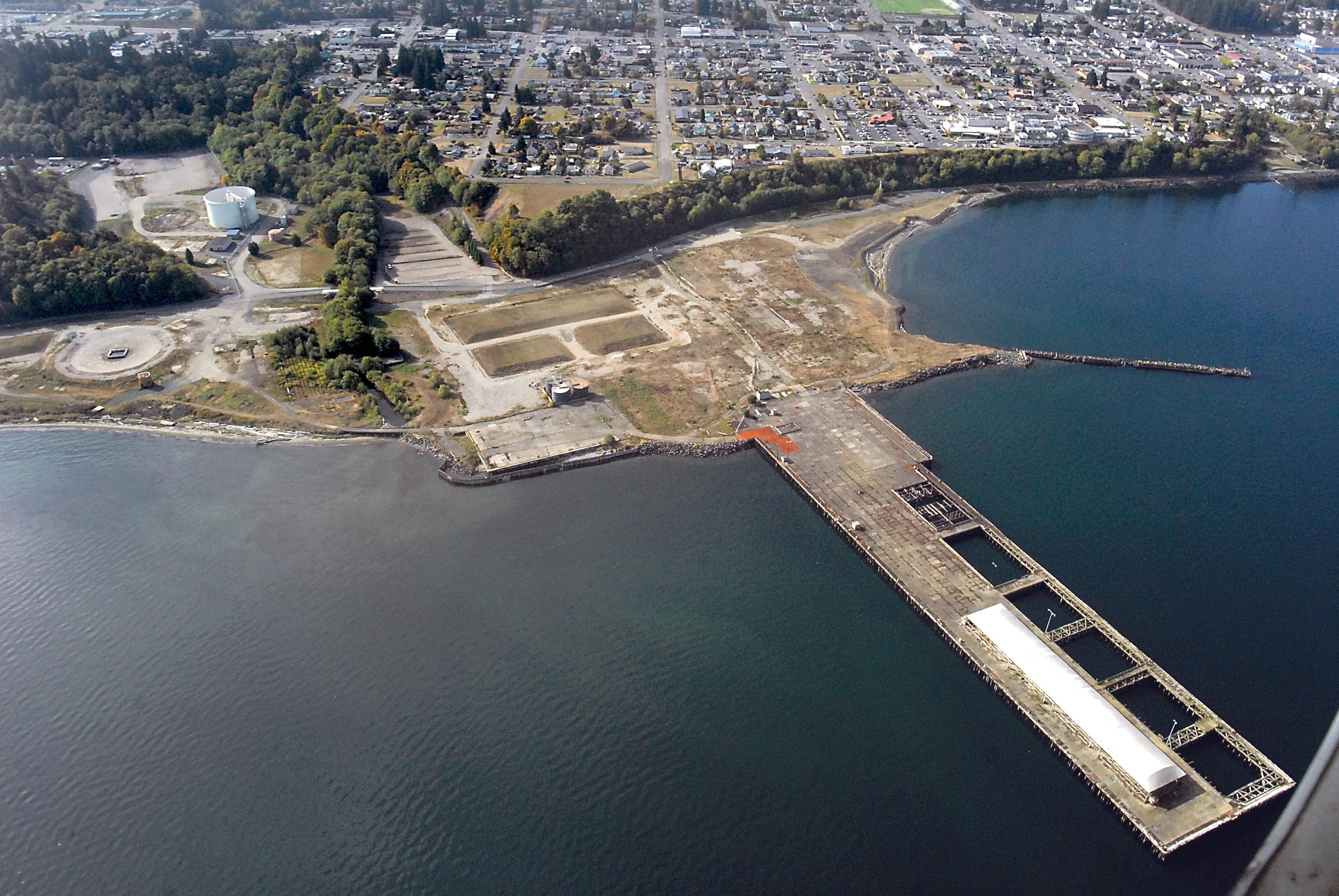
PORT ANGELES — Mercury, arsenic, dioxins and polycyclic aromatic hydrocarbons are among the ingredients of the toxic brew in the eastern side of Port Angeles Harbor near the site of the former Rayonier mill.
A draft Marine Data Summary Report released Tuesday by the state Department of Ecology in Olympia summarized the amount and types of marine contamination in the 1,300 acres of water and sediment.
The poisons are concentrated most highly in water in the eastern part of the former log pond and near the mill dock, the report said, but “are spread throughout the marine environment.”
These areas also contain sediments that are toxic to such marine organisms as crabs, clams and small crustaceans.
Other toxins include phthalates, phenols, semi-volatile organic compounds, and polychlorinated biphenyls (PCBs).
Rayonier also found some areas of low and high pH in groundwater. The pH scale measures a material’s acid or alkaline content.
The study is separate from an effort to evaluate and clean up the west side of the Harbor, said Marian Abbett, site manager for Ecology.
Ecology has named the city and port of Port Angeles, Georgia-Pacific LLC, Nippon Paper Industries USA and forest services company Merrill & Ring as at least partially responsible for removing potentially harmful substances found in the sediment lining the bottom of the western portion of the harbor.
The Rayonier study area on the eastern side is being cleaned up under an agreed order, which is a legal agreement to conduct a remedial investigation and to evaluate cleanup options.
The investigation evaluates the extent of contamination. A document called a feasibility study details cleanup options.
According to Ecology, Rayonier is on schedule with its agreed order tasks. The company’s next deadline is Feb. 9, when a draft analysis of cleanup options is due.
“We’re committed to following the plan that’s been agreed upon,” Russell Schweiss, Rayonier’s director of corporate communications, said Tuesday.
“That commitment remains.”
The draft Marine Data Summary Report includes data from earlier studies, such as Ecology’s Port Angeles Harbor Sediments Study.
This report, along with data about the upland portion of the study area, will help Rayonier develop a plan for cleaning up the study area.
Ecology plans a public comment period next year, probably toward the end of the year, on the draft Marine Data Summary Report, Rayonier’s evaluation of cleanup alternatives and an upland date summary released in 2013, Abbett said.
Ecology is making the lengthy marine and upland reports available for review now so the public has more time to review them, Abbett said.
They can be viewed at:
■ The Port Angeles Library, 2210 S. Peabody St.
■ Ecology’s Southwest Regional Office, 300 Desmond Drive SE, Lacey, by appointment. Contact Susan Baxter at Susie.Baxter@ecy.wa.gov or 360-407-6365.
■ Ecology’s website, http://tinyurl.com/PDN-Rayoniersite.
Questions about the cleanup and report can be addressed to Abbett at marian.abbett@ecy.wa.gov.
As for the poisons in the water, mud and dirt, dioxins are likely cancer-causing agents, according to the Environmental Protection Agency.
Polycyclic aromatic hydrocarbons are suspected carcinogens that also may cause birth defects, according to the Agency for Toxic Substances.
Phthalates block male hormones and can interfere with normal genital development.
Phenols in long-term exposure can cause anorexia, progressive weight loss, diarrhea, vertigo, salivation, urine and blood and liver effects, according to the EPA.
PCBs have been banned in the U.S. since 1979 as carcinogens that also can damage the endocrine, immune, nervous and reproductive systems, and cause other adverse health effects.
The substances entered the water while Rayonier operated a pulp mill at the site at the foot of Ennis Street from 1930 to 1997.
The upland site comprises 75 acres, most of which is fenced off to people except for the paved Waterfront Trail segment of the Olympic Discovery Trail that crosses it.
Ecology released its report on the upland site in 2013. Past partial cleanups have removed 30,000 tons of contaminated soil. A Port Angeles Harbor Sediments Study was released in 2012.
Rayonier agreed to a cleanup plan in August 2010. Since then, the company and Ecology have set preliminary cleanup standards and technologies.
Still to be completed are cleanup alternatives, public comment on them, and an interim action plan.
“The Rayonier Mill agreed order does not set calendar due dates because all of the tasks build on earlier tasks,” according to a statement by Natalie Graves, public involvement coordinator, Ecology Toxics Cleanup Program.
As of February 2013, the cleanup had cost the company $26 million.
________
Reporter James Casey can be reached at 360-452-2345, ext. 5074, or at jcasey@peninsuladailynews.com
