
EVERETT — The Snohomish County Public Utility District pulled the plug on a tidal energy project the day before bids came in for installing two undersea turbines near Whidbey Island.
The U.S. Department of Energy has decided to not fund a full 50 percent of the project, as originally planned. The county PUD announced Tuesday that it cannot move forward without those federal dollars.
The project started in 2006 as a research effort. Two turbines were to be installed in Admiralty Inlet for no more than five years to determine whether tidal energy would be viable as a long-term power source. Initial cost estimates called for $20 million. The figure has since been revised upward to $38 million.
The project was the first of its kind in the Pacific Northwest and one of only a few around the world, so preliminary cost estimates were essentially educated guesswork, said Steve Klein, general manager of the PUD. In the past eight years, a lengthy permitting and licensing process and unexpected costs nearly doubled the price tag.
The $38 million figure is still just a guess, Klein said. The cutoff for companies to submit bids for manufacturing and installing turbines was to be today, Oct. 1, after which the district could determine a better price estimate.
“This is not something where we’ve done it and don’t have a handle on the cost,” Klein said. “We’re still deciding how to do it. This project doesn’t exist anywhere except on paper.”
Officials with the U.S. Department of Energy’s Water Power Program declined to comment Tuesday afternoon.
In a statement, the department said it awarded a maximum of $10 million for the Snohomish County project through a specific funding opportunity in 2010, with the understanding that the PUD would cover at least half the expense.
The PUD estimates that the project has cost less than $8 million so far, with $3.5 million coming from the Department of Energy. That amount does not include in-kind contributions such as studies performed by laboratories or for research and development of equipment by the University of Washington — neither of which was paid by the PUD, Klein said.
No ratepayer money was used for the project, he said.
At least 100 people have been involved in the tidal energy project in one way or another. No employees were assigned to it full-time.
“If you put this in perspective, this is a small part of what we do,” Klein said. “Our budget is almost three-quarters of a billion dollars.”
More than 80 percent of PUD energy is hydroelectric from dams, mostly through the Bonneville Power Administration. Up to 8 percent of the PUD’s power is wind-generated, and more than 450 customers have installed solar units. The district also is researching geothermal energy and tapping into biomass and biogas energy, which is fueled largely by wood waste and cow manure.
It’s all part of diversifying energy sources and creating long-term renewable power, according to the PUD.
“We talk about it here, but to actually go out and do renewable energy is not easy,” Klein said. “People in the U.S. feign support for renewable energy.”
If the tidal power project had moved forward, the district planned to award contracts for building turbines in December, to do site preparation by mid-2015 and to install the turbines in 2016.
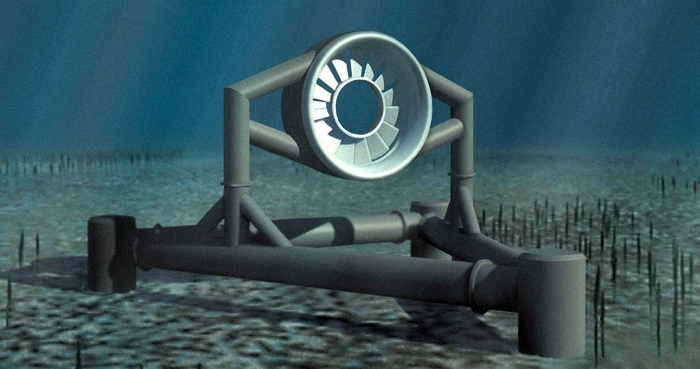
The equipment would have been 200 feet underwater off the west shore of Whidbey Island. The turbines look like giant fans, each weighing 414 tons and standing 65 feet tall on a 100-by-85-foot triangular platform. The turbines would have been crafted by OpenHydro, a company based in Ireland. The platforms would have been manufactured locally, Klein said.
OpenHydro had been talking about building a new manufacturing plant in Western Washington, likely in or near Everett. Without the tidal energy project, it’s doubtful such a development will happen, Klein said.
“As with anything, you need those first initial steps,” Klein said. “We’re at the cutting edge of that and we’re facing challenges. And that’s why we need partners.”
For more than eight years, the district worked with other regional, federal and international organizations. Partners included the Department of Energy, UW, BPA, the Pacific Northwest Laboratory and OpenHydro.
The project faced some opposition. Native American tribes worried the turbines would interfere with their fishing rights or harm fish. The Tulalip tribe, Suquamish tribe and Point No Point Treaty Council, representing the Jamestown S’Klallam and Port Gamble S’Klallam tribes, submitted testimony against the project.
The North American Submarine Cable Association and a California-based company, Pacific Crossing, also fought the turbines, arguing that they could damage underwater fiber-optic cables. Pacific Crossing is responsible for thousands of cables that pass through Admiralty Inlet, running from the West Coast to Asia.
Despite opposition, the PUD completed licensing and permitting for the project about six months ago. The district has about a year before it must start construction or rescind those permits, said Anne Spangler, general counsel for the PUD. They plan to rescind them.
“At this point, unless we get a partner that’s willing to step up and take on a proportional share of the project, this project will not move forward,” Klein said. “The nation loses the chance to research a new renewable energy source that could have been added into the mix for powering our country in the future.”
———
The Daily Herald is a sister newspaper to the Peninsula Daily News. Herald reporter Kari Bray can be reached at kbray@heraldnet.com or at 425-339-3439.
