
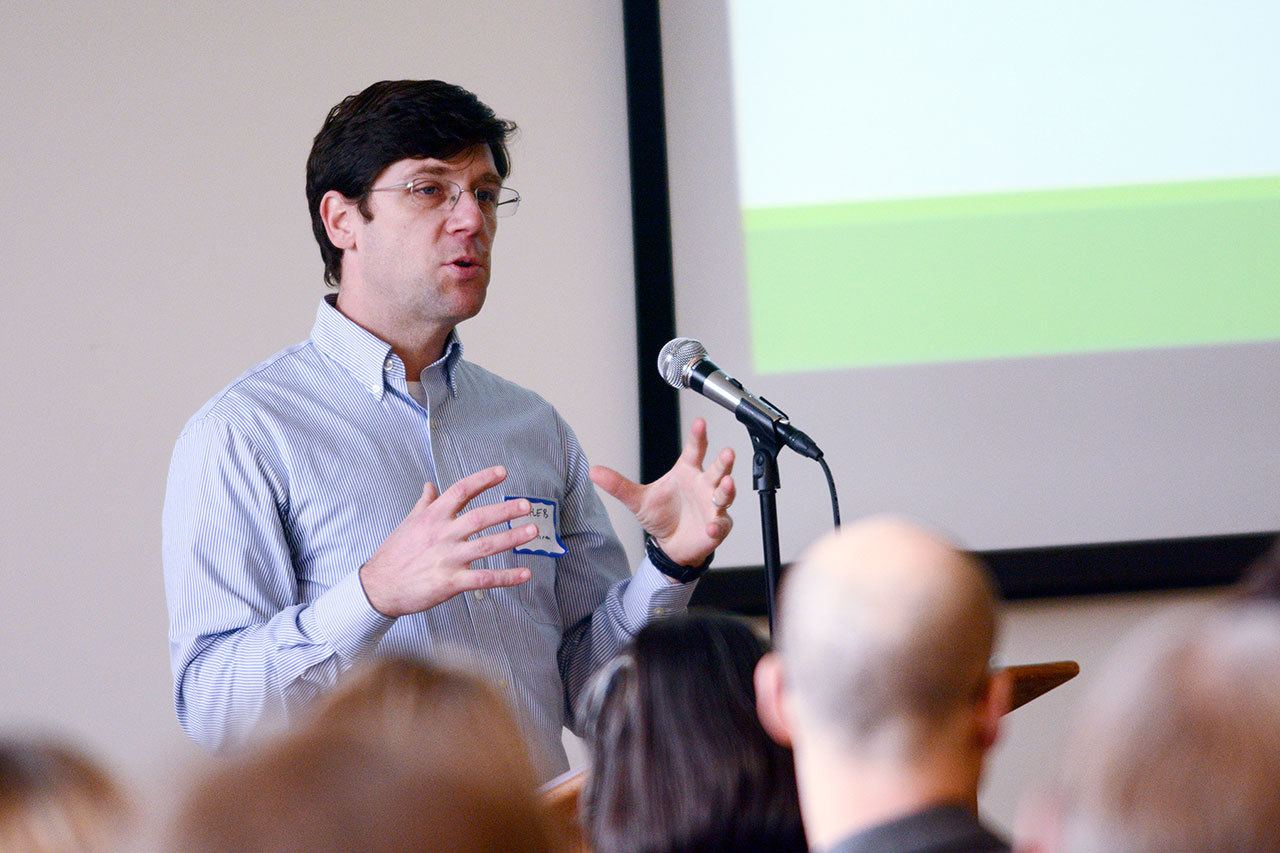
KINGSTON — An estimated 974 injection heroin users in Clallam, Jefferson and Kitsap counties want help, a researcher told some 300 professionals who attended the Olympic Community of Health Opioid Summit.
“Most people using drugs don’t want to be using them,” said Caleb Banta-Green, a researcher at University of Washington’s Alcohol and Drug Abuse Institute.
“Despite what we might think, they’re not really having fun.”
Doctors, caseworkers, chemical dependency professionals, elected officials and law enforcement from across the three counties met at the summit Monday in Kingston to get a grasp of what the opioid epidemic — both in illegal narcotics and abuse of prescription drugs — looks like in the region and what can be done to address it.
The summit marks a transition between a data-gathering phase into action, with the goal of ending what public health officials call an opioid epidemic.
Clallam County had 62 documented overdoses last year and at least six deaths. Data from Jefferson County was incomplete but appeared to show that the epidemic is not as severe as in Clallam or Kitsap County.
Olympic Community of Health’s goals are to prevent abuse by improving prescribing practices, expanding access to treatment and prevent overdose deaths by making naloxone more available. Naloxone is used to counteract the effects of an overdose of opioids.
Port Angeles Police Chief Brian Smith, who attended the summit, said he was impressed to see health professionals, law enforcement and social service workers all working together to create on “a very well-thought-out plan and a very well-thought-out approach.”
Law enforcement is part of the solution, he said, adding he is optimistic of creating stronger partnerships locally to help people with opioid use disorder.
“We know how to find them and we know what their situations are,” he said. “What we in law enforcement need is a mechanism to hand them off to someone who can get them into treatment.”
What exactly treatment looks like can vary, but there needs to be multiple options available, Banta-Green said.
“The point is we need options,” he said. “It’s not an option to only offer one medication.”
Often it can take weeks or months for a person who wants medication for opioid use disorder to actually get into treatment, he said.
Steps need to be taken to make treatment available to those who want it when they want it, he said.
“Right now, most treatment is set up for the providers, not for people,” Banta-Green said.
Providers across the three counties who participated in an Olympic Community of Health survey identified a number of factors that would encourage them to prescribe buprenorphine, a drug commonly used to treat opioid use disorder.
Of the 64 providers who responded, 42 percent said the amount of paperwork needs to be decreased and 36 percent said it would help if patient substance use treatment were coordinated outside their clinic.
In the survey, 52 percent of providers said limited access to chemical dependency treatment was a barrier to prescribing buprenorphine.
Another 48 percent had concerns that providing buprenorphine was too time-consuming.
Michelle Peavy, clinical psychologist at Evergreen Treatment Services — which has clinics in King, Thurston and Grays Harbor counties — said opioid addiction needs to be treated as a chronic relapsing medical condition. She equated it to diabetes.
The traditional method, which she said hasn’t worked, has been to kick people out of treatment if they relapse.
“In a medical community, this doesn’t happen,” she said. “If it’s a medical model, when people have an increase in symptoms, that means the treatment is not working and should be altered.”
Peavy said being physically dependent on opioids is different than being addicted.
To be addicted, a person needs to not only be physically dependent on opioids but also have cravings, loss of control over use, continued use despite adverse consequences and salience, she said.
It isn’t clear how long a person should be on a medicine-assisted treatment program, but it does take time, Peavy said.
In Evergreen’s medicine-assisted opioid treatment program, there are two ways clients find success, she said.
Some taper off of buprenorphine, while others prefer to stay on the drug, staying on it for life, she said.
Dr. Tom Locke, Jefferson County health officer, said that what makes this effort significant is that professionals from all fields dealing with opioid use disorder are now working together.
“We all have overlapping goals,” said Locke, who is on the Olympic Community of Health steering committee. “We need to learn to work together and have a system that makes that easy to do.”
________
Reporter Jesse Major can be reached at 360-452-2345, ext. 56250, or at jmajor@peninsuladailynews.com.
