
PORT ANGELES — A 911 dispatcher’s job might seem simple. They answer phone calls, determine the emergency and notify relevant agencies that a response is needed.
But being a dispatcher is anything but simple.
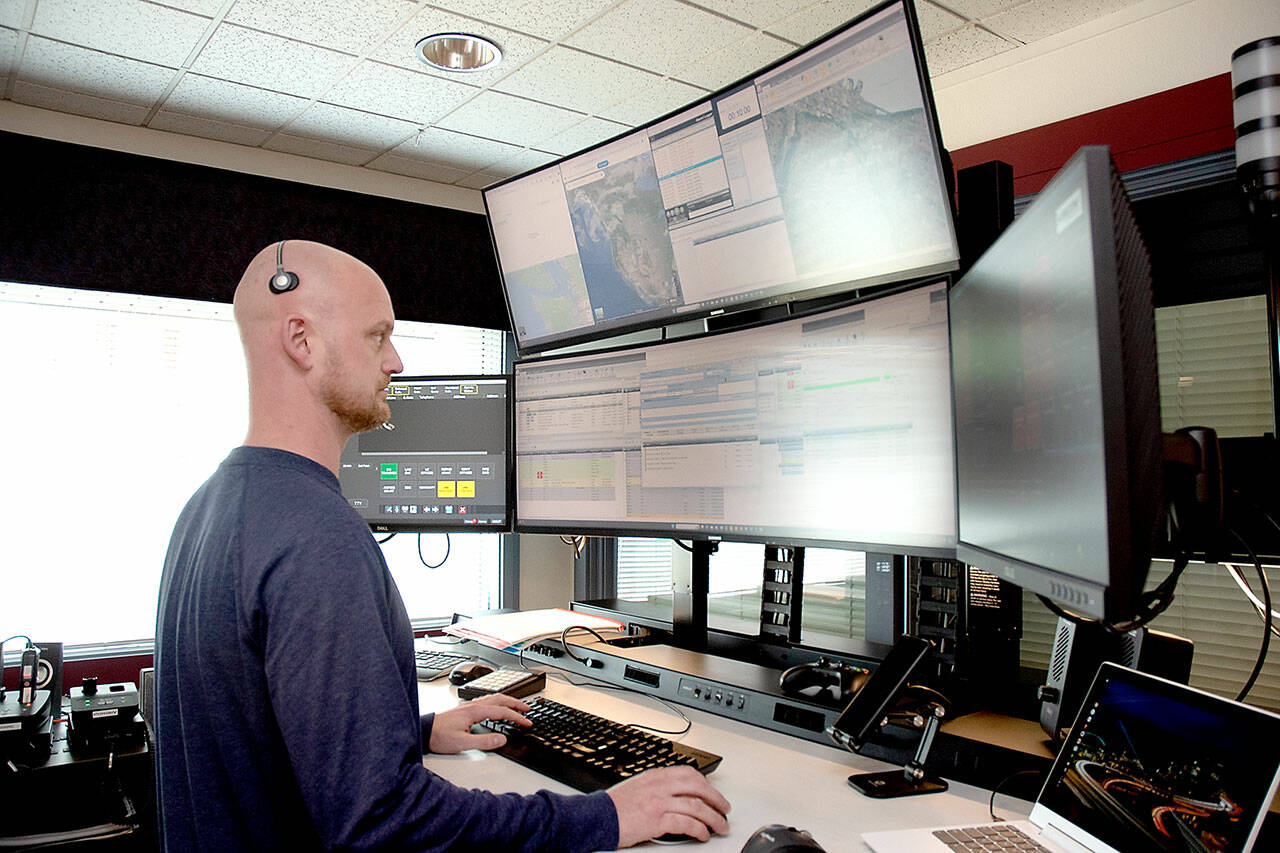
To do their job, dispatchers must operate a foot pedal, a microphone, two radios, two reference binders, four computer screens, over 10 computer tabs, 17 different emergency agencies, more than 20 radio channels and a variety of voices coming at them at all times.
The staffing crisis that the Clallam County dispatch center Peninsula Communications (PenCom) is facing makes these dispatchers’ jobs even more difficult.
Inside the staffing crisis
PenCom has the budget to hire 20 people. But PenCom Operations Director Karl Hatton said, due to the staffing crisis, he has never had a full roster.
Currently, PenCom has 11 employees with two individuals on long-term leave and one in training. Forty-five percent of its positions are empty.
PenCom has had to survive with these low numbers for months at a time, Hatton said.
Because PenCom operates all day every day, the staffing crisis puts a heavy workload on the 11 employees who must work hundreds of hours of overtime to keep the center running.
In 2023, dispatchers worked around 5,700 hours of overtime.
PenCom’s staffing crisis began in early 2019 when it lost staff members from retirement, training failure, Coast Guard movement and other reasons, Hatton said.
After that, Hatton said PenCom has struggled to get anyone to apply, let alone find quality applicants.
The situation at PenCom is not unique; it is something that 911 centers across the nation are facing.
Hatton has taken steps to try to address the staffing crisis.
One step was decreasing the number of on-call dispatchers.
From noon to midnight, PenCom has three dispatchers. From midnight to noon, it only has two.
The dispatch center has four consoles — three divided up to cover the east, west and central areas of Clallam County, and one dedicated to non-emergency calls or taking over bigger emergencies.
When only two dispatchers are working, they divide the east position between them.
Hatton said they rarely, if ever, have someone for the fourth console.
“If I had my way, we would have three dispatchers on the floor 24/7 and a supervisor either at the extra console or in the office 24/7,” Hatton said.
Because of the staffing crisis, that dream seems very far off.
Hatton and PenCom administrative supervisors have also been working overtime at the dispatch consoles, on top of their regular duties, to help fill holes.
PenCom has also increased its pay.
In 2021, it implemented a 20 percent pay raise. In 2022 and 2023, it implemented a 5 percent pay raise.
Currently, dispatchers get around $29 an hour to start, along with full benefits and a hiring bonus of $5,000.
Over the past two years, PenCom has also offered annual retention bonuses of $10,000 per year.
Hatton has also increased advertising efforts to try to attract more recruits.
To be a dispatcher, applicants must have a high school diploma or GED, be proficient in computer skills, pass some tests and live within a 30-minute response time of PenCom.
Applicants train for five to six months before they work a console. During training, they are taught geography, non-emergency and emergency call training, emergency dispatch, use of computer-aided dispatch (CAD), fire and law radio, and how to do things like CPR over the phone.
Even after certification, PenCom will often send dispatchers through more training if evaluations reveal a need.
Because of the staffing crisis, PenCom’s non-emergency lines are sometimes answered at a slower rate than normal. Callers are also put on hold more frequently, according to Hatton.
PenCom still answers around 97 percent of all incoming calls within 10 seconds. This is greater than the industry standard which says 90 percent of incoming 911 calls should be answered within 10 seconds.
Inside the dispatch center
PenCom dispatches for 17 agencies, including seven law enforcement agencies, seven fire departments, the Olympic National Park after hours and Emergency Medical Services (EMS).
Dispatchers handle both 911 emergency calls and non-emergency calls.
Last year, PenCom got around 118 emergency calls per day and 166 non-emergency calls per day.
These calls resulted in an average of 133 calls for law enforcement, 44 calls for EMS and 7 calls for the fire department every day.
Hatton said a lot of people don’t understand what dispatchers do.
Dispatchers are hidden first responders, sitting behind on-field first responders to make sure the situation gets handled and everyone stays safe.
“Part of our job is keeping [first responders] safe in the field,” Hatton said.
During peak call time, dispatchers often answer two or more calls at once, asking non-emergency calls to hold and addressing the most pressing concerns.
Dispatchers handle calls through a complicated system.
Dispatcher consoles are equipped with four computer monitors: two large screens stacked on each other in the middle and one smaller screen on either side.
The computer on the left is the phone system that handles 911 calls, texts, outgoing calls and non-emergency calls.
The computer on the right contains all their radio channels.
The two middle screens are the “brains of dispatch” according to Hatton. These screens contain CAD, the command line where dispatchers create calls for service, a ten-minute timer, a mobile chat messaging system, a list of all all active calls, a list of active first responders and their availability, hundreds of law enforcement records, maps overlaid with information and more.
While this information helps give first responders information they need, Hatton said it also “increases the complexity.”
“It gives us, at our fingertips, this massive amount of data and complexity that can be overwhelming that we have to figure out how to deal with,” Hatton said.
Dispatchers must pay attention both to the digital world in front of them and the room that they are sitting in. They listen to incoming calls through a one-eared headset and use the other ear for radio traffic and to listen to the other dispatchers.
Dispatchers often step in to help each other handle an overload of calls or to share information that might be helpful.
“We all take care of each other,” Hatton said.
Dispatchers also help track law enforcement hours, keep timers for emergency situations, coordinate things between multiple different agencies, call funeral homes to get them to pick up the deceased and coach over-the-phone emergency medical responses.
“Many of us have helped deliver babies in the past,” Hatton said. “I’ve done CPR in my career probably hundreds of times.”
Hatton said a lot of calls don’t require much action and it “feels like we’re kind of babysitting.
“One minute it feels like we’re checking on kids and waiting for something to happen. The next minute, something is crazy. Then we’re back to babysitting,” Hatton said. “That’s kind of the job.”
However, Hatton said he knows “because I answered a phone, I saved someone’s life.
“I sleep easy with that,” Hatton said.
______
Reporter Emma Maple can be reached by email at emma.maple@peninsuladailynews.com.
