
PORT ANGELES — The moment he met U.S. Olympic champion Joe Rantz of Sequim, writer Daniel James Brown knew: Here is a story to surpass any novel.
Rantz was 93 and in hospice care at the home of his daughter, Judy Willman. Willman was Brown’s neighbor, as well as an archivist who had kept a trove of memorabilia from the 1936 Olympic Games.
Those Olympics were in Hitler’s Berlin. And Rantz, along with the U.S. rowing team, brought home the gold medal.
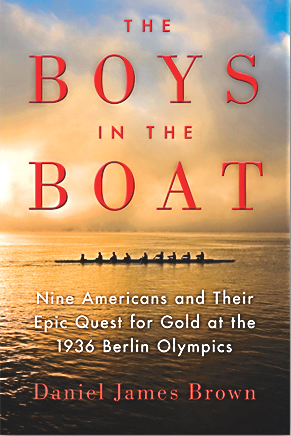
The story of how Rantz and his crew got to the games became The Boys in the Boat, which since its release in mid-2013 has sold some 1.5 million copies.
Brown still finds inspiration in this true tale. He’ll be the keynote speaker at Peninsula Behavioral Health’s annual benefit at the Red Lion Hotel tonight.
The event quickly sold out, according to PBH’s Rebekah Miller.
While writing The Boys in the Boat was an adventure, so is discussing the book’s heart.
“I like to talk about when I stand back from the story, what does it mean to me?” Brown said in an interview from his home near Redmond.
The 1936 rowing team, which came from the University of Washington, was made up of young men who were working class.
They had grown up on dairy farms, out in the woods, and in small towns like Sequim.
Rantz was abandoned after his stepmother couldn’t stand Sequim anymore and his father took her and their other children away.
But when Rantz started rowing, he began a journey that taught him how to trust the people around him. It was an odyssey that would change everything.
In rowing, those compatriots are known collectively as “the boat,” and that trust — built through exhausting workouts and a shared yearning — took the UW rowers to the Olympics.
“This story of nine young Americans who climbed in a boat and pulled together so beautifully,” Brown said, “is a metaphor for what that generation did.
“They found themselves in the same boat, beginning with the Depression, and going on to win World War II on two fronts.
“It came to me after the book was all done: People are so interested in the book [because] it’s looking back to a time they are either old enough to remember or that they are hankering for, a time when we were more able to pull together.
“I know there’s a hunger for that. I hear it over and over, from young people, from old people.”
One example of this unity came when the UW crewmen first qualified to go to Berlin as the U.S. Olympic team.
They would have to pay their own way. This was in the depth of the Depression, so reaping big money from any source seemed unlikely.
But a homegrown campaign began in Seattle.
Supporters of the team stood on street corners, selling little badges for 50 cents apiece — and they helped raise the needed $5,000 in 48 hours.
That sent the boys to the Olympics, and it was a point of pride for people here. Perhaps it was an early version of the Seattle Seahawks’ 12th Man phenomenon, Brown said.
The Boys in the Boat has done exceedingly well in hardcover and paperback. Next, it’s slated to be a movie.
The Weinstein Co. purchased the rights and brought Kenneth Branagh on board to direct. But now Branagh is out and a new director sought, Brown reported.
The author said he won’t be involved with the picture in any meaningful way. He added, however, that the producers are looking at whether it’s feasible to film in Washington state.
The North Olympic Peninsula, it turns out, has a young rower who is following in Rantz’s wake.
Elise Beuke, a Sequim High School student like Rantz was, has rowed her way to a scholarship to UW. The senior plans to join the university’s women’s crew team after she graduates.
Also locally, The Boys in the Boat has drawn eyes to the sport of rowing — what boat builder George Pocock called a “symphony of motion.”
Sequim’s Museum & Arts Center, 175 W. Cedar St., has a “Boys in the Boat” exhibit, replete with memorabilia and a short film from the 1936 Olympics and a cedar racing shell constructed by Pocock, the renowned builder behind the vessels Rantz and crew rowed at UW.
The museum is open from 11 a.m. to 3 p.m. Wednesdays through Saturdays with free admission, though donations are accepted.
In Port Angeles, the Olympic Peninsula Rowing Association has programs for adults and youths, with information found on www.OPRArowing.org.
________
Features Editor Diane Urbani de la Paz can be reached at 360-452-2345, ext. 5062, or at diane.urbani@peninsuladailynews.com.
