
By Jonel Aleccia
The Seattle Times
SEATTLE (AP) — Hayden Werdal can move his right hand and wiggle his left thumb. He can kick his right leg a bit and bend the left one.
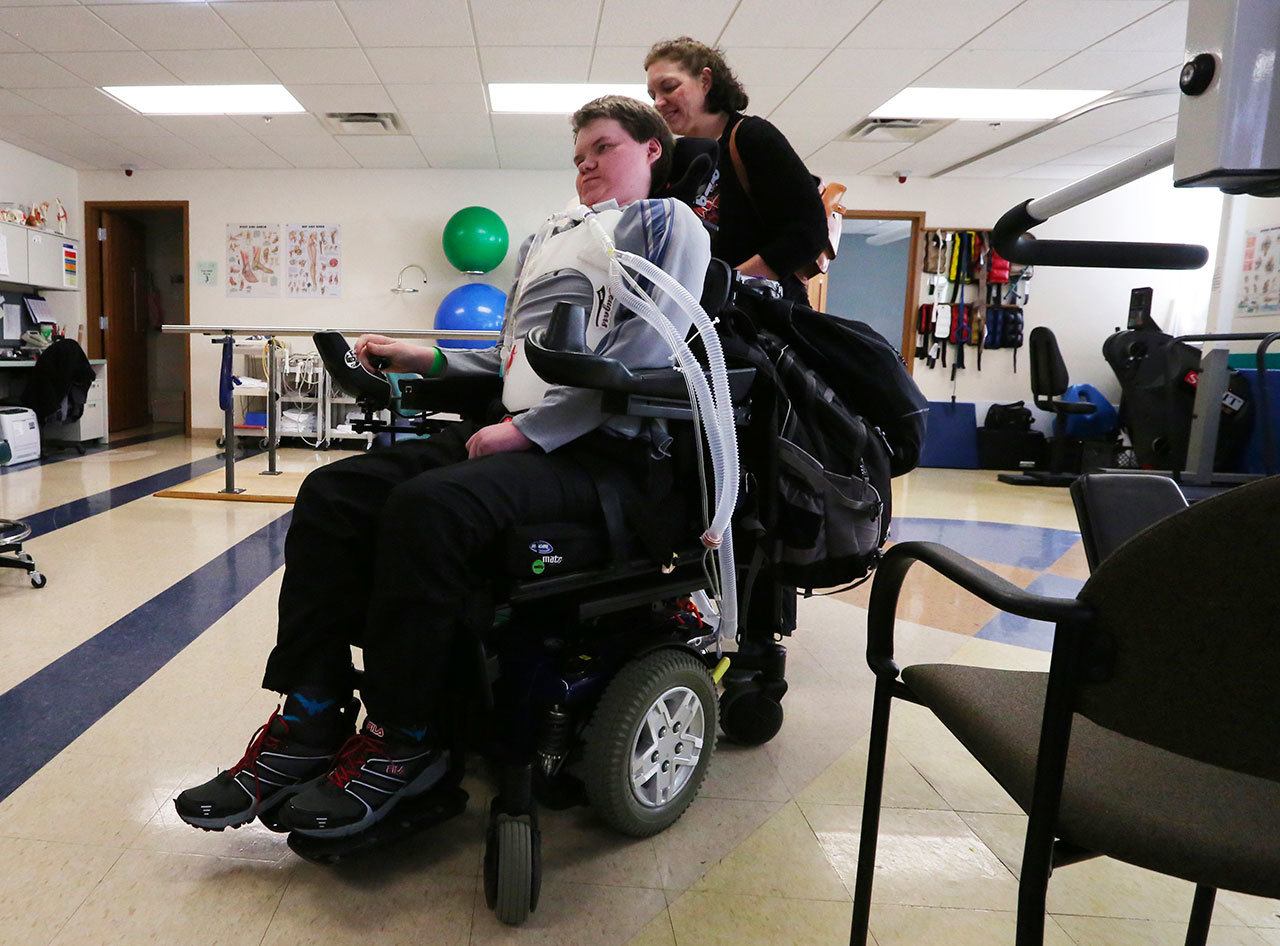
But for the 15-year-old Bremerton boy, that’s been the extent of his motion for two years, ever since he came down with a mysterious, polio-like illness that left him mostly paralyzed from the neck down.
“Hayden is getting stronger, but he’s still considered a quadriplegic,” said his mother, Heather Werdal, 44. “We fight all the time to get back to some normal.”
This fall, just as Hayden marks the second year of his illness, medical experts in Washington state and beyond are puzzling once again over the disorder known as acute flaccid myelitis, or AFM.
Eight Washington children have been hospitalized with confirmed AFM since September, according to the Centers for Disease Control and Prevention (CDC).
The disorder has been ruled out in a ninth child, Daniel Ramirez, 6, of Bellingham, who died Oct. 31. The cause of his death remains under investigation.
But for Hayden Werdal and his family, recovering from the neurological disorder with no known cause or cure is a daily struggle.
“This wasn’t going to be our forever,” Heather Werdal said.
Hayden — who is nearly 6-foot-4, with dark hair, blue eyes and a quick smile — was 13 in October 2014 when he got what his mom thought was just a nasty cold. Within a week, he had a stiff neck and tingling hands and feet. Two days later, his neck couldn’t support his head.
Within weeks, he was paralyzed, breathing with the help of a ventilator.
“We thought we were going to lose him,” Heather Werdal recalled.
The eventual diagnosis was AFM, which appears to start with a common respiratory illness, but quickly leads to devastating and possibly permanent paralysis.
“We had no idea a cold could do this,” said Heather Werdal.
Mom tracks new cases
Hayden was part of a surge in AFM cases in 2014 — at least 120 between August and December that year in 34 states, according to the CDC. That included two confirmed cases in Washington.
There were far fewer in 2015, just 21 in 16 states. But this year it’s up again.
Even as Heather Werdal has followed the new cases reported in Washington, she has been tracking a spike in numbers on a closed Facebook page for families of kids with the neurologic disorder.
“We’re getting this huge influx,” she said. “It’s probably 10 a week from all over the country.”
That anecdotal evidence mirrors cases documented by the CDC, which has confirmed 89 cases in 33 states this year between January and September.
CDC and state officials acknowledge they haven’t been able to pinpoint the cause of AFM, which is characterized not only by limb weakness, but by distinctive lesions that attack the gray matter of the spinal cord.
Cases are confirmed through symptoms and specific findings from magnetic resonance imaging, or MRI, said Dr. Scott Lindquist, the Washington state epidemiologist for infectious disease.
Officials in Washington state and at the CDC are intensifying the investigation. A CDC epidemic intelligence service officer will review every detail of the eight regional AFM cases, interviewing families for any potential clues.
“That’s where we’re at in this investigation, gathering more data,” Lindquist said.
Parents are understandably worried, but there’s no specific action known to prevent AFM.
Doctors urge typical steps to prevent illness, including frequent hand-washing, avoiding sick people and cleaning any potentially contaminated surfaces.
“Sick from a cold”
Dr. Susan Apkon, director of rehabilitation medicine at Seattle Children’s, treated Hayden for several months in 2014.
“I think what’s important to convey is that AFM is not in itself a virus,” she said. “It is not contagious. It is an incredibly rare result of a contagious viral infection.”
In Hayden’s case, the whole family got sick, including his brother, Evan, now 16, who did not develop AFM.
Heather Werdal said she believes Hayden and the others may have genetic or other predispositions that may make them vulnerable to AFM.
“We think there’s something unique in our kids’ DNA that triggers this,” she said.
Whatever the cause, AFM has dramatically altered the Werdal family’s life.
Hayden requires 24-hour care, with two day nurses and a night nurse, in addition to his family.
Hayden’s father, Jeff Werdal, 44, is an IT systems analyst with the city of Bellevue, a position with good health-care coverage. But costs are high, so the family has a GoFundMe fundraising page to help with expenses.
Hayden’s needs have included a motorized wheelchair and the ongoing costs of the physical therapy and occupational therapy that appear to be helping his recovery.
“Four months ago, he did not have respiratory support muscles,” said Kristi van Niel, the occupational therapist who works with Hayden twice a week. Now, they’re getting stronger, which means Hayden is progressing toward breathing on his own.
Hayden himself is matter-of-fact about his condition. He’s back in class as a freshman at Central Kitsap High School, where he’s taking three classes and hopes to catch up with his classmates.
When friends ask, he tells them: “I just got sick from a cold.”
He’s a fan of all video games, including “the scary ones.” And he went to the recent homecoming dance.
“We said, ‘Did you dance?’” his mother recalled. “He said, ‘I wiggled.’”
Hayden said he has days when he gets “mopey,” but he tries to follow the advice of his uncle, who is also a quadriplegic.
“He says, ‘Suck it up,’” Hayden said, grinning.
No one knows when — or if — Hayden will recover full movement, but his mother said he’s determined to regain as much as he can.
“We told him we’re going to figure out a life for him,” she said. “We didn’t see this as the worst thing in the world.”
