
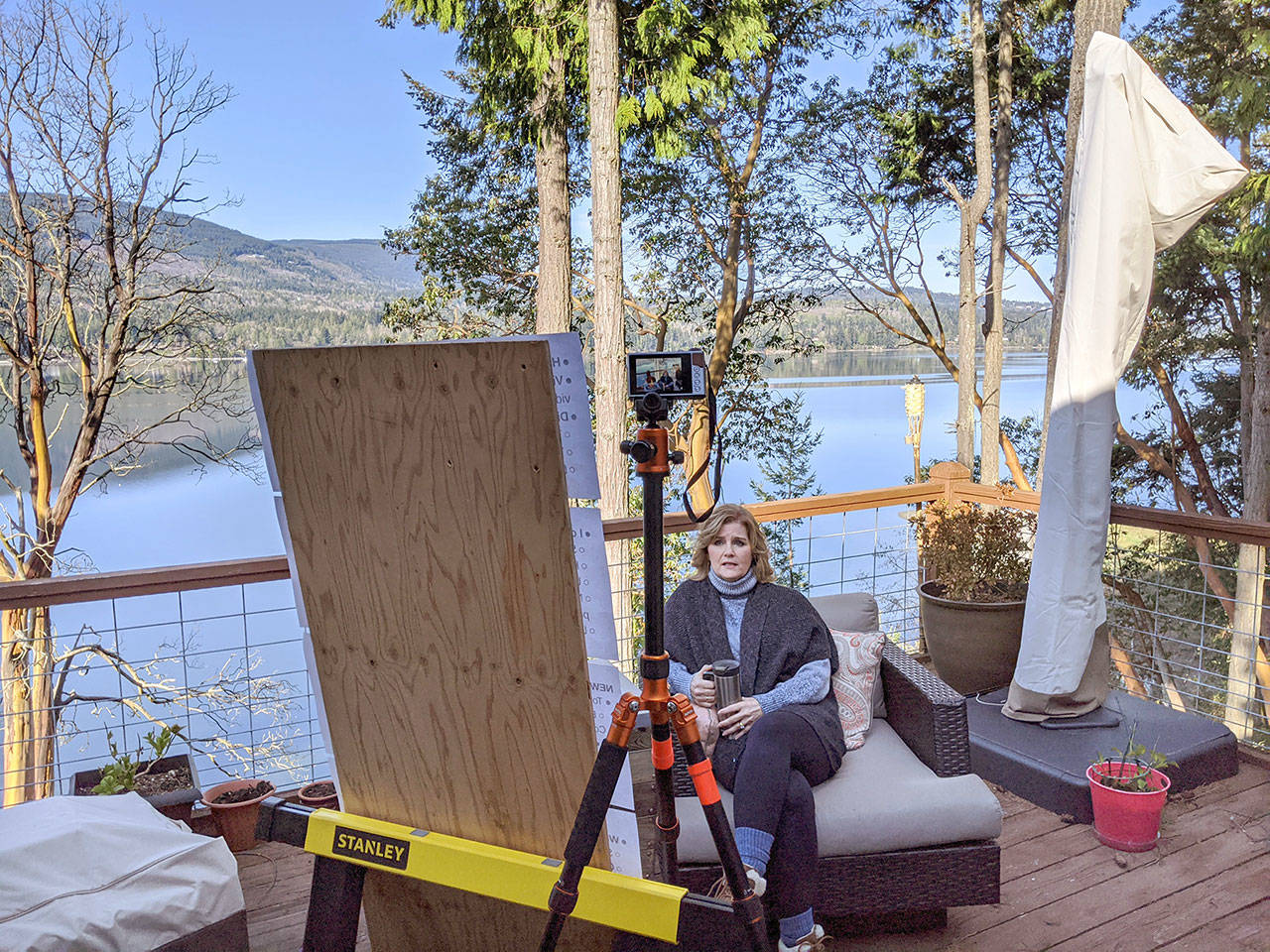
The biggest challenge of teaching students remotely is not seeing them every day, say teachers on the North Olympic Peninsula.
“The grief of not being able to see students, say goodbye, and assure them we will be okay was the hardest for me,” said Mary Krzysiak, a second-grade teacher at Dry Creek Elementary in Port Angeles.
“We didn’t find out about the stay-at-home order until after students were released for the day so it was very difficult to not be able to have those closing discussions with our kids.”
Gov. Jay Inslee closed schools in mid-March to curb the spread of the coronavirus, thinking that they could reopen in mid-April. But on April 6, the governor announced that schools would be closed for the remainder of the school year.
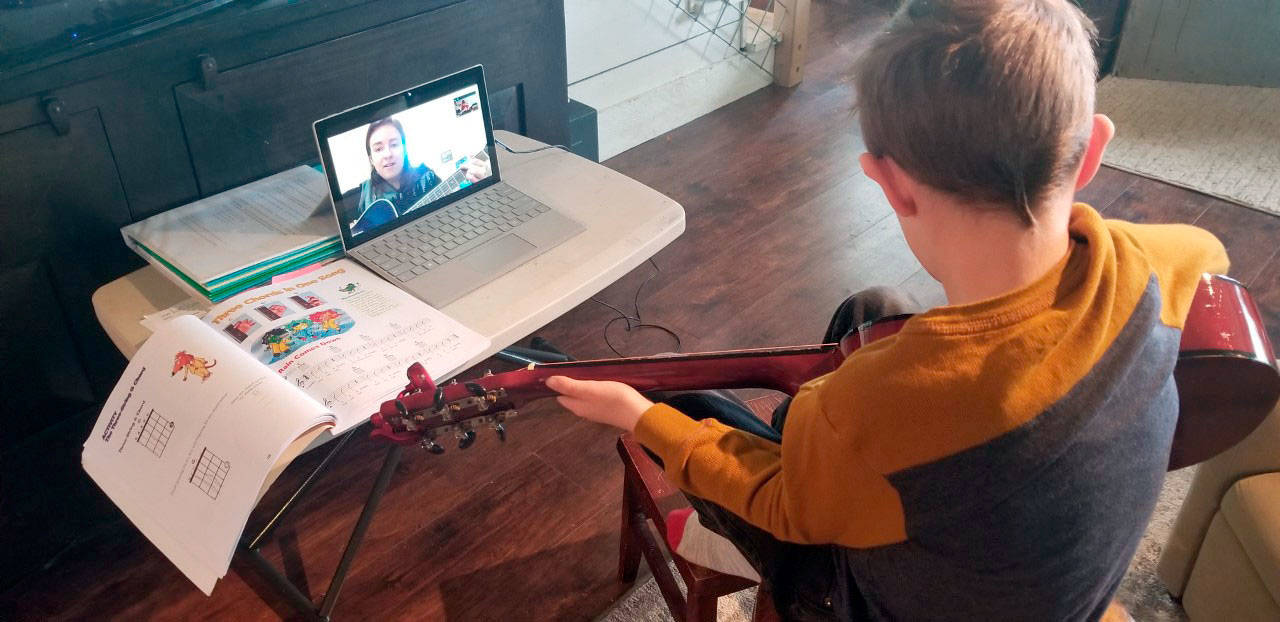
First-grader Leland Munn learns to play the guitar in a Zoom lesson from his teacher Emma Eliason. Eliason teaches Music in the Quilcene School District across all grades.
The initial announcement allowed no prior preparation. It was the first challenge teachers faced: putting together temporary and eventually continuous lesson plans for their students with less than a day’s notice.
“We had one day to prepare our kids with packets for them to take home for, at that time, a six-week period,” said Kimberly Knudson, a first-grade teacher in the Quilcene School District.
Eventually, lesson plans had to be continuous, a challenge exacerbated by the lack of internet access for some households.
“I built the first week’s online lessons on my website based on the work that was sent home,” Knudson said.
“After that, when we realized it would be an indefinite period of time we’d be out, my lessons have been electronic, both synchronous and asynchronous.
“I have one family who doesn’t have internet access. For them they have all the materials they need to support themselves with continued learning with support from me.”
Internet access is the biggest obstacle for some students. Teachers in both Jefferson and Clallam counties agree that high-speed internet and access to it is a necessity for students and their families as well as themselves, especially if they cannot return to their brick-and-mortar classrooms in the fall.
“Equity for all, this comes with computers and reliable internet for all students and teachers, and platforms that support the learning process for teachers, students, and parents,” said Heidi Johnson, first-grade teacher at Chimacum Primary School.
“Unfortunately, that will cost money and I do not know how that will be accomplished.”
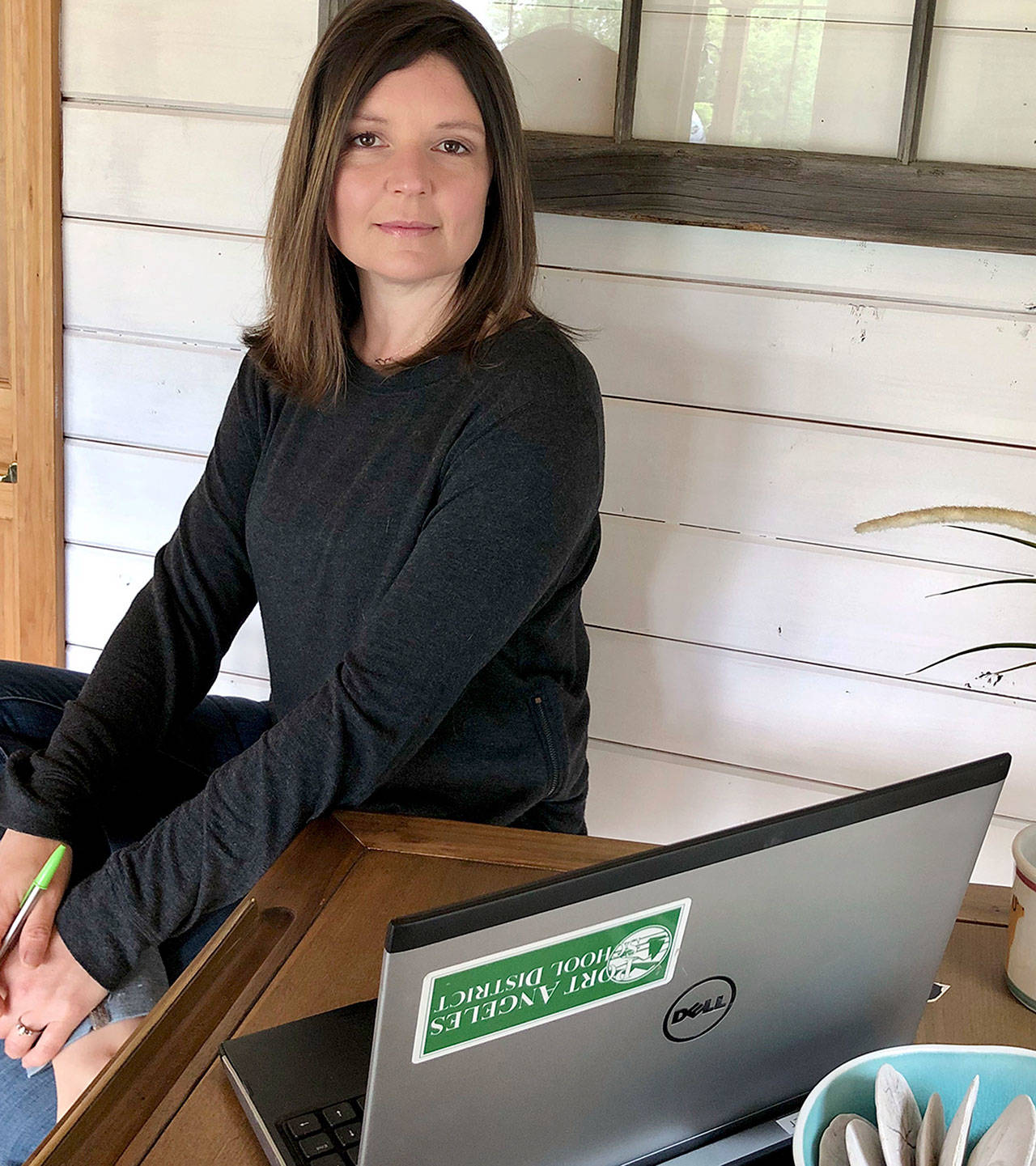
Mary Krzysiak, a second-grade teacher at Dry Creek Elementary in the Port Angeles School District, has converted her home into a virtual classroom.
Keeping even students with internet engaged is another challenge for teachers. They said that younger students often need parental support, while some older students have mentally “checked out.”
“Overall, online teaching has been challenging from a learning and teaching perspective, and I’d consider it subpar to what students experience in the classroom,” said Angie Gooding, AP U.S. History teacher at Port Angeles High School.
“For the majority of my students, learning online doesn’t offer the same depth or thoroughness that classroom learning ensures. For example, in my classroom I can see a student’s confusion and address it immediately. I can also read body language and can assess their understanding based on these slight cues, which are immeasurable when it comes to guiding student learning,” she explained.
“Another thing that classroom instruction offers is a chance to adjust a lesson mid-stream; if a lesson isn’t going as expected, teachers can stop and change the lesson so that we have more success in the classroom,” added Gooding, who won a 2016 Community Service Award for being an accomplished teacher who also founded the Port Angeles Citizen Action Network.
“Often I will immediately change my lesson if I realize students don’t grasp a difficult concept, or back up and reteach a skill that students are struggling with.
Online teaching doesn’t offer the same benefits as face-to-face, Gooding said.
“I have about a 50 to 60 percent student engagement rate, which is exceptionally low,” she said, attributing it to a variety of reasons — lack of WiFi access, stress at home, confusion over assignments, or a struggle with apathy or with how to schedule themselves.”
For older students who have “checked out,” teachers reach out to the students’ families, friends, and peers to get them to re-engage with school.
They are using such applications as Zoom and Google Hangouts to maintain social connections, play educational games, and also check in on students’ social, emotional, and mental health in this time of isolation.
For younger students, parents have more pressure of keeping them on task, which can be extremely difficult if there are multiple children in the house, or if the parents are essential workers and that responsibility falls to someone else in the household.
“Our families did not sign up to be home-school teachers,” Knudson said.
“I’m doing my best to help these amazing parents put a new ‘hat’ on, and it’s not easy for them or their children.”
Younger students tend to do their school work out of workbooks that are delivered with school lunch programs and engage with their teachers on Zoom, Class Dojo, Google Hangouts, or other platforms.
Teachers outline the lessons through YouTube videos that students can pause or play at their own speed and if they still have questions they can ask for one on one time with the teachers.
Other teachers, schools, and districts have adjusted to project-based learning, which incorporates multiple subjects into one or multiple themed projects.
For example, the Quilcene School District chose the theme of the U.S. Civil War. Students studied the history as well as, in science class, the diseases that plagued soldiers during the Civil War; in English class, they were assigned writing letters as though they were living in the 1860s.
Band, art, and dance students learned about the music, art, and cultural dances of the same time period.
Students would spend time on these units for two weeks before moving on to the next theme.
“I have been very impressed with the richness and depth of these interdisciplinary projects and the way the staff has collaborated to develop them,” said James Weller, a math teacher in the Quilcene district.
Though online learning has challenged the teachers and students and their families, some teachers have said the situation has fostered new relationships with their students and student families that they hope will carry into the next year.
“Although I would so much prefer to be working with my students in person right now, I think online learning has helped me build relationships in unique ways,” said Emma Eliason, a Quilcene music teacher.
“I am communicating with parents and families often, being invited into their homes virtually, and they’re seeing my home as well.
“Some are sharing funny stories and videos with me and I’m really enjoying seeing their projects.”
She said that much of the student work has been “impressively creative.
“It’s different than what we’re all used to a traditional school, but I also think there are some positive things that are coming out of the whole situation, Eliason said.
“It’s an unforeseen opportunity for creativity and growth for both the students and the staff.”
________
Reporter Ken Park can be reached at kpark@peninsuladailynews.com.
