
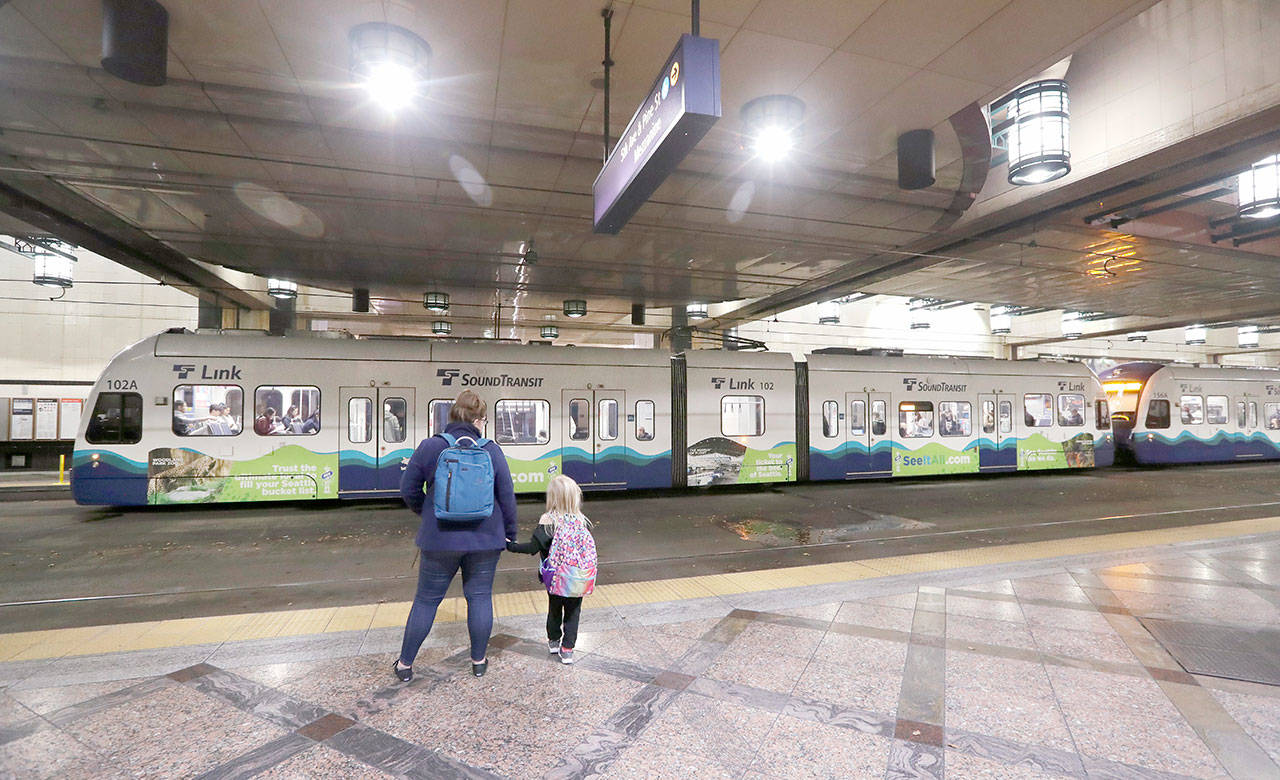
In this Nov. 6, 2019, photo, southbound passengers wait as they look across at a northbound Sound Transit light rail train at an underground station in downtown Seattle. The Washington Supreme Court on Thursday upheld vehicle registration tax increases in the Puget Sound area, a decision that preserves billions of dollars in voter-approved money earmarked for light rail and other projects. (Elaine Thompson/The Associated Press)

In this Nov. 6, 2019, photo, southbound passengers wait as they look across at a northbound Sound Transit light rail train at an underground station in downtown Seattle. The Washington Supreme Court on Thursday upheld vehicle registration tax increases in the Puget Sound area, a decision that preserves billions of dollars in voter-approved money earmarked for light rail and other projects. (Elaine Thompson/The Associated Press)

Supreme Court upholds billions of dollars in transit funding

Funding still in question

  • The Associated Press
  • Friday, February 14, 2020 1:30am
  • News

The Associated Press

SEATTLE — The state Supreme Court on Thursday upheld vehicle registration tax increases in the Puget Sound area, a decision that preserves billions of dollars in voter-approved money earmarked for light trail and other projects.

Seven people had sued to overturn a rate increase by the Central Puget Sound Regional Transit Authority, known as Sound Transit.

Voters in 2016 approved the rate hike to fund the Sound Transit 3 expansion project. The voter-approved expansion project aims to build 62 miles of light rail, reaching Everett in the North, Tacoma and new neighborhoods in Seattle and fast-growing cities to the east, including Kirkland and Redmond.

The lawsuit sought a refund of millions of dollars in car registration fees collected through the increase to help pay for the $54 billion expansion.

In a 7 to 2 decision, the high court justices found that the motor vehicle excise tax used to pay for the Sound Transit projects was constitutional.

Many people who live within in Sound Transit taxing district, which stretches from Everett to south of Tacoma, have long complained their car registration fees were excessive and didn’t accurately reflect the value of their vehicles. Lawyers for the people who sued argued the law authorizing the car fees was vague and the MVET increase was illegal because it wrongly changed the way Sound Transit determined how much vehicles were worth for taxing purposes.

Writing for the majority, Justice Susan Owens said the law authorizing the tax hikes was valid and that it was clear in the text of the statute how cars would be valued for taxing.

Two justices, Sheryl Gordon McCloud and Debra Stephens, dissented.

Gordon McCloud wrote that the underlying statute governing the vehicle tax increase was illegally vague.

“The MVET statute therefore violated the constitutional mandate designed to provide clarity to the legislative process,” she wrote.

Despite the Supreme Court’s ruling the underlying funding for Sound Transit is still in question.

On Wednesday a King County Superior Court judge rejected most of a legal challenge to Tim Eyman’s Initiative 976, a measure voters approved last year that would steeply discount the price of car registrations while gutting transportation budgets across the state.

Judge Marshall Ferguson said King County and a coalition of Washington cities had failed to carry the heavy burden of demonstrating that the $30 car tab measure was unconstitutional on most of their claims.

Those claims included that the description of the initiative on the ballot was misleading and that the measure violated the Washington Constitution’s rule that initiatives be limited to one subject. I-976 will remain blocked from taking effect while the sides gather information and make arguments to the court about those issues, Ferguson said.

The case is expected to wind up before the state Supreme Court.

More in News

Broadband provider says FCC action would be ‘devastating’ to operations

CresComm WiFi serves areas in Joyce, Forks and Lake Sutherland

Public safety tax is passed

Funds could be used on range of services

Stevens Middle School eighth-grader Linda Venuti, left, and seventh-graders Noah Larsen and Airabella Rogers pour through the contents of a time capsule found in August by electrical contractors working on the new school scheduled to open in 2028. The time capsule was buried by sixth graders in 1989. (Paula Hunt/Peninsula Daily News)
Middle school students open capsule from 1989

Phone book, TV Guide among items left behind more than 30 years ago

Electronic edition of newspaper set Thursday

Peninsula Daily News will have an electronic edition on… Continue reading

Hill Street reopens after landslide

Hill Street in Port Angeles has been reopened to… Continue reading

Tom Malone of Port Townsend, seeks the warmth of a towel and a shirt as he leaves the 46-degree waters of the Salish Sea on Saturday after he took a cold plunge to celebrate the winter solstice. “You can’t feel the same after doing this as you did before,” Malone said. (Steve Mullensky/for Peninsula Daily News)
Solstice plunge

Tom Malone of Port Townsend, seeks the warmth of a towel and… Continue reading

Tribe, Commerce sign new agreement

Deal to streamline grant process, official says

Jefferson Healthcare to acquire clinic

Partnership likely to increase service capacity

Joe McDonald, from Fort Worth, Texas, purchases a bag of Brussels sprouts from Red Dog Farm on Saturday, the last day of the Port Townsend Farmers Market in Uptown Port Townsend. The market will resume operations on the first Saturday in April 2026. (Steve Mullensky/for Peninsula Daily News)
End of season

Joe McDonald of Fort Worth, Texas, purchases a bag of Brussels sprouts… Continue reading

Clallam requests new court contracts

Sequim, PA to explore six-month agreements

Joshua and Cindy Sylvester’s brood includes five biological sons, two of whom are grown, a teen girl who needed a home, a 9-year-old whom they adopted through the Indian Child Welfare Act, and two younger children who came to them through kinship foster care. The couple asked that the teen girl and three younger children not be fully named. Shown from left to right are Azuriah Sylvester, Zishe Sylvester, Taylor S., “H” Sylvester, Joshua Sylvester (holding family dog Queso), “R,” Cindy Sylvester, Phin Sylvester, and “O.” (Cindy Sylvester)
Olympic Angels staff, volunteers provide help for foster families

Organization supports community through Love Box, Dare to Dream programs