
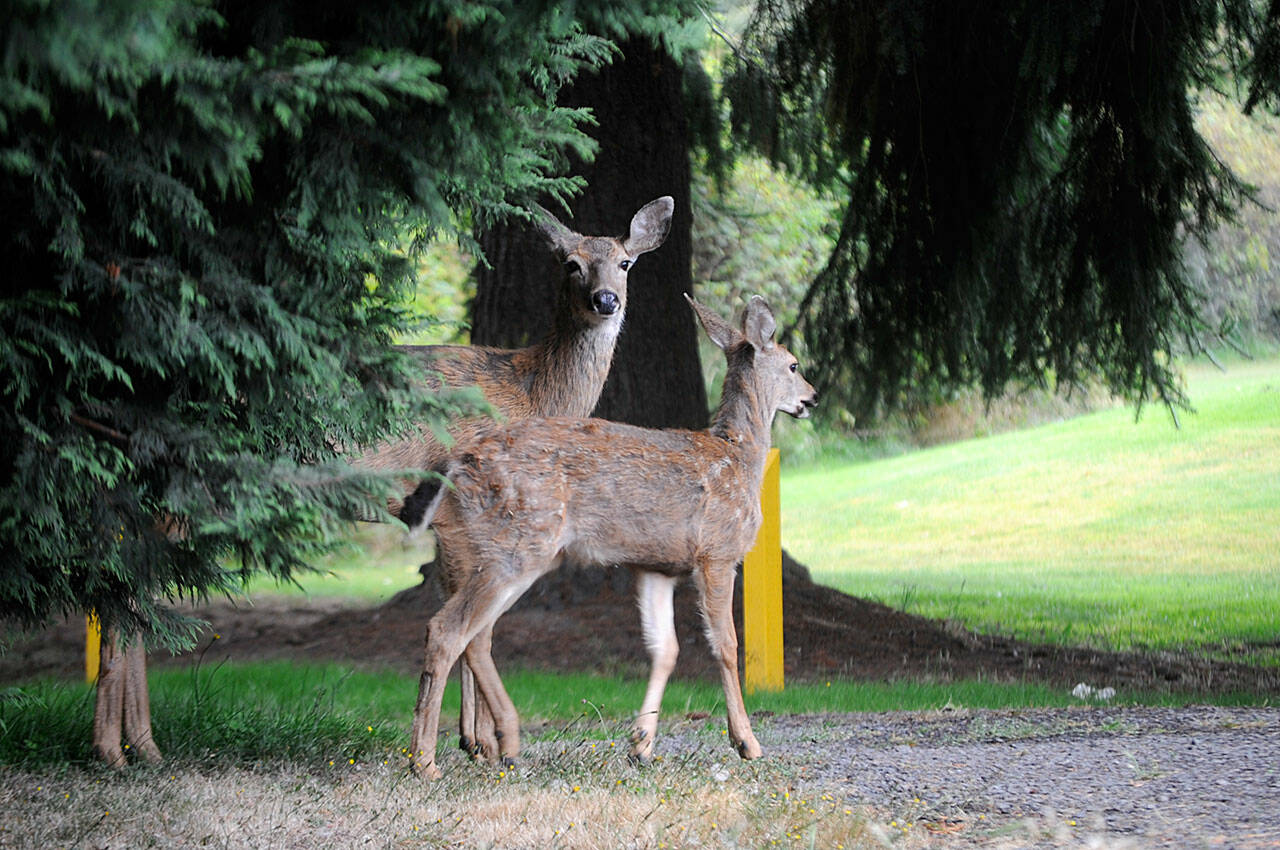
SEQUIM — Concerns over deer damaging landscaping, vehicle collisions and aggressive behavior have prompted the Sunland Owners Association’s board of directors to consider culling the Columbian black-tailed deer’s numbers through trapping and euthanasia.
Although the board of the Sunland Owner’s Association declined to comment for this story, residents said a board decision on a draft plan to keep the deer population to about 22 tentatively could be announced at the next board meeting at 3 p.m. Oct. 18.
Discussions between Sunland residents and the state date back to at least 2015, when Matthew Blankenship, a wildlife conflict specialist for the state Department of Fish and Wildlife, said he began working with residents to lessen the animals’ impact. In recent months, he worked with Sunland’s Deer Study Committee to write a draft Sunland Urban Deer Management Plan.
If implemented, the plan would be the first time the state’s Fish and Wildlife department has undertaken a community-based deer management process, Blankenship said.
It “involves the community as a whole to develop a community plan and implement and analyze its effectiveness,” he said.
Jann Hale, a retired nurse who has lived in Sunland North for six years, said she opposes killing any deer and seeks alternatives.
She gained enough signatures to call a residents-only meeting to discuss deer on Sept. 13 with about 20 speakers opposed to removing deer and a handful in favor, multiple residents confirmed.
About 130 people attended at capacity with masks and social distancing required.
“Not everyone knew about this going on,” Hale said. “I wanted to give people an opportunity to have their say.”
George Bannon, a Sunland North resident for seven years, said he supports the plan.
“I’ve had some experience with (the deer) eating flowers and bushes,” he said.
While he hasn’t experienced any aggressive deer, Bannon had other concerns, such as with ticks and Lyme disease hurting pets and residents, and occasional car accidents.
“Yard damage is costly,” he said. “We spray all of our bushes with deer repellent and even that doesn’t mean they stay away.”
“The game department said it’s overpopulated,” he added. “It’s not all the deer. It’s just lowering their numbers.”
Research
Blankenship said he and Sunland volunteers have “done quite a bit of research on deer,” including surveys of residents on deer impact in 2018 and 2021, and a deer count in 2020.
The plan went out in August for a one-month public comment period to learn if the public supported it, but Blankenship said only about 70 households of 900-plus residents responded, something he said was not typical of Sunland.
According to survey results from Blankenship, 72 homes responded — with 42 against the plan, 27 for it, and three undecided.
Blankenship said he told the Sunland Owners Association’s board that the department “would not implement any community-based plan with only hearing from 8 percent of the community.”
“The purpose of this plan is to create a plan that addresses the conflict and meets the needs of the majority of residents,” Blankenship said.
“We need to hear from more residents in order to have a large enough sample size that can be used to infer the community’s sentiments.”
Plan details
The draft plan aims to annually reduce the deer population in the area to 22 between 2022-2025, if necessary. State officials would trap, euthanize and harvest the deer meat for local food banks and tribal agencies, Blankenship said.
Continued deer counts by volunteer Sunland residents would determine deer density, the draft plan states.
Research by the Swinomish Indian Tribe showed that natural settings held a density of 22 deer per square mile, whereas Sunland is about 2.5 times that, according to the draft plan.
Options ruled out by state officials are fertility control (considered experimental); managed hunts (too dense of population), and trapping and translocation (not allowed in Washington state, and has high deer mortality rates).
“The Sunland deer population is expected to grow exponentially if left unmanaged, resulting in a higher management cost in future years,” the draft plan states.
“Although the removal of deer within urban environments can be controversial, research across the country indicates that it can have positive effects at reducing conflicts associated with deer browsing and deer-vehicle collisions.”
Some of the plan’s other goals are to reduce vehicle collisions with deer to an average of one per year; minimize the percentage of respondents who report they are “very to extremely concerned” about deer damage to plantings, gardens and landscaping around their homes to less than 25 percent; and reduce the number of incidents/reports of deer acting aggressively toward Sunland residents to an average of two reports/incidents per year, all by 2025.
Blankenship and the deer committee also made multiple recommendations, such as the Homeowners Association adding information on its website on deer-resistant landscaping and repellents.
They also recommended adopting stricter policies on wildlife feeding, and amending fence restrictions that are aesthetically pleasing and effectively excludes deer from “areas deemed critical by individual residents.”
If the draft plan is approved by the board, Blankenship said the state would implement trapping with deer count assistance from Sunland residents, and use it as a case study for Washington state on community-based deer management.
Community response
The draft compares community surveys from 2018 and 2021 showing the community generally likes deer, with 61.54 percent having a positive response to them in 2018 and 58.32 percent in 2021.
However, residents in 245 homes said that, since 2018, they’ve experienced damage to their gardens and/or landscaping from deer, while 74 said they’ve experienced deer being aggressive, and 27 said they’ve been involved in deer-related auto accidents, according to Blankenship’s report, “An Analysis of Deer Conflict Severity.”
Of those who have experienced garden/landscaping issues, 213 homeowners said they’ve planted deer-resistant plants, 165 have used deer repellent and 115 said they’ve upgraded fencing.
The state Department of Transportation reported there were 1.25 deer-vehicle collisions each year on roads adjacent to Sunland from 2017-present, while Fish and Wildlife staff states Sunland residents report 2.65 incidents of deer acting aggressively annually from 2015-2020.
While responses to the draft plan were low, the 2021 survey showed 219 residents supported the Deer Advisory Committee and the state working together to control the deer population.
However, residents from 84 homes said they needed more information, 41 said maybe, and 30 said no.
When residents were asked about the deer population over five years, most said it’s increased, with 124 saying it’s “increased greatly,” 83 saying it’s “increased slightly,” 94 stating it’s the same, and 11 stating it’s decreased slightly (10) or greatly (one).
“The deer count was done last October and a lot of people don’t think it’s accurate,” Hale said.
According to Blankenship, the Sunland deer population survey (count) was conducted twice a day at dawn and dusk by volunteers from Oct. 5-8, 2020.
“The numbers to me don’t add up and justify killing the deer,” Hale said. “(Blankenship) told us the deer are all healthy, so we don’t see any reason to support or justify it.”
Hale proposes using other methods for mitigating the deer, such as planting more plants or trees they don’t like, using deer repellent, looking at fencing restrictions, and recounting the present deer population.
“A majority, at least in Sunland North, like the deer,” Hale said. “The reason I moved here was to look at deer.”
For more information about the Sunland Owners Association, visit sunlandhomeowners.com.
________
Matthew Nash is a reporter with the Olympic Peninsula News Group, which is composed of Sound Publishing newspapers Peninsula Daily News, Sequim Gazette and Forks Forum. Reach him at mnash@sequimgazette.com.
