
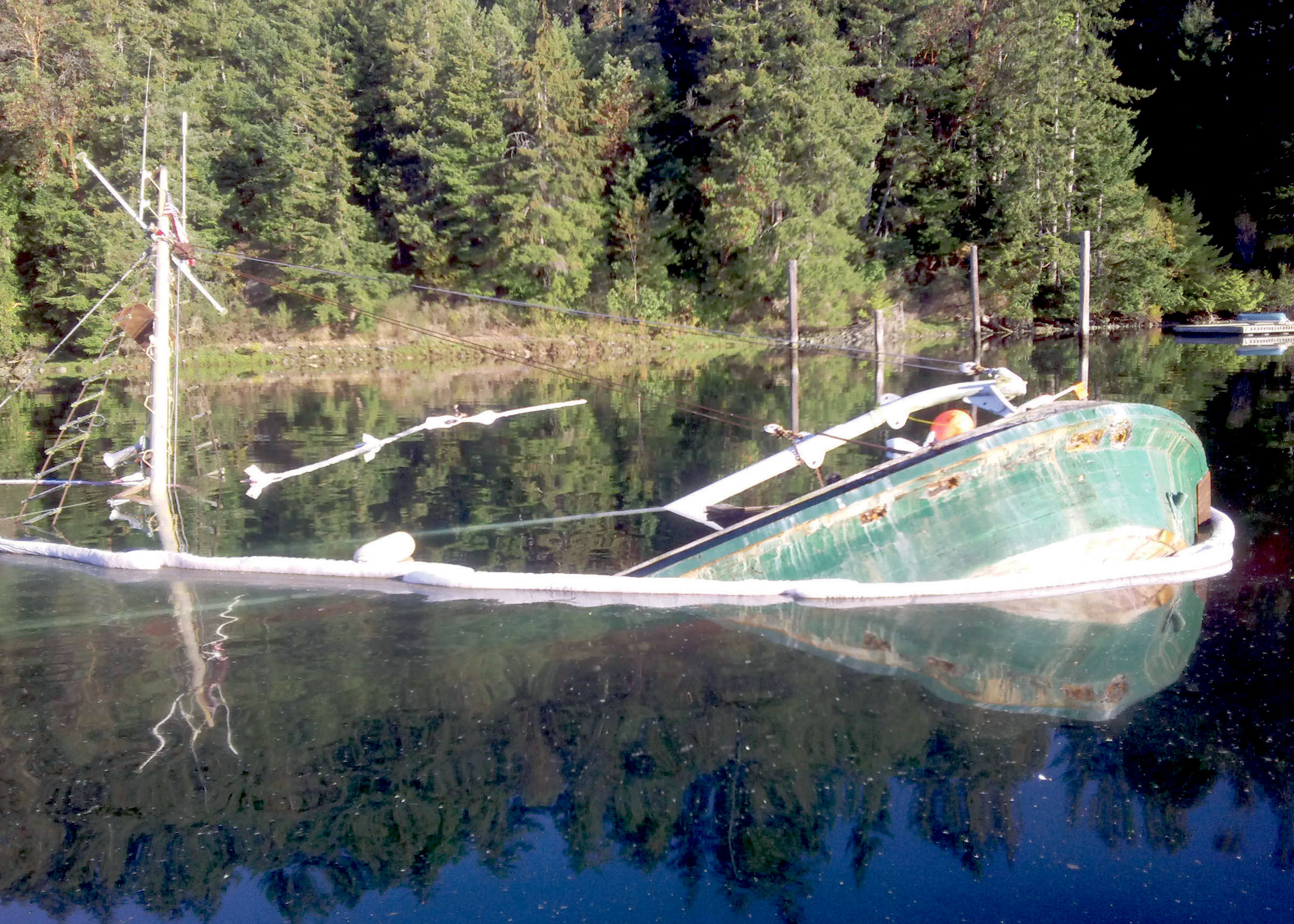
BRINNON — The captain of a 65-foot pleasure craft that sank near a Pleasant Harbor shore last month has 10 days to file a Coast Guard-approved salvage plan to raise his partially-submerged vessel.
Otherwise, the state Department of Natural Resources will take possession of the Avalon on Oct. 24 and hire a contractor to have it removed.
Randy Schleich said he is willing to work with the Coast Guard, Natural Resources and other state agencies to salvage the 1929 wooden purse seiner he purchased about a year ago.
“By all means, pull the boat up,” Schleich said during a meeting last Friday on the Avalon response in Brinnon.
“Let’s get it up. I want to keep the boat, and I will make payments until I have paid every dime back, every nickel, every penny back. But nobody seems to want to do that.”
Schleich complained that the state and federal agencies have no mechanism in place to allow him make payments on the vessel’s salvage and the $70,000 he already owes for a multi-agency response to a diesel spill.
The cost of salvage is currently undetermined.
He said he is “wiling to stand up” and reimburse the federal Oil Spill Liability Trust Fund and Natural Resources over time.
Kyle Murphy, assistant division manager of Natural Resources’s aquatics division, said the agency lacks the legal authority to “work on an owner’s behalf to remove their vessel and then hand that vessel back over to them.”
“The Department of Natural Resources is not the government’s salvage company,” Murphy said.
The Avalon sank as it was being towed by a 14-foot skiff in the early morning hours of Sept. 14.
Schleich and his crew were in the process of installing a new engine when it ran aground.
“We had a plan,” Schleich said after the community meeting.
“We were working our plan, and the motor died at the wrong time. Inertia backed it into the beach.”
The grounded vessel tipped onto its side, exposing water line seams that opened at low tide.
The open seams caused the Avalon to take on water faster than the two-inch bilge pumps could handle, he said.
The vessel sank bow-first at about 2:30 a.m., releasing about 70 gallons of diesel into Pleasant Harbor.
“Oops happened,” Schleich said. “I’m sorry. I didn’t want it to happen, obviously.”
Schleich and three crew members made it to shore at the Pleasant Harbor State Park on the skiff.
Later that day, the Coast Guard hired Global Diving and Salvage to contain the diesel spill.
A containment boom was placed around the vessel, and absorbents collected diesel from the water.
Coast Guard Cmdr. Brian Meier, chief of response for Coast Guard Sector Puget Sound, said 350 gallons of diesel were removed from the Avalon’s fuel tanks.
“After that product was removed, we stabilized the tanks and plugged the vents to keep the residual [fuel] from getting into the environment,” Meier told about 30 attendees of the community meeting.
“Had those actions not been taken within the first day, this could have been seven times worse than it was.”
David Byers, statewide spill response manager for the state Department of Ecology, said diesel spills are “always a challenge.”
“It’s hard to boom it fast enough,” he said.
“As soon as it hits the water, it spreads out very quickly into a thin film.
“Once the diesel spreads out to that thin rainbow, or silvery sheen, it’s pretty much game over for recovery.”
Byers said there were no reports of a fish kill or oiled birds as a result of the Avalon sinking.
“Even if you don’t see those, we still know that diesel enters the environment, enters the ecosystem and takes a while for the area to recover,” Byers said.
Property owners near the sunken vessel reported a diesel smell coming from the Avalon.
Nature has its own way of cleaning diesel spills, Byers said, through evaporation and biological degradation.
“It continues to evaporate into the air, and it continues to dissolve into the water column, and certainly you’ve smelled the results of the diesel fumes in the area as a result of it evaporating into the air,” Byers said.
Although Schleich has a “right to salvage his vessel,” Meier said the owner needs to submit a Coast Guard-approved salvage plan that accounts for safety and minimizes environmental impacts.
“It’s a big deal, and should be a big deal, when the federal government and the state government are talking about taking someone’s personal property,” Meier said.
“That person has a right to enact salvage of that vessel.
“Right now, we have a Captain of the Port order against the vessel preventing salvage from occurring until a salvage plan is acceptable from us and from our experts at the salvage engineering and response team.”
The Coast Guard must show an “imminent and substantial threat to the environment” to remove the Avalon, which is surrounded by a hard boom.
“We don’t believe that the substantial part exists, based on what we did to mitigate the fuel from entering into the environment,” Meier said.
The state, however, can take temporary possession of a derelict vessel if it poses a non-substantial imminent threat to human health and the environment if the vessel owner is “unwilling or unable to assume immediate responsibility.”
“The vessel owner is willing and attempting to take the steps necessary to remove his vessel,” Murphy said.
“We don’t feel like we meet those conditions for taking temporary possession of the vessel.”
Instead, Natural Resources has initiated a 30-day custody process that ends Oct. 24.
The agency has an emergency contractor that could remove the Avalon “within a day or two” of Natural Resources taking custody.
Schleich, who can challenge the state’s possession of the Avalon in court, submitted two handwritten salvage plans to Coast Guard officials.
Meier said the plans failed to meet buoyancy requirements, and that Schleich’s proposed salvage team lacked hazard certification.
Schleich said he has made arraignments for his divers to take a hazard-certification course.
“It sounds like we’re very close then, and that’s encouraging,” Meier told Schleich.
________
Reporter Rob Ollikainen can be reached at 360-452-2345, ext. 5072, or at rollikainen@peninsuladailynews.com.
