
By MARTIN FACKLER
Copyright 2014 New York Times News Service
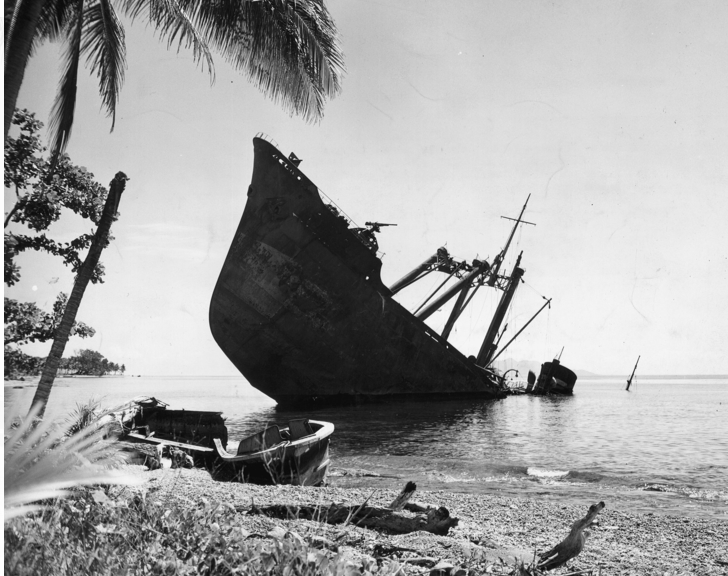
GUADALCANAL, Solomon Islands — Using a trowel to dig into the shadowy floor of the rain forest, pausing only to wipe away sweat and malaria-carrying mosquitoes, Atsushi Maeda holds up what he has traveled so far, to this South Pacific island, to find: a human bone, turned orange-brown with age.
Mr. Maeda, 21, was looking for the remains of missing Japanese soldiers at the site of one of World War II’s most ferocious battles.
Others have done this work before him, mostly aging veterans or bereaved relatives.
But he was with a group of mostly university students and young professionals, nearly all of them under 40 and without a direct connection to the soldiers killed here.
They had come to honor their countrymen, many of whom were no older than they are when they fell on the battlefield. The group was also searching for answers.
“These young men who died here believed they were defending their family and loved ones,” said Mr. Maeda, a university junior in religious studies. “We need to rediscover their sacrifices and learn from them.”
As the 70th anniversary of the end of World War II approaches, there has been a surge in interest among young Japanese about the disastrous war that their nation has long tried to forget.
It is a phenomenon that crosses political lines, encompassing progressives who preach the futility of war as well as conservatives who question the historical record of Japan’s wartime atrocities.
What these young people have in common is an urgent sense that they learned too little about the war, both from school, where classes focus on earlier Japanese history, and from tight-lipped family members, who prefer not to revisit a painful time.
Driving this nationwide pursuit into the past has been China’s hostility toward Japan over control of disputed East China Sea islands, known in China as the Diaoyu and in Japan as the Senkaku.
Despite recent diplomatic maneuvering to ease tensions, anxiety about China’s rise remains strong in Japan.
“For the first time since 1945, Japan is facing a small but real possibility of conflict,” said Yurie Chiba, a magazine editor who organizes talks by veterans, has written about the new interest in World War II and argues that Japan must never go to war again.
“This makes people want to learn more about those who fought in the war, to rediscover how horrible war can be.”
Kankoh Sakitsu, 42, the head priest of a Buddhist temple in Tokyo who organizes expeditions to Guadalcanal, has seen interest among young people grow after his first trip here in 2008.
Since then, he has arranged three other journeys for groups of Japanese, including this one in September.
Mr. Sakitsu originally went to Guadalcanal to pray at the battle sites out of a sense of contrition because he feels Japanese Buddhism failed to oppose the war in the 1930s and 1940s, and so shares responsibility for it.
Once on the island, he was shocked when a relics collector brought him the bones of Japanese soldiers.
He became determined to hunt for the remains of some 7,000 of his countrymen still missing on Guadalcanal, victims of the six-month battle that started in August 1942 and helped turn the Pacific war in favor of the United States and its allies.
Mr. Sakitsu said most of the 36,000 Japanese soldiers dispatched here were unaware of the strategic objectives for their country’s aggression in the South Pacific.
“They just saw themselves as answering the call of their nation,” he said. Some 22,000 Japanese and 7,000 Americans died on Guadalcanal.
Realizing that veterans were growing too old to continue to look for the 1.1 million Japanese still missing across Asia and the Pacific, Mr. Sakitsu hit on the idea of bringing in a new generation of Japanese to take over the hunt.
When he posted an online recruiting ad, he was surprised at the number of replies from university students.
Veterans and others donate to the expeditions, and the Health Ministry, which oversees the retrieval and repatriation of war remains, helps subsidize the ventures.
In Japan, the denials of war atrocities by the country’s nationalists often get attention.
But the participants in the September expedition said they were part of a less-vocal majority who did not seek to glorify or whitewash the war that left three million Japanese soldiers and civilians dead, and their country in ruins.
Rather, they simply want to recover memories of the war, particularly the experiences of ordinary soldiers who died on distant battlefields like Guadalcanal, an occurrence they do not want Japan to repeat.
“This is not about nationalism or ideology, but a rediscovery of the sacrifices of common soldiers who were no older than many of our members when they died,” Mr. Sakitsu said.
It is also, he said, about a realization that the generations who fought in the war will soon be gone, taking with them the last living links to a dark chapter in Japan’s history that the nation still struggles to come to terms with.
The right-leaning government of Prime Minister Shinzo Abe has called for more positive portrayals of Japan’s wartime behavior, outraging the victims of 20th-century Japanese empire-building, like China and South Korea.
One of the first to join Mr. Sakitsu in 2011 was Atushi Hirano, now a 22-year-old university senior studying to become a schoolteacher. He has been on all four expeditions.
Mr. Hirano said that he had avoided so overtly political a topic until five years ago, when the death of his grandfather, a veteran who fought in China, made him suddenly realize that he had never talked with him about those war experiences.
It was a resulting sense of remorse that brought him to Guadalcanal, Mr. Hirano said, a place most of his friends had barely heard of.
“Coming here, seeing the bones and war relics, helping those who died finally return to Japan, these are the next best ways to learn,” he said. “How can we avoid repeating the mistake of the war if we don’t know what happened?”
The desire to find out more about the war years is showing up in many other ways across the country.
Bookstores are filled with vivid memoirs and books describing weapons and battles.
The last veterans, now in their 90s and eager to recount their wartime experiences before they die, draw crowds of listeners. The biggest-grossing domestic-made movie of the year — and one of the most debated — has been “The Eternal Zero,” the fictional story of a young Japanese man who is prompted by the funeral of his grandmother to learn about the grandfather he never knew, a pilot of Japan’s storied Zero fighter plane who died as a kamikaze in the war.
During their two weeks on Guadalcanal, the 27 expedition members found about 30 sets of remains, mostly partial skeletons unearthed from the hard, dark brown jungle floor.
On one afternoon, the group dug shallow pits into a hillside where, 72 years before, retreating Japanese soldiers had set up a field hospital to treat their wounded.
Mixed in with the bones, which were so fragile that they crumbled if squeezed too hard, the group also found personal items: Japanese-made buttons, eyeglasses, a toothbrush.
At day’s end, the items were laid on bright green banana leaves so the group could offer short prayers before heading back to its campsite across a river.
Keiko Terasaki, 27, a first-time participant, wiped away a tear as she carefully wrapped some bones in leaves.
“Japan has neglected these men by leaving them in the jungle,” said Ms. Terasaki, who works as an aide to a City Council member in Hiroshima. “They gave everything when their nation needed it.”
Mr. Sakitsu, the leader, said the September group was special because it was joined for the first time by one of the last surviving Japanese veterans from the battle, Junshiro Kanaizumi.
Mr. Kanaizumi, 95, was an army engineer who helped build roads in the jungle.
Now bent and frail with age, shuffling to the edge of the jungle with the help of a walking stick, Mr. Kanaizumi wore the same khaki jumpsuit with a Japanese flag on one shoulder as the other members.
Peering into one of the leaf-wrapped bundles, Mr. Kanaizumi said it was possible he once knew the man now reduced to a pile of crumbling bones.
“I hope they learn the miserable reality of war,” he said. “Once I am gone, who will be around to tell them that the only lesson from war is to never do it again?”
