
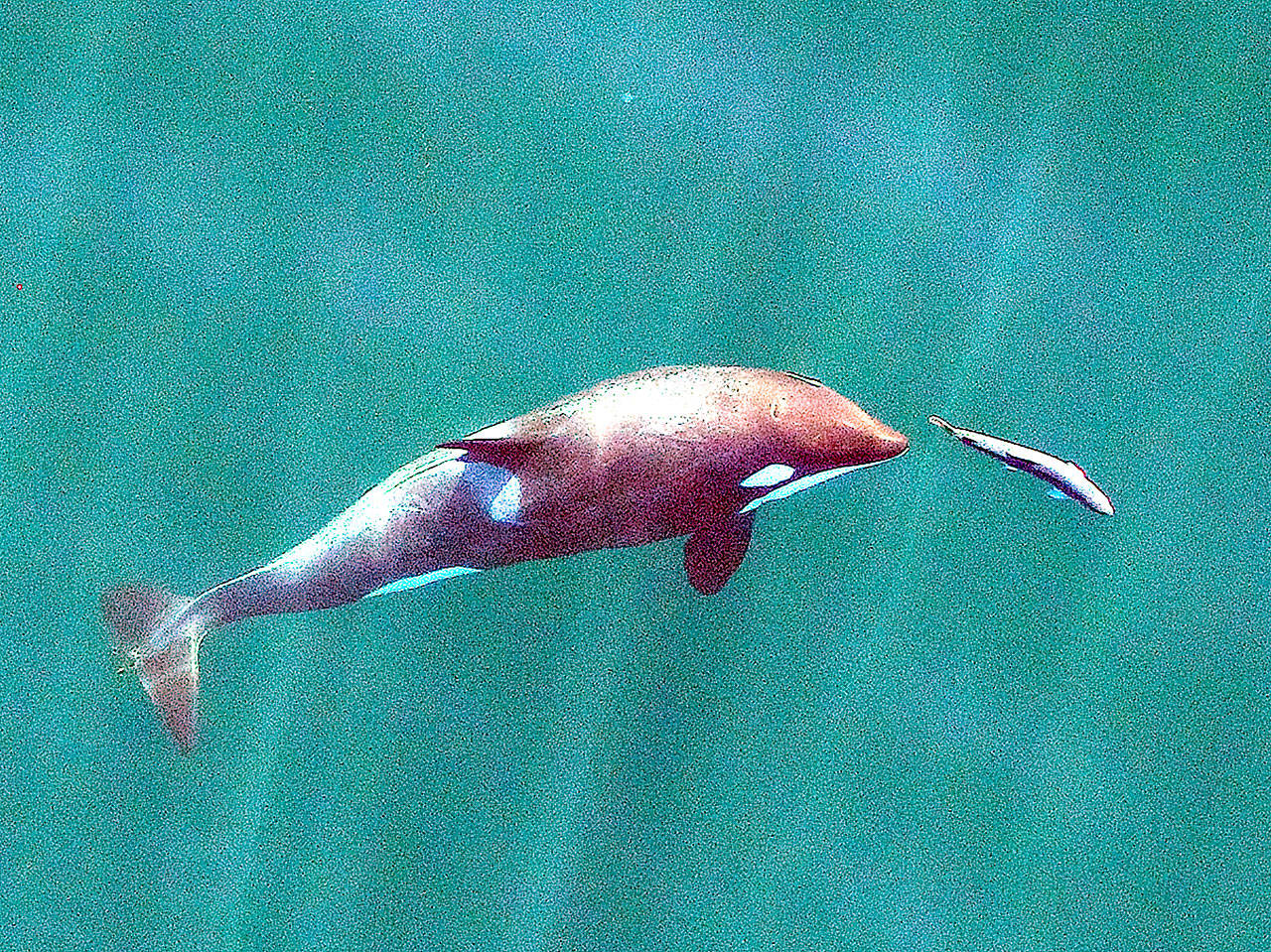
In this Sept. 2017 photo made with a drone, a young resident orca chases a chinook salmon near San Juan Island. The photo, made under a National Marine Fisheries Service (NMFS) permit, which gives researchers permission to approach the animals, was made in collaboration with NOAA Fisheries/Southwest Fisheries Science Center, SR3 Sealife Response, Rehabilitation, and Research and the Vancouver Aquarium’s Coastal Ocean Research Institute. Endangered Puget Sound orcas that feed on chinook salmon face more competition from seals, sea lions and other killer whales than from commercial and recreational fishermen, a new study finds. (John Durban/NOAA Fisheries/Southwest Fisheries Science Center via AP)

In this Sept. 2017 photo made with a drone, a young resident orca chases a chinook salmon near San Juan Island. The photo, made under a National Marine Fisheries Service (NMFS) permit, which gives researchers permission to approach the animals, was made in collaboration with NOAA Fisheries/Southwest Fisheries Science Center, SR3 Sealife Response, Rehabilitation, and Research and the Vancouver Aquarium’s Coastal Ocean Research Institute. Endangered Puget Sound orcas that feed on chinook salmon face more competition from seals, sea lions and other killer whales than from commercial and recreational fishermen, a new study finds. (John Durban/NOAA Fisheries/Southwest Fisheries Science Center via AP)

Study finds host of predators depleting salmon for southern resident orcas

By Phuong Le

The Associated Press

SEATTLE — Harbor seals, sea lions and some fish-eating orcas have been rebounding along the Northeast Pacific Ocean in recent decades. But that boom has come with a trade-off: They’re devouring more of the salmon prized by a unique but fragile population of endangered orcas.

Competition with other marine mammals for the same food may be a bigger problem than fishing, at least in recent years, for southern resident orcas that spend time in Puget Sound, a new study suggests.

Researchers used models to estimate that from 1975 to 2015, marine mammals along the U.S. West Coast ate dramatically more chinook salmon — from 6,100 metric tons to 15,200 metric tons, according to a study published Monday in the journal Scientific Reports.

In the same period, salmon caught by commercial and recreational fishing from Northern California to Alaska declined from 16,400 to 9,600 metric tons.

“This really quantifies yet another pressure on recovering the salmon population,” said co-author Isaac Kaplan, a research fishery biologist with the Northwest Fisheries Science Center, part of NOAA Fisheries. Other threats to salmon include habitat damage, dams and pollution.

The emphasis typically has been on managing how fishing affects salmon. But this study brings the rest of the ecosystem, including predators, into the picture, Kaplan said.

Researchers have known marine mammals gorge on salmon in certain hot spots, including the Columbia River between Oregon and Washington.

But the predators may be eating even more in the ocean than thought.

The authors estimated how much salmon in different life stages four marine mammals ate based on a number of assumptions, including their weight, diet and size. The species included California sea lions, Stellar sea lions, harbor seals and fish-eating orcas.

The study does a very good job of accounting for who eats chinook salmon during its various life stages, said Andrew Trites, professor and director of the marine mammal research unit at the University of British Columbia. He was not involved in the study.

“They’ve identified some of the major players, but they haven’t identified them all,” such as other fish, marine birds and porpoises, he said.

The study found orcas, which increased from 292 to 644, ate the most salmon in terms of biomass, or weight, while harbor seals ate the greatest numbers of salmon, mostly juvenile fish.

Scientists also found certain populations of fish-eating resident orcas in southeast Alaska and Canada waters ate a lot more salmon. But the orcas that spend time in Puget Sound ate about the same volume they did 40 years ago, mostly because their numbers have been relatively constant.

Puget Sound orcas, also known as southern resident killer whales, face greater challenges than their orca counterparts farther north because they have a narrower menu of fish stocks and fewer available fish compared with what they need, Kaplan said.

These whales have struggled due to lack of food, pollution and impacts from boats since they were listed as endangered in Canada in 2003 and 2005 in the U.S. There are now just 76, down from a high of 140 decades ago.

Marine mammal protection efforts including the Marine Mammal Protection Act in 1972 have meant good news for other populations. Harbor seals, for example, increased 210,000 to 355,000.

Puget Sound orcas consume adult chinook salmon — also called king salmon because they’re the largest — that migrate back to Puget Sound waters.

“Every other one of those predators has a chance to eat that salmon before. They’re the last ones to sit at the table and get a chance to eat,” said Brandon Chasco, lead author of the study and an Oregon State University postdoctoral student.

Meanwhile, harbor seals feast on millions of smaller, juvenile salmon as they migrate to the ocean from local rivers.

“They’re first in line to eat the prey before they become adults,” Chasco said. “The question is whether those fish would have died in the ocean, or if they’re taking prey out of the mouths of predators farther downstream.”

The authors say efforts to restore threatened salmon runs may be masked by the increasing numbers eaten by these marine mammals.

The study was paid for by the Pacific Salmon Commission, which was formed by the governments of Canada and the United States in 1985.

More in News

Sue Long, left, Vicki Bennett and Frank Handler, all from Port Townsend, volunteer at the Martin Luther King Day of Service beach restoration on Monday at Fort Worden State Park. The activity took place on Knapp Circle near the Point Wilson Lighthouse. Sixty-four volunteers participated in the removal of non-native beach grasses. (Steve Mullensky/for Peninsula Daily News)
Work party

Sue Long, left, Vicki Bennett and Frank Handler, all from Port Townsend,… Continue reading

Portion of bridge to be replaced

Tribe: Wooden truss at railroad park deteriorating

Kingsya Omega, left, and Ben Wilson settle into a hand-holding exercise. (Aliko Weste)
Process undermines ‘Black brute’ narrative

Port Townsend company’s second film shot in Hawaii

Jefferson PUD to replace water main in Coyle

Jefferson PUD commissioners awarded a $1.3 million construction contract… Continue reading

Scott Mauk.
Chimacum superintendent receives national award

Chimacum School District Superintendent Scott Mauk has received the National… Continue reading

Hood Canal Coordinating Council meeting canceled

The annual meeting of the Hood Canal Coordinating Council, scheduled… Continue reading

Bruce Murray, left, and Ralph Parsons hang a cloth exhibition in the rotunda of the old Clallam County Courthouse on Friday in Port Angeles. The North Olympic History Center exhibit tells the story of the post office past and present across Clallam County. The display will be open until early February, when it will be relocated to the Sequim City Hall followed by stops on the West End. The project was made possible due to a grant from the Clallam County Heritage Advisory Board. (Dave Logan/for Peninsula Daily News)
Post office past and present

Bruce Murray, left, and Ralph Parsons hang a cloth exhibition in the… Continue reading

This agave grew from the size of a baseball in the 1990s to the height of Isobel Johnston’s roof in 2020. She saw it bloom in 2023. Following her death last year, Clallam County Fire District 3 commissioners, who purchased the property on Fifth Avenue in 2015, agreed to sell it to support the building of a new Carlsborg fire station. (Matthew Nash/Olympic Peninsula News Group file)
Fire district to sell property known for its Sequim agave plant

Sale proceeds may support new Carlsborg station project

As part of Olympic Theatre Arts’ energy renovation upgrade project, new lighting has been installed, including on the Elaine and Robert Caldwell Main Stage that allows for new and improved effects. (Olympic Theatre Arts)
Olympic Theatre Arts remodels its building

New roof, LED lights, HVAC throughout

Weekly flight operations scheduled

Field carrier landing practice operations will be conducted for aircraft… Continue reading

Workers from Van Ness Construction in Port Hadlock, one holding a grade rod with a laser pointer, left, and another driving the backhoe, scrape dirt for a new sidewalk of civic improvements at Walker and Washington streets in Port Townsend on Thursday. The sidewalks will be poured in early February and extend down the hill on Washington Street and along Walker Street next to the pickle ball courts. (Steve Mullensky/for Peninsula Daily News)
Sidewalk setup

Workers from Van Ness Construction in Port Hadlock, one holding a grade… Continue reading