
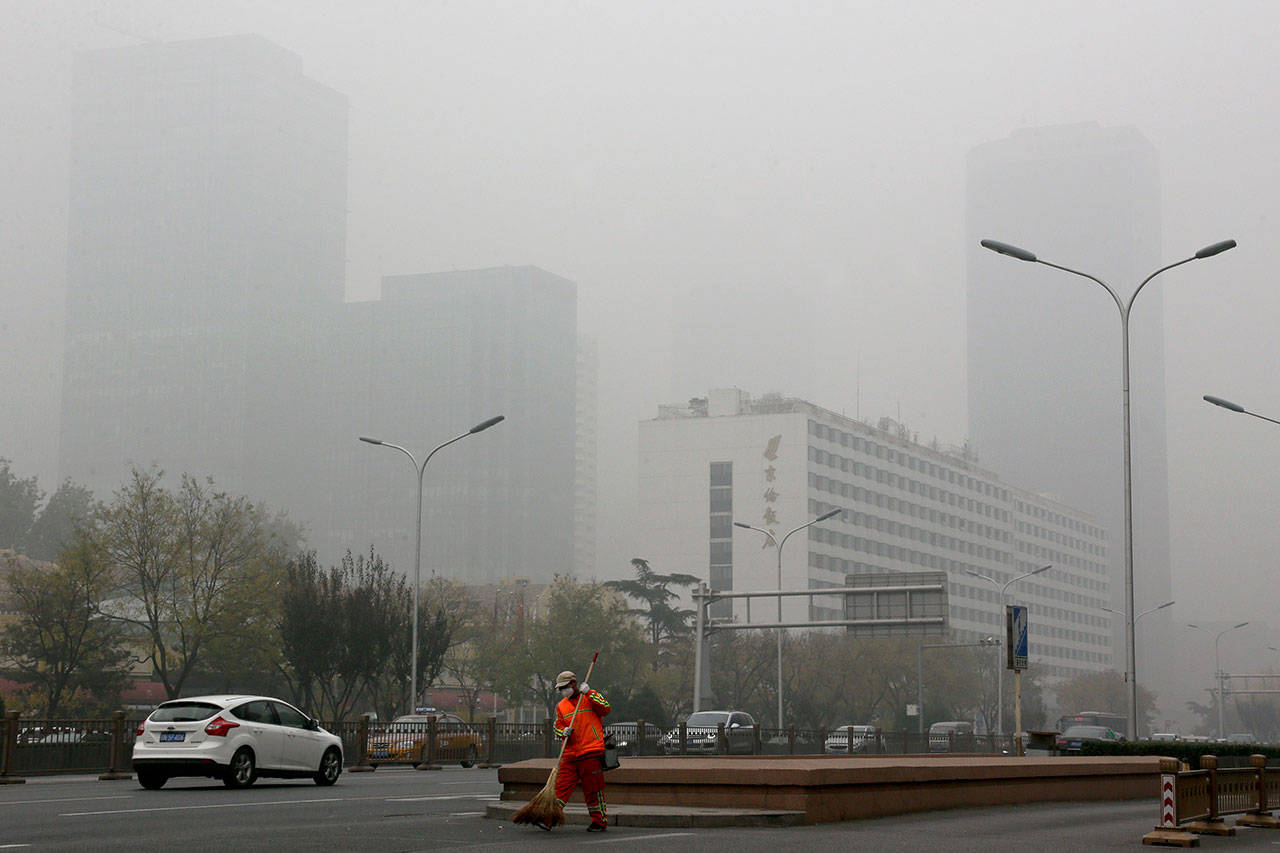
In this Nov. 14, 2018, file photo, a cleaner wearing a mask against pollution sweeps a street in Beijing. The world cut its daily carbon dioxide emissions by 17 percent at the peak of the pandemic shutdown last month, a new study found. But with life and heat-trapping gas levels inching back toward normal, the brief pollution break will likely be “a drop in the ocean” when it comes to climate change, scientists said. (Andy Wong/Associated Press file)

In this Nov. 14, 2018, file photo, a cleaner wearing a mask against pollution sweeps a street in Beijing. The world cut its daily carbon dioxide emissions by 17 percent at the peak of the pandemic shutdown last month, a new study found. But with life and heat-trapping gas levels inching back toward normal, the brief pollution break will likely be “a drop in the ocean” when it comes to climate change, scientists said. (Andy Wong/Associated Press file)

Study: Carbon pollution falls during pandemic

  • By SETH BORENSTEIN AP Science Writer
  • Wednesday, May 20, 2020 5:29am
  • NewsCoronavirus

By Seth Borenstein | The Associated Press

KENSINGTON, Md. — The world cut its daily carbon dioxide emissions by 17 percent at the peak of the pandemic shutdown last month, a new study found.

But with life and heat-trapping gas levels inching back toward normal, the brief pollution break will likely be “a drop in the ocean” when it comes to climate change, scientists said.

In their study of carbon dioxide emissions during the coronavirus pandemic, an international team of scientists calculated that pollution levels are heading back up — and for the year will end up between 4 percent and 7 percent lower than 2019 levels. That’s still the biggest annual drop in carbon emissions since World War II.

It’ll be 7 percent if the strictest lockdown rules remain all year long across much of the globe, 4 percent if they are lifted soon.

For a week in April, the United States cut its carbon dioxide levels by about one-third. China, the world’s biggest emitter of heat-trapping gases, sliced its carbon pollution by nearly a quarter in February, according to a study Tuesday in the journal Nature Climate Change. India and Europe cut emissions by 26 percent and 27 percent respectively.

The biggest global drop was from April 4-9 when the world was spewing 18.7 million tons of carbon pollution a day less than it was doing on New Year’s Day.

Such low global emission levels haven’t been recorded since 2006. But if the world returns to its slowly increasing pollution levels next year, the temporary reduction amounts to “a drop in the ocean,” said study lead author Corinne LeQuere, a climate scientist at the University of East Anglia.

“It’s like you have a bath filled with water and you’re turning off the tap for 10 seconds,” she said.

By April 30, the world carbon pollution levels had grown by 3.3 million tons a day from its low point earlier in the month. Carbon dioxide stays in the air for about a century.

Outside experts praised the study as the most comprehensive yet, saying it shows how much effort is needed to prevent dangerous levels of further global warming.

“That underscores a simple truth: Individual behavior alone … won’t get us there,” Pennsylvania State University climate scientist Michael Mann, who wasn’t part of the study, said in an email. “We need fundamental structural change.”

If the world could keep up annual emission cuts like this without a pandemic for a couple decades, there’s a decent chance Earth can avoid warming another 1.8 degrees from now, study authors said. But getting the type of yearly cuts to reach that international goal is unlikely, they said.

If next year returns to 2019 pollution levels, it means the world has only bought about a year’s delay in hitting the extra 1.8 degrees of warming that leaders are trying to avoid, LeQuere said. That level could still occur anywhere from 2050 to 2070, the authors said.

The study was carried out by Global Carbon Project, a consortium of international scientists that produces the authoritative annual estimate of carbon dioxide emissions. They looked at 450 databases showing daily energy use and introduced a measurement scale for pandemic-related societal “confinement” in its estimates.

Nearly half the emission reductions came from less transportation pollution, mostly involving cars and trucks, the authors said. By contrast, the study found that drastic reductions in air travel only accounted for 10 percent of the overall pollution drop.

In the U.S., the biggest pollution declines were seen in California and Washington with plunges of more than 40 percent.

More in News

Port Townsend Main Street Program volunteers, from left, Amy Jordan, Gillian Amas and Sue Authur, and Main Street employees, Sasha Landes, on the ladder, and marketing director Eryn Smith, spend a rainy morning decorating the community Christmas tree at the Haller Fountain on Wednesday. The tree will be lit at 4 p.m. Saturday following Santa’s arrival by the Kiwanis choo choo train. (Steve Mullensky/for Peninsula Daily News)
Decoration preparation

Port Townsend Main Street Program volunteers, from left, Amy Jordan, Gillian Amas… Continue reading

Port Angeles approves balanced $200M budget

City investing in savings for capital projects

Olympic Medical Center Board President Ann Henninger, left, recognizes commissioner Jean Hordyk on Wednesday as she steps down after 30 years on the board. Hordyk, who was first elected in 1995, was honored during the meeting. (Paula Hunt/Peninsula Daily News)
OMC Commissioners to start recording meetings

Video, audio to be available online

Jefferson PUD plans to keep Sims Way project overhead

Cost significantly reduced in joint effort with port, city

Committee members sought for ‘For’ and ‘Against’ statements

The Clallam County commissioners are seeking county residents to… Continue reading

Christopher Thomsen, portraying Santa Claus, holds a corgi mix named Lizzie on Saturday at the Airport Garden Center in Port Angeles. All proceeds from the event were donated to the Peninsula Friends of Animals. (Dave Logan/for Peninsula Daily News)
Santa Paws

Christopher Thomsen, portraying Santa Claus, holds a corgi mix named Lizzie on… Continue reading

Peninsula lawmakers await budget

Gov. Ferguson to release supplemental plan this month

Clallam County looks to pass deficit budget

Agency sees about 7 percent rise over 2025 in expenditures

Officer testifies bullet lodged in car’s pillar

Witness says she heard gunfire at Port Angeles park

A copper rockfish caught as part of a state Department of Fish and Wildlife study in 2017. The distended eyes resulted from a pressure change as the fish was pulled up from a depth of 250 feet. (David B. Williams)
Author to highlight history of Puget Sound

Talk at PT Library to cover naming, battles, tribes

Vern Frykholm, who has made more than 500 appearances as George Washington since 2012, visits with Dave Spencer. Frykholm and 10 members of the New Dungeness Chapter, NSDAR, visited with about 30 veterans on Nov. 8, just ahead of Veterans Day. (New Dungeness Chapter DAR)
New Dungeness DAR visits veterans at senior facilities

Members of the New Dungeness Chapter, National Society Daughters of… Continue reading

Festival of Trees contest.
Contest: Vote for your favorite tree online

Olympic Medical Center Foundation’s Festival of Trees event goes through Dec. 25