
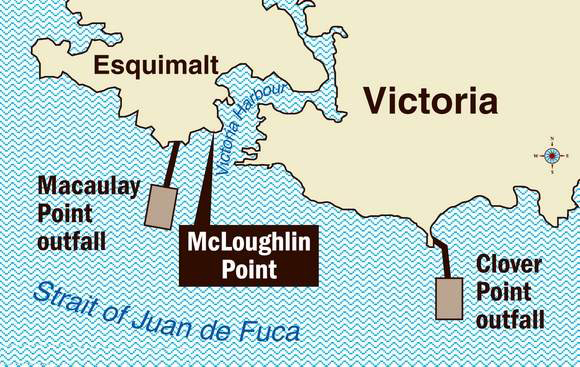
North Olympic Peninsula residents for decades have had two 39-inch sewer outfall pipes pointing screened untreated effluent at them from Victoria.
The outfalls serve the 300,000 people and their drains residing in and around the provincial Canadian capital.
Peninsula Daily News has long followed efforts by Victoria’s regional governments, bolstered by partial funding from the Ottawa federal government, to build sewage treatment plants.
The Victoria area would then discharge clean, treated wastewater into the same Strait of Juan de Fuca as Port Angeles, Sequim, Port Townsend and other North Olympic Peninsula locales have done for decades.
But cost has always been the big issue — and headway toward building one large treatment plant for the capital of British Columbia stopped in 2014 when the Esquimalt City Council refused to rezone the logical Victoria Harbour spot at an outfall under McLoughlin Point.
The time estimate of bringing sewage treatment to Victoria went from as soon as 2017 or 2018 to beyond 2020, raising cockles again on both sides of the border.
Last Wednesday, U.S. Rep. Derek Kilmer — who grew up in Port Angeles in the 1980s while those same two outfalls were discharging the same kind of untreated sewage, metals, detergents and other compounds into the Strait as they do now — took advantage of the Washington, D.C., visit of a group of Canadian parliamentarians who were mainly from the eastern city of Ottawa, Canada’s capital.
“It’s time for Canada to solve this sewage problem,” said Kilmer, who now lives in Gig Harbor, which by the way has its own sewage treatment plant that treats millions of gallons of wastewater from its 6,800 residents.
“I grew up in Port Angeles, right across the water from Victoria,” Kilmer roiled.
“So it concerns me when after many years, Canada continues to send raw sewage right into the Strait of Juan de Fuca.
“I’ll continue to call on our Canadian partners to work on a solution so we can ensure this does not impact our shared waters any longer.”
Kilmer’s tirade wasn’t lost north of the border.
Columnist Jack Knox of the Victoria Times-Colonist daily newspaper placed the blame right on the regional government of lower Vancouver Island:
“The — how best to describe it? — sedate pace of the capital region’s approach to the sewage problem has long been a sore spot with our southern neighbors, who accuse us of dragging our feet,” Knox wrote late last week.
“So, yes, our neighbors are ticked off, which should concern us because (A) they’re our friends and (B) they have guns (the Peninsula Daily News recently reported a surge in concealed-pistol licenses across the Strait, with one in 10 area residents now packing a permit).
“Yet . . . after the first quarter-century or so, [as it’s] become progressively harder to deny U.S. accusations of foot-dragging over sewage, we still manage to do so with a straight face.
“For this is our self-righteous defense:
“We’re not dragging our feet. We’re just grossly incompetent.
“Good lord, this is Dysfunction-by-the-Sea we’re talking about.
“Greater Victoria’s 91 mayors and councilors can’t coordinate anything: police, fire, regional transportation, bike routes, food-scrap disposal, whose turn it is to call out the grief counselors when it snows.
“Jeez, even what should have been a dead-simple [regional government] amalgamation referendum turned into a 13-car pile-up in November, with eight municipalities unable to come up with a common ballot question and the other five refusing to ask anything at all.”
Knox noted that since Esquimalt, in essence, refused to allow a single sewage plant for the region to locate on Victoria Harbour, the planning group of Victoria-area governments called the Capital Regional District “is now chasing ‘subregional’ solutions in which a west-side group including Esquimalt, View Royal, Colwood, Langford and the Songhees looks at one set of treatment options, and an east-side group including Victoria, Saanich and Oak Bay explores another, while Metchosin ponders whether to build two-holers or stick with one.”
Knox concluded: “If it’s any comfort to the Americans, our Three Stooges routine could cost us hundreds of millions in federal and provincial grants. Having pushed the completion date to 2023 from 2020, we are testing the patience of those who write the checks.
“Losing the funding wouldn’t absolve us of the government-ordered responsibility to build sewage treatment, though.
“And besides, as long as our neighbors think we’re using their bathtub as our toilet, this ain’t over.”
