
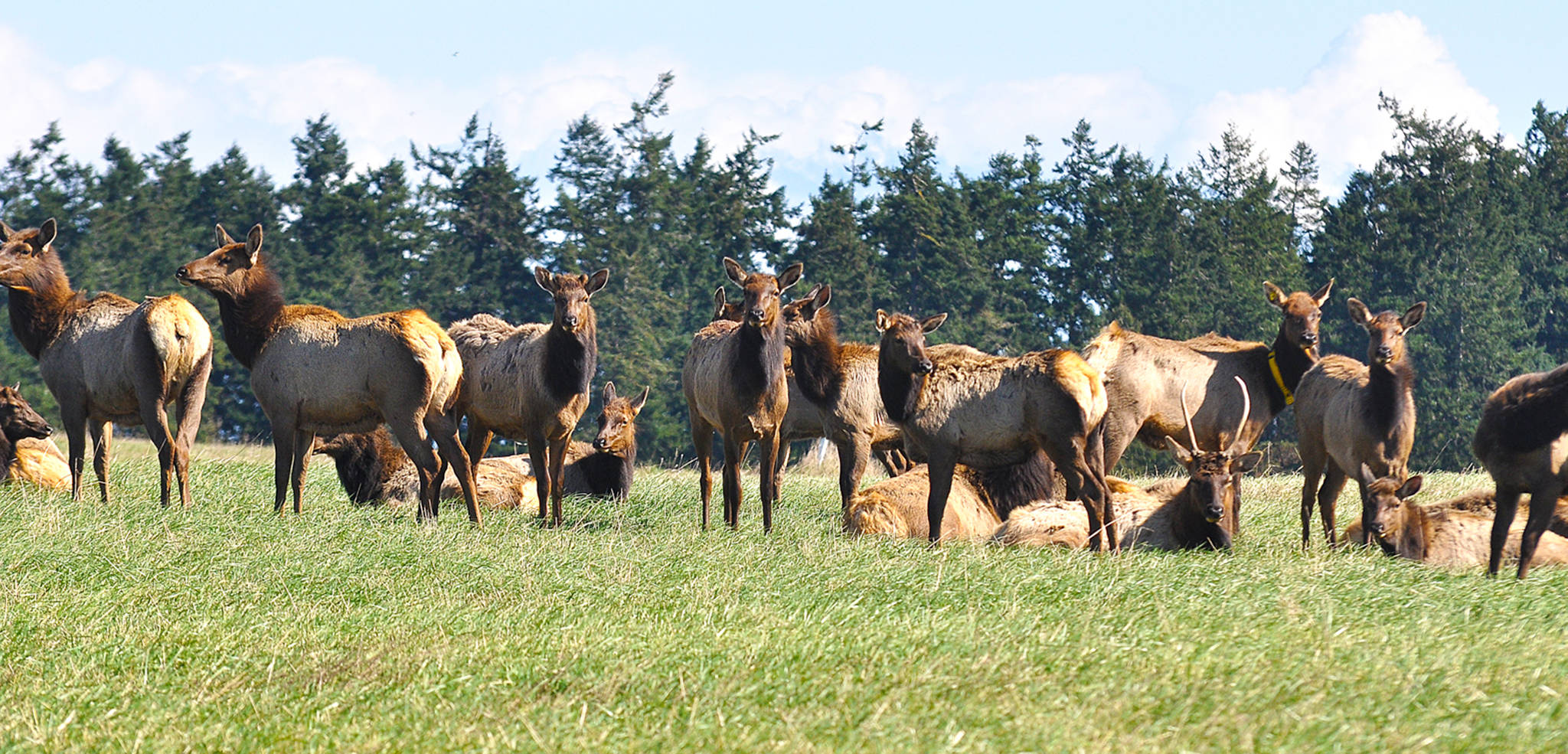
Sequim’s elk herd, seen here in 2013, reached about 100 total elk about 10 years ago before local farmers found the numbers were too large and hurt local crop production. State Department of Fish and Wildlife staff said the herd needs to be thinned again. (Jay Cline)

Sequim’s elk herd, seen here in 2013, reached about 100 total elk about 10 years ago before local farmers found the numbers were too large and hurt local crop production. State Department of Fish and Wildlife staff said the herd needs to be thinned again. (Jay Cline)

State says Sequim elk herd numbers being thinned due to causing local crop damage

SEQUIM — Sequim’s Roosevelt Elk herd is once again being thinned because its numbers are too high and they are badly impacting local crops, according to the state Department of Fish and Wildlife.

Last week, a local resident captured a photo of an elk being killed on private property — and the killing was later revealed to be a legal action by the property owner through a state damage prevention permit.

Brian Calkins, Department of Fish and Wildlife Region 6 wildlife program manager, said the herd now has about 40 elk. Their number will be brought down to about 25, depending upon the agricultural damage they inflict.

“The number of permits we issue isn’t directly tied to bringing population down. It’s more about the amount of damage the land owners are experiencing,” Calkins said.

“We want to do the minimum amount of harvesting without reducing their numbers too low.”

In recent years, area farmers reported tens of thousands of dollars in damage to local crops from the elk.

This year, the state has agreements with four agricultural producers and has issued six damage prevention permits in the Sequim area to control the elk population, Calkins said.

Calkins reports four elk have been killed under the permits.

Farmers typically work with a state wildlife conflict specialist, Calkins said, to determine the best course of action for thinning the herd.

He said farmers are typically allowed to only take cows or antler-less elk but in Sequim some bulls have been killed due to their higher number compared to cows.

About a decade ago, the herd grew to nearly 100 elk and former Fish and Wildlife staff reported that if left alone they could cause “an incredible amount of agricultural damage” and grow exponentially due to not having natural predators.

That led to nearly 50 elk being harvested in one year, Fish and Wildlife staff reported.

“[The Sequim group of elk] are appreciated by many folks in the community but they do cause a lot of agricultural damage in the area,” Calkins said.

“Through a lot of interaction with public and land owners we’ve arrived that there are too many elk [today].”

Killing elk though, Calkins said, is considered a last resort.

“We always prefer nonlethal deterrents first, [i.e.] noise, or in extreme cases fences, but it’s very expensive,” he said.

“We do find with hazing, or scare tactics, that after a period of time animals become accustomed to it and it becomes less effective. It’s more effective when harvesting a few [animals] along with hazing.”

In the past 10 years, Fish and Wildlife staff report Sequim’s situation has become more manageable for land owners. However, Sequim’s situation isn’t unique in allowing harvesting, Calkins said.

“We work with landowners all over the state with deer and elk damage issues,” he said.

On the Olympic Peninsula, Calkins said the state is working with landowners in Forks when elk come into town and in less populated areas of the West End as well as on the southern edge of the Olympic Mountains.

Wildlife conflict specialists also help land owners manage other animals such as deer, bats and raccoons.

However, Calkins said they “put in a tremendous amount of work every year dealing with land owners and the damage they incur from the elk.”

Calkins said his department is given direction by the state Legislature to assist landowners and sometimes landowners receive compensation under certain conditions depending on the damage evoked from wildlife.

To reach the state Department of Fish and Wildlife Region 6 office, call 360-249-4628 or visit https://wdfw.wa.gov. Region 6 includes eight counties including Clallam, Jefferson, Kitsap, Mason, Pierce, Thurston, Grays Harbor and Pacific Counties.

________

Matthew Nash is a reporter with the Olympic Peninsula News Group, which is composed of Sound Publishing newspapers Peninsula Daily News, Sequim Gazette and Forks Forum. Reach him at mnash@sequimgazette.com.

More in News

Sue Long, left, Vicki Bennett and Frank Handler, all from Port Townsend, volunteer at the Martin Luther King Day of Service beach restoration on Monday at Fort Worden State Park. The activity took place on Knapp Circle near the Point Wilson Lighthouse. Sixty-four volunteers participated in the removal of non-native beach grasses. (Steve Mullensky/for Peninsula Daily News)
Work party

Sue Long, left, Vicki Bennett and Frank Handler, all from Port Townsend,… Continue reading

Portion of bridge to be replaced

Tribe: Wooden truss at railroad park deteriorating

Kingsya Omega, left, and Ben Wilson settle into a hand-holding exercise. (Aliko Weste)
Process undermines ‘Black brute’ narrative

Port Townsend company’s second film shot in Hawaii

Jefferson PUD to replace water main in Coyle

Jefferson PUD commissioners awarded a $1.3 million construction contract… Continue reading

Scott Mauk.
Chimacum superintendent receives national award

Chimacum School District Superintendent Scott Mauk has received the National… Continue reading

Hood Canal Coordinating Council meeting canceled

The annual meeting of the Hood Canal Coordinating Council, scheduled… Continue reading

Bruce Murray, left, and Ralph Parsons hang a cloth exhibition in the rotunda of the old Clallam County Courthouse on Friday in Port Angeles. The North Olympic History Center exhibit tells the story of the post office past and present across Clallam County. The display will be open until early February, when it will be relocated to the Sequim City Hall followed by stops on the West End. The project was made possible due to a grant from the Clallam County Heritage Advisory Board. (Dave Logan/for Peninsula Daily News)
Post office past and present

Bruce Murray, left, and Ralph Parsons hang a cloth exhibition in the… Continue reading

This agave grew from the size of a baseball in the 1990s to the height of Isobel Johnston’s roof in 2020. She saw it bloom in 2023. Following her death last year, Clallam County Fire District 3 commissioners, who purchased the property on Fifth Avenue in 2015, agreed to sell it to support the building of a new Carlsborg fire station. (Matthew Nash/Olympic Peninsula News Group file)
Fire district to sell property known for its Sequim agave plant

Sale proceeds may support new Carlsborg station project

As part of Olympic Theatre Arts’ energy renovation upgrade project, new lighting has been installed, including on the Elaine and Robert Caldwell Main Stage that allows for new and improved effects. (Olympic Theatre Arts)
Olympic Theatre Arts remodels its building

New roof, LED lights, HVAC throughout

Weekly flight operations scheduled

Field carrier landing practice operations will be conducted for aircraft… Continue reading

Workers from Van Ness Construction in Port Hadlock, one holding a grade rod with a laser pointer, left, and another driving the backhoe, scrape dirt for a new sidewalk of civic improvements at Walker and Washington streets in Port Townsend on Thursday. The sidewalks will be poured in early February and extend down the hill on Washington Street and along Walker Street next to the pickle ball courts. (Steve Mullensky/for Peninsula Daily News)
Sidewalk setup

Workers from Van Ness Construction in Port Hadlock, one holding a grade… Continue reading